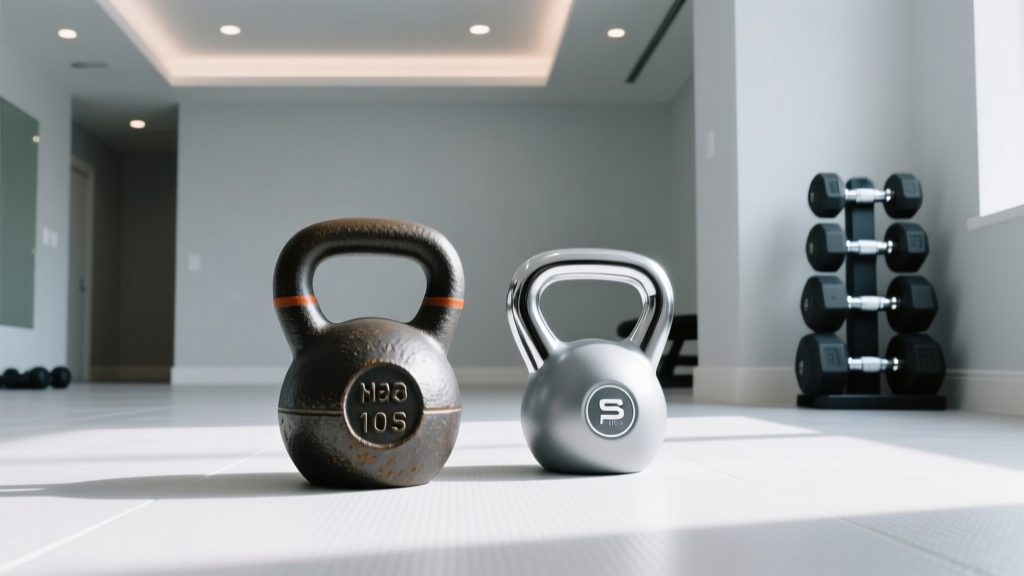
Cast Iron vs Competition Kettlebells, Space Limits & Dumbbell Cleans
Optimize your home gym layout by comparing cast iron vs competition kettlebells. Explore spatial footprints, storage, and clearance for dumbbell cleans.

The Spatial Dilemma: Variable vs. Uniform Footprints
Designing a high-performance home gym in 2026 requires more than just buying the right equipment; it demands a rigorous approach to spatial geometry and layout optimization. When outfitting a compact lifting zone—typically ranging from 60 to 120 square feet—the physical dimensions of your free weights dictate your storage solutions, flooring requirements, and movement corridors. Nowhere is this more apparent than in the debate between cast iron and competition kettlebells, especially when contrasted with the spatial footprint required for exercises like dumbbell cleans.
While most buying guides focus solely on grip texture or bell shape, a space-optimization perspective reveals a hidden layer to this decision. Cast iron kettlebells scale in physical size as weight increases, creating a tapered storage profile. Competition kettlebells maintain identical external dimensions regardless of weight, demanding standardized shelving. Furthermore, the ballistic swing arc of a kettlebell requires vastly different floor clearance than the strict vertical corridor needed for dumbbell cleans. Let us break down the exact measurements, costs, and layout frameworks necessary to engineer your ideal free-weight zone.
Quick Metric: The 2026 Pricing Landscape
Cast Iron Kettlebells: Currently averaging $1.50 to $2.20 per pound. A 24kg (53lb) bell costs roughly $95.
Competition Kettlebells: Holding steady at $3.50 to $4.80 per pound due to precision steel-steel or hollow-core manufacturing. A 24kg bell costs roughly $185.
Space Cost Efficiency: Cast iron allows for smaller, cheaper A-frame racks for lighter weights, whereas competition bells require uniform, heavy-duty horizontal shelving.
Cast Iron Kettlebells: The Tapered Storage Approach
Cast iron kettlebells, such as the Rogue E-Coat Cast Iron Line or Yes4All Solid Iron series, are poured into molds that scale proportionally with mass. A 12kg cast iron bell might measure just 220mm in height and 180mm in width, while a 32kg behemoth expands to over 300mm in height and 230mm in width.
Layout Implications for Cast Iron
Because of this variable geometry, cast iron bells are best stored on tiered A-frame racks or slanted gravity-fed shelving. From a layout perspective, an A-frame rack occupies a minimal 24-inch by 24-inch floor footprint, making it ideal for tight corners or narrow garage gym aisles. However, the varying handle diameters (ranging from 30mm on light bells to 40mm on heavy ones) and shifting centers of mass mean that wall-mounted horizontal pegs must be spaced at irregular intervals to prevent the bells from clanking together.
- Pros for Small Spaces: Lighter cast iron bells take up significantly less physical shelf space than their competition counterparts.
- Cons for Small Spaces: Inability to use uniform, flush-mounted wall shelving; requires deeper floor racks for the larger, heavier bells.
Competition Kettlebells: Standardized Shelving & Layouts
Competition kettlebells—engineered to strict international standards by brands like Kettlebell Kings and Onnit—measure exactly 280mm in height, 210mm in width, and feature a uniform 35mm handle diameter across all weights from 8kg to 32kg. The weight difference is achieved by altering the hollow core and internal fill materials (such as steel shot or dense composites).
Layout Implications for Competition Bells
This uniformity is a dream for minimalist, space-optimized gym layouts. Because every bell shares the exact same physical footprint, you can install heavy-duty, flush-mounted steel wall brackets (such as the Rogue MonsterLite Wall Mount Shelves) at precise, repeating intervals. This lifts the equipment entirely off the floor, freeing up valuable square footage for movement. Furthermore, the uniform 35mm handle ensures that your grip mechanics remain identical whether you are warming up with a 12kg or maxing out with a 24kg, reducing the cognitive load during complex flow routines.
Movement Corridors: Kettlebell Ballistics vs. Dumbbell Cleans
When mapping out your gym's floor plan, you must account for the 'movement corridor'—the three-dimensional space your body and the implement occupy during a lift. This is where the spatial contrast between kettlebell swings/snatches and dumbbell cleans becomes critical for space optimization.
According to biomechanical guidelines referenced by the National Strength and Conditioning Association (NSCA), ballistic kettlebell movements require a massive longitudinal drop zone. A heavy kettlebell swing or snatch generates a forward momentum arc that extends 36 to 48 inches past the lifter's toes. If you are training in a narrow galley-style gym or a converted hallway, a kettlebell snatch poses a severe hazard to walls, mirrors, or parked vehicles.
The Dumbbell Clean Advantage in Tight Spaces
Conversely, dumbbell cleans operate almost entirely within the lifter's sagittal plane. When performing a dumbbell clean (especially with compact rubber hex dumbbells), the mass travels in a tight, vertical corridor close to the body's center of gravity. The lateral clearance required is merely the width of your shoulders plus the dumbbell heads (roughly 36 inches total), and the longitudinal depth required is barely 24 inches past your toes.
Expert Layout Tip: If your home gym depth is less than 8 feet, prioritize vertical pulling movements like dumbbell cleans and kettlebell strict presses. Reserve the 10-foot longitudinal corridors for heavy kettlebell swings and snatches to avoid drywall impacts.
Organizations like StrongFirst emphasize that while kettlebell ballistics are unparalleled for posterior chain power, their spatial requirements must be respected. In a 60-square-foot micro-gym, substituting high-rep kettlebell snatches with heavy dumbbell cleans allows you to maintain explosive hip extension and upper-back recruitment without requiring a 6-foot safety buffer behind you.
Spatial Footprint Comparison Matrix
| Equipment Type | Storage Footprint | Lateral Clearance | Longitudinal Depth | Ceiling Requirement |
|---|---|---|---|---|
| Cast Iron Kettlebell (24kg) | Variable (A-Frame) | 48 inches | 84+ inches | 7.5 feet (Snatch) |
| Competition Kettlebell (24kg) | Uniform (Wall Mount) | 48 inches | 84+ inches | 7.5 feet (Snatch) |
| Hex Dumbbells (Cleans) | Tiered Rack / Wall | 36 inches | 24 inches | 7.0 feet (Clean) |
Designing Your 60-Square-Foot Lifting Zone
To synthesize these spatial realities into an actionable layout, follow this step-by-step framework for a standard 6-foot by 10-foot garage gym bay.
- Establish the Drop Zone: Lay down a single 4x6-foot, 3/4-inch thick horse stall mat. This 24-square-foot vulcanized rubber island acts as your primary lifting platform, protecting the concrete and dampening acoustic vibrations.
- Mount the Competition Bells: Install heavy-duty wall shelving on the 10-foot back wall. Because competition bells share a 210mm width, you can mount 5 hooks spaced exactly 10 inches apart, keeping 120lbs of iron completely off the floor and out of your swing corridor.
- Position the Dumbbell Rack: Place a compact, 3-tier dumbbell rack against the adjacent side wall. Stock it with rubber hex dumbbells (from 15lbs to 50lbs). Hex heads prevent rolling, which is critical when storing them in tight alcoves near your drop zone.
- Map the Corridors: Stand in the center of the mat. Face the side wall for dumbbell cleans and strict presses to utilize the narrow lateral corridor. Face the open garage door (or the longest unobstructed path) for heavy kettlebell swings and snatches, ensuring your 84-inch longitudinal depth is clear of vehicles or workbenches.
Final Verdict: Match the Iron to the Architecture
The choice between cast iron and competition kettlebells ultimately hinges on your storage architecture and budget. If you have ample floor space and prefer the cost-efficiency of cast iron ($1.75/lb), an A-frame rack in the corner will serve you well. However, if you are micro-optimizing a tight urban apartment gym or a narrow garage bay, the uniform geometry of competition kettlebells allows for zero-footprint wall storage, maximizing your usable floor area. By understanding the distinct movement corridors of ballistic swings versus the compact verticality of dumbbell cleans, you can engineer a space that is not only safe and functional but perfectly scaled to your architectural constraints.
More gear to consider
All reviews
Loadable Dumbbell Maintenance: Honoring the Dumbbell Origin

Loadable Dumbbells for Back Fat Exercises: 2026 Market Trends
EZ Bar vs Straight Bar: Curls, RDLs & Dumbbell RDL GIF Form Guide

How to Build Traps with Dumbbells: 2026 Heavy Rack Storage Trends
Power Rack vs Squat Rack vs Stand: Incline Dumbbell Overhead Extensions
