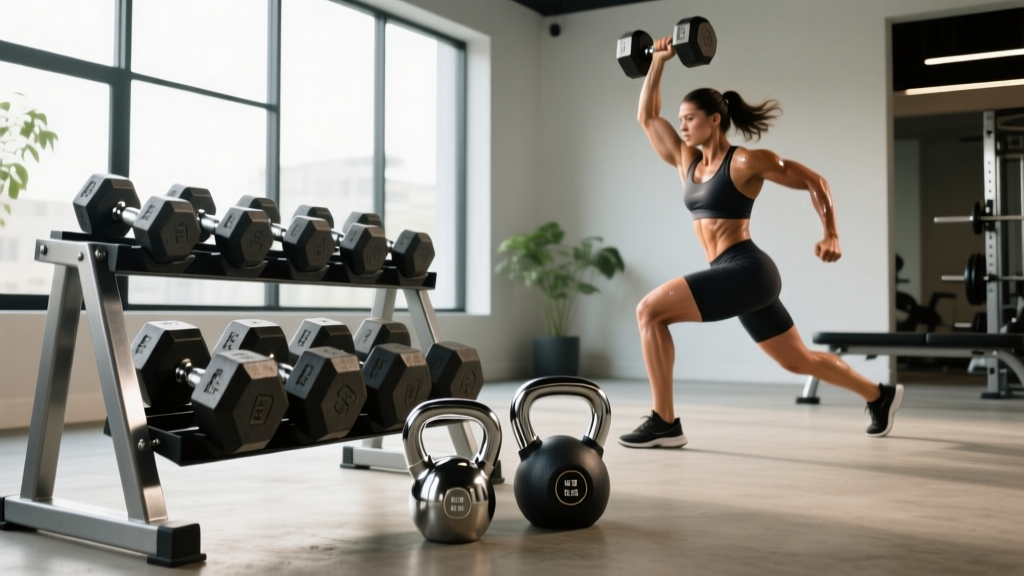
Cast Iron vs Competition: Beyond Dumbbell Exercises for Biceps and Chest
Discover our 2026 cast iron vs competition kettlebell buying guide. Learn how to upgrade your dumbbell exercises for biceps and chest with the right bell.

For years, the foundation of upper-body hypertrophy and strength has been built on traditional free weights. Most lifters spend their formative years mastering standard dumbbell exercises for biceps and chest, relying on the symmetrical balance and predictable center of mass that hex or rubber dumbbells provide. However, as training age increases, plateauing on the incline bench or standard curl rack becomes a common frustration. Enter the kettlebell: an implement with an offset center of mass that fundamentally alters joint mechanics, grip demands, and stabilizer recruitment.
But not all kettlebells are created equal. The market is sharply divided into two distinct metallurgical camps: Cast Iron and Competition (Steel). Choosing between them isn't just an aesthetic preference; it dictates your grip mechanics, exercise selection, and long-term durability. In this 2026 expert buying guide, we break down the exact specifications, failure modes, and pricing of both styles to help you seamlessly upgrade your upper-body programming.
The Biomechanical Shift: Why Transition from Dumbbells?
When you perform standard dumbbell exercises for biceps and chest, the load is distributed evenly on either side of the handle. According to joint mechanics data cataloged by ExRx.net, this symmetrical load allows the prime movers (pectoralis major, biceps brachii) to work with minimal rotational interference.
A kettlebell, however, places the bulk of the mass below and anterior to the handle. This offset center of mass creates a rotational torque. During a chest press, your anterior deltoid and rotator cuff must work overtime to prevent the bell from tipping backward. During a bicep curl, the offset load forces the brachioradialis and wrist flexors to stabilize the implement, turning a simple isolation movement into a comprehensive forearm and grip stimulus.
Expert Insight: The Grip Irradiation EffectBecause kettlebell handles are generally thicker and require more active stabilization than a standard 28mm Olympic barbell or 32mm dumbbell, they trigger 'irradiation'—a neurological phenomenon where gripping tightly increases motor unit recruitment in the surrounding chest and arm musculature. This makes kettlebells a potent tool for breaking through hypertrophy plateaus.
Cast Iron Kettlebells: The Purist’s Choice
Cast iron kettlebells are sand-cast from gray iron, resulting in a solid, dense implement. They are the traditional choice for hardstyle training and general physical preparedness (GPP).
Top Pick: Rogue Fitness Cast Iron (2026 Edition)
Rogue remains the gold standard for cast iron bells in the US market. Their current iteration features a machined flat base and a highly durable powder-coat finish.
- Handle Diameter: Scales with weight. A 16kg bell features a ~33mm handle, while a 32kg bell jumps to ~35mm.
- Finish: Matte powder coat. Unlike cheap enamel coatings that chip and rust when bells clash together during double front squats, powder coat binds to the iron matrix and flexes slightly, preventing micro-chipping.
- Pricing (2026): Expect to pay between $1.60 and $2.20 per pound, depending on the weight tier.
The Failure Mode: Scaling Handle Thickness
The primary drawback of cast iron is that the physical dimensions change as the weight increases. If you are transitioning your dumbbell exercises for biceps and chest to kettlebells, a 35mm handle on a heavy 32kg bell can cause premature forearm fatigue during high-rep crush-grip curls, limiting the stimulus to the actual bicep muscle.
Competition Kettlebells: Precision and Uniformity
Competition kettlebells are engineered for the sport of kettlebell lifting (Girevoy Sport), where athletes perform high-rep snatches and jerks. The defining feature is absolute dimensional uniformity. An 8kg competition bell is the exact same physical size as a 48kg bell.
Top Pick: Kettlebell Kings Steel Competition
Kettlebell Kings dominates the competition space with their single-cast steel shells. To maintain the standard 228mm x 203mm footprint across lighter weights, the bells are hollow and filled with iron sand or steel shot, while heavier weights (20kg+) are solid steel.
- Handle Diameter: Strictly 33mm across all weights.
- Window Size: The gap between the handle and the bell body (the window) is standardized, ensuring your forearm rests in the exact same position regardless of the weight you are pressing or curling.
- Pricing (2026): Premium pricing, ranging from $3.80 to $5.50 per pound due to the complex steel molding and filler processes.
'The beauty of the competition bell lies in the 33mm handle. When learning the nuances of the kettlebell press or bottoms-up curl, you never have to recalibrate your grip mechanics as you move up in weight.' — StrongFirst Kettlebell Press Mechanics
Head-to-Head Comparison Matrix
| Feature | Cast Iron (e.g., Rogue) | Competition (e.g., KB Kings) |
|---|---|---|
| Material | Solid Gray Iron | Steel Shell (Hollow/Filled) |
| Handle Diameter | Variable (30mm - 35mm+) | Uniform 33mm |
| Dimensions | Scales with weight | Uniform across all weights |
| Best For | Hardstyle, Grinds, Outdoors | High-rep ballistics, Technique |
| Avg. Cost (2026) | $1.60 - $2.20 / lb | $3.80 - $5.50 / lb |
Programming Translation: Adapting Your Chest and Bicep Work
Upgrading your dumbbell exercises for biceps and chest requires more than just swapping the implement; it requires adjusting your lever arms and stabilization strategies. Here is how to translate your favorite movements to the kettlebell.
1. The Kettlebell Floor Press (Chest)
Unlike a dumbbell floor press where the weight rests directly over the wrist, the kettlebell rests on the forearm, slightly forward of the joint. This increases the lever arm, demanding intense anterior deltoid and pec minor stabilization. Pro Tip: Keep your elbow tucked at a 45-degree angle to protect the shoulder capsule and maximize pectoral recruitment.
2. The Bottoms-Up Kettlebell Press (Chest & Shoulder)
Hold the kettlebell upside down by the handle. This eliminates the stability provided by the heavy bell resting on your forearm and forces the rotator cuff and core to work in overdrive. It is an unparalleled diagnostic tool for identifying left-to-right pressing imbalances that standard dumbbells often mask.
3. The Crush-Grip Horn Curl (Biceps)
Instead of holding the handle, grip the sides of the kettlebell horns and squeeze inward as hard as possible while curling. This 'crush grip' leverages the neurological principle of irradiation, forcing maximum motor unit recruitment in the biceps brachii while completely neutralizing the rotational torque of the offset load.
4. The Offset Towel Curl (Biceps & Grip)
Loop a thick cotton towel through the kettlebell handle and curl the towel. The instability of the fabric combined with the offset load turns a basic bicep isolation into a brutal grip and brachioradialis builder, far exceeding the stimulus of a standard dumbbell hammer curl.
Expert Verdict & Buying Framework
Which Bell Should You Buy in 2026?
Choose Cast Iron if: You are primarily focused on heavy, low-rep strength grinds (like heavy floor presses and weighted pull-ups), you train outdoors where steel shells might dent or scratch, or you are on a strict budget building out a home gym. The Rogue Cast Iron line is virtually indestructible and offers the best dollar-to-pound ratio.
Choose Competition if: You are prioritizing high-rep ballistic endurance, you want to perfect your technique without recalibrating your grip every time you change weights, or you have smaller hands that benefit from the strict 33mm handle diameter. The uniform window size ensures your forearm won't bruise during repetitive cleans or complex transitions.
Ultimately, moving beyond traditional dumbbell exercises for biceps and chest into the realm of kettlebell training will expose weak links in your grip, stabilizers, and kinetic chain. Whether you opt for the rugged, variable geometry of cast iron or the surgical precision of competition steel, the offset load will force your upper body to adapt, grow, and stabilize in ways a standard dumbbell rack simply cannot replicate.
More gear to consider
All reviews
Best Adjustable Dumbbells for the Dumbbell Romanian Deadlift (2026)

Olympic Barbell Knurling Guide & Dumbbell One Leg Calf Raise Setup Walkthrough

Power Rack, Squat Rack or Stand? Troubleshooting the Dumbbell Cutout

Train Lower Back With Dumbbells: 2026 Adjustable Set Comparison

Olympic Barbell Buying Guide: Weight, Knurling & Gold's Gym Gold Dumbbells Setup
