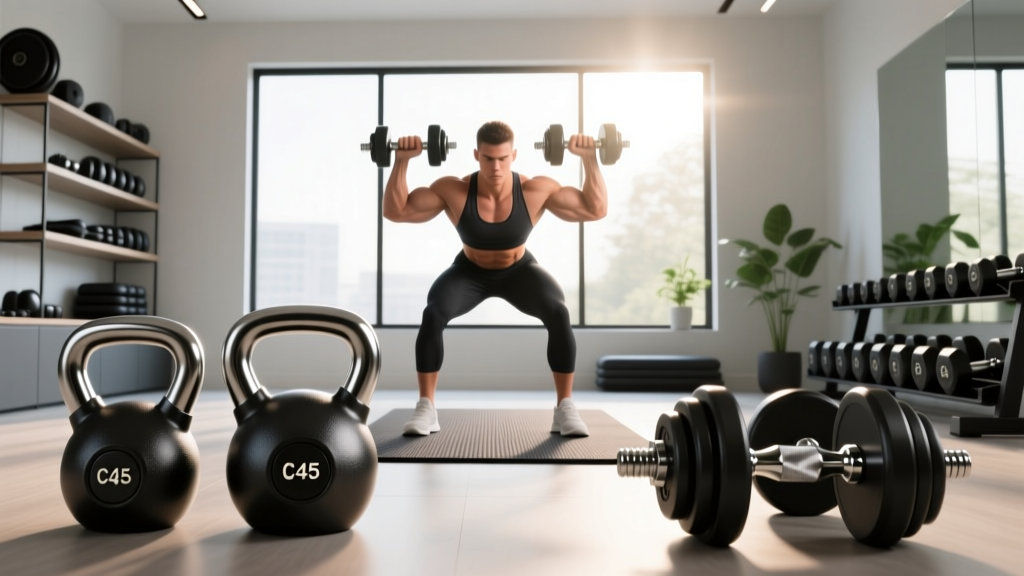
Kettlebell Guide & Chest Exercises with Dumbbells No Bench
Optimize your home gym layout with our cast iron vs competition kettlebell guide, plus space-saving chest exercises with dumbbells no bench required.

In 2026, the micro-gym revolution is in full swing. With urban living spaces shrinking and garage real estate at a premium, fitness enthusiasts are no longer just buying equipment; they are curating spatial footprints. A successful home gym isn't defined by how much gear you can cram into a room, but by how efficiently that gear integrates into your available square footage. This dual-focus guide tackles two major space-optimization challenges: choosing between cast iron and competition kettlebells for optimal storage density, and eliminating the bulky weight bench by mastering chest exercises with dumbbells no bench required.
The Spatial Dilemma: Cast Iron vs. Competition Kettlebells
When outfitting a compact training zone, kettlebells offer unparalleled versatility. However, the physical geometry of the bell you choose dictates your storage strategy. The market is largely split into two categories: traditional cast iron and standardized competition bells.
Cast Iron Kettlebells: The Variable Footprint
Cast iron bells (like those from CAP Barbell or Yes4All) are poured into molds that scale with weight. A 12kg bell is compact and easily tucked into a corner, but a 32kg cast iron bell is a massive, wide-bottomed sphere that refuses to fit on standard shelving. Because their dimensions are non-uniform, designing a flush, space-saving storage rack is nearly impossible. You are forced to use staggered floor stands or deep, heavy-duty shelving that protrudes 18 to 24 inches into your workout space.
Competition Kettlebells: The Geometry of Efficiency
Competition kettlebells, governed by international standards, maintain the exact same physical dimensions regardless of weight. According to StrongFirst's official dimension guidelines, a standard competition bell is exactly 280mm tall and 210mm wide, with a uniform 35mm handle diameter. This uniformity is a dream for spatial layout design. You can mount a flush wall-rack or use a compact vertical tree, knowing that every bell from 8kg to 32kg will slot in perfectly without overhang or wasted vertical clearance.
Dimensional Data & Storage Matrix
To visualize the spatial impact, consider how a standard 3-bell set (16kg, 24kg, 32kg) interacts with a standard 3-tier vertical storage rack.
| Feature | Cast Iron Set (Variable) | Competition Set (Uniform) |
|---|---|---|
| Max Width (32kg) | ~265mm (10.4 inches) | 210mm (8.25 inches) |
| Max Height (32kg) | ~310mm (12.2 inches) | 280mm (11.0 inches) |
| Handle Diameter | 30mm - 33mm (Varies) | 35mm (Standardized) |
| Rack Footprint Required | 24' W x 18' D (Staggered) | 12' W x 10' D (Flush/Vertical) |
| Wall-Mount Compatibility | Poor (Bottoms protrude) | Excellent (Flush alignment) |
Space-Saving Upper Body: Chest Exercises with Dumbbells No Bench
The standard Olympic flat bench (such as the popular Rep Fitness FB-5000) measures roughly 44.5 inches long by 17.5 inches wide. While that sounds small, factoring in the operational clearance required for loading plates and extending arms, a bench permanently consumes roughly 24 square feet of your gym's layout. Eliminating the bench is one of the most aggressive space-optimization strategies available.
Fortunately, you can achieve elite pectoral hypertrophy using just a pair of adjustable or hex dumbbells and the floor. Here is a biomechanically sound protocol for chest exercises with dumbbells no bench required.
1. The Dumbbell Floor Press Protocol
The floor press is a staple for powerlifters to build triceps lockout strength, but it is equally effective for chest development when programmed correctly. According to the ExRx.net Dumbbell Floor Press guide, the primary limitation is the truncated range of motion (ROM) caused by the triceps hitting the floor. The Fix: Use a slight glute bridge to elevate your torso, effectively increasing the ROM and allowing for a deeper pectoral stretch before the elbows make contact with the ground.
- Setup: Lie supine, knees bent, feet flat. Hold dumbbells directly over the chest.
- Execution: Lower the weights with a 45-degree tuck at the elbows until the triceps gently touch the floor. Pause for 1 second to eliminate the stretch reflex, then explosively press upward.
- Space Required: Exactly the length of your body plus 12 inches of lateral clearance.
2. Glute-Bridge Dumbbell Flyes
Flyes are notorious for requiring a bench to achieve a full stretch. By elevating your hips into a sustained glute bridge, you alter the angle of your torso relative to gravity. This mimics a slight decline bench fly, targeting the lower sternal fibers of the pectoralis major while simultaneously engaging the posterior chain.
- Hike your hips high and maintain a rigid bridge throughout the set.
- With a slight bend in the elbows, open the dumbbells wide until you feel a deep stretch across the chest cavity.
- Squeeze the pecs to bring the weights back together, stopping just short of clacking them together to maintain constant muscular tension.
3. Standing Svend Press (The Zero-Footprint Movement)
When you literally have zero floor space to lie down, the standing Svend press provides immense time-under-tension for the inner chest. Stand in a corner of your room, press a single dumbbell (or two light ones) out in front of your sternum, and actively crush the handles together while performing short, pulsing presses. It requires less than 4 square feet of space and delivers a massive metabolic burn to the pectorals.
2026 Pricing & Freight Realities
When optimizing your layout, budget and logistics play a hidden role. In 2026, the freight landscape for heavy iron remains a critical factor.
Cost Per Pound & Shipping Thresholds
- Cast Iron: Typically retails between $1.80 and $2.50 per pound. However, buying a full set from 8kg to 32kg often triggers oversized freight surcharges from standard carriers, sometimes adding $80 to $120 in shipping fees that negate the initial savings.
- Competition Bells: Premium brands like Rogue Fitness or Kettlebell Kings price their competition bells between $4.00 and $5.50 per pound. Because these brands cater to commercial and serious home gyms, they frequently offer free freight-shipping thresholds (often around $500+), making the delivered cost-per-pound surprisingly competitive when factoring in the spatial benefits.
Expert Verdict: Which Setup Fits Your Square Footage?
If your dedicated training space is a sprawling 2-car garage (400+ sq ft), cast iron kettlebells and a dedicated flat bench are perfectly viable. The spatial inefficiencies are masked by sheer volume.
However, if you are designing a micro-gym, an apartment corner, or a shared living space under 100 square feet, the math heavily favors standardization. Investing in a uniform set of competition kettlebells allows for flush, vertical wall storage that keeps your floors clear. Pairing this with a disciplined regimen of chest exercises with dumbbells no bench required allows you to reclaim the 24 square feet normally held hostage by a weight bench. The result is a highly functional, uncluttered training environment that proves you don't need a massive footprint to build elite strength.
More gear to consider
All reviews
Squat Stand vs Power Rack Setup with Lifeline Hex Rubber Dumbbell

Best Adjustable Dumbbells for a Rear Deltoid Workout With Dumbbells
Power Rack / Squat Rack / Stand: Reverse Dumbbell Curl Muscles Worked
Dumbbell Workouts for Belly Fat: 2026 Adjustable Gear & Mistakes
EZ Curl vs Straight Bar Care & Abs Workout at Home with Dumbbells