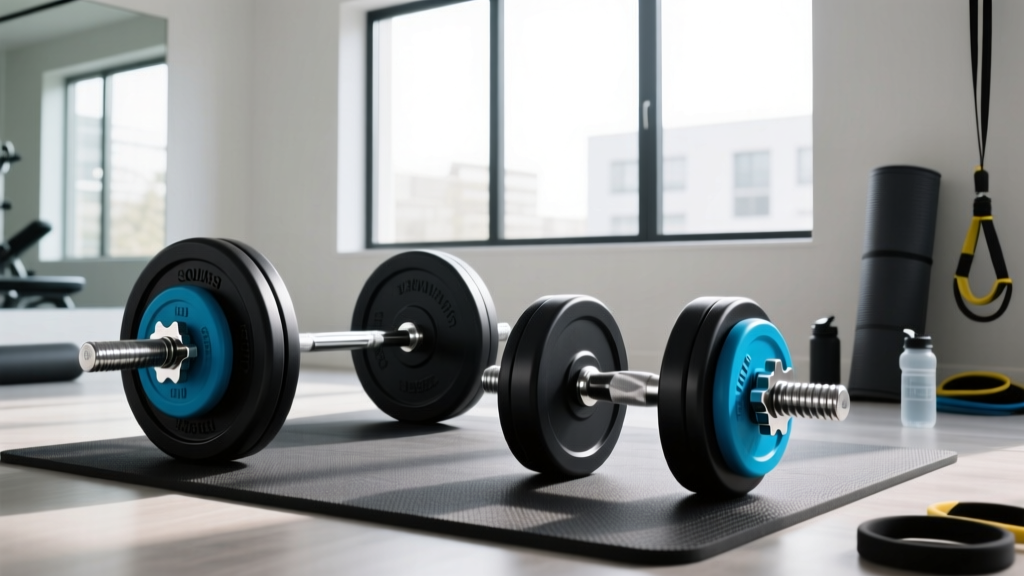
How to Curl Dumbbells Progressively: Budget Guide to Loadable Sets
Discover how to curl dumbbells progressively without breaking the bank. We break down the true cost of loadable dumbbell handles vs. fixed hex sets.

The Micro-Loading Dilemma in Isolation Movements
When building a home gym, most lifters default to buying a rack of fixed rubber hex dumbbells. While this setup looks professional and offers quick weight changes, it harbors a hidden flaw that specifically sabotages isolation exercises like the bicep curl. If your primary goal is mastering how to curl dumbbells with strict, momentum-free form, you will quickly hit a wall with fixed-weight increments.
The biceps brachii is a relatively small muscle group. According to biomechanical data outlined by the American Council on Exercise (ACE), the elbow flexors are highly susceptible to tendon strain and form breakdown when the load increases too rapidly. Commercial fixed dumbbells jump in 5-pound increments. For a lifter curling 25-pound dumbbells, jumping to 30 pounds represents a massive 20% overload. This forces the lifter to introduce hip hinge, shoulder swing, and momentum—completely defeating the purpose of the isolation movement.
This is where loadable dumbbells with interchangeable plates become the ultimate budget and performance hack. By utilizing Olympic plates and fractional change plates, you can micro-load your curls in 1-pound or even 0.5-pound increments, ensuring continuous progressive overload without compromising your connective tissue.
Budget Breakdown: Loadable Dumbbells vs. Fixed Hex Sets
Let us look at the hard numbers. Building a comprehensive dumbbell collection is one of the most expensive endeavors in home gym construction. Below is a 2026 market comparison between purchasing a standard fixed set versus investing in a high-quality loadable handle system.
| Equipment Setup | Upfront Cost (2026) | Space Required | Micro-Loading Capability |
|---|---|---|---|
| Fixed Hex Dumbbells (5-50 lbs, 10 pairs) | $450 - $650 + $150 Rack | High (Tier Rack or A-Frame) | None (5-lb jumps per pair) |
| Loadable Handles + 110 lbs of Cast Iron Plates | $280 - $360 Total | Low (Single Shelf or Floor) | Excellent (Down to 0.5-lb) |
As the data illustrates, the loadable route cuts your initial capital expenditure by more than 50% while simultaneously solving the micro-loading problem. The money saved can be reallocated toward premium fractional plates and precision collars.
2026 Loadable Handle Market Analysis
Not all loadable dumbbell handles are created equal. The sleeve length, knurling depth, and tolerance of the sleeve diameter dictate whether your plates will rattle during the eccentric phase of your curl. Here is a value analysis of the top three contenders on the market.
1. Rogue Loadable Dumbbell Handles (The Gold Standard)
- Price: $165.00 per pair
- Sleeve Length: 10.5 inches
- Value Proposition: Machined from solid steel with a bright zinc finish, these handles feature a 10.5-inch sleeve that can comfortably hold up to 45 pounds of standard Olympic plates per side. The knurling is aggressive but not tear-inducing, perfectly suited for the sweaty grip required during heavy hammer curls and supinating bicep curls. According to Garage Gym Reviews, the tight tolerance between the sleeve and the plate hole virtually eliminates plate rattle, preserving your mind-muscle connection.
2. Titan Fitness Loadable Dumbbell Handles (The Mid-Tier Contender)
- Price: $109.99 per pair
- Sleeve Length: 9.5 inches
- Value Proposition: Titan offers a slightly more budget-friendly option with a knurled handle that mimics their popular Cerakote barbells. The 9.5-inch sleeve is slightly shorter, meaning you will run out of real estate if you attempt to load past 55 pounds per hand. However, for bicep curls where the weight rarely exceeds 60-70 pounds per hand for the average natural lifter, this is an exceptional value.
3. Yes4All Olympic Dumbbell Handles (The Strict Budget Option)
- Price: $45.00 - $55.00 per pair
- Sleeve Length: 8.5 inches
- Value Proposition: If you are outfitting a gym on a shoestring budget, Yes4All provides functional steel handles. The knurling is relatively passive, and the sleeves are secured with standard hex nuts rather than snap-ring or machined collars. Warning: Hex nuts take time to screw on and off, making drop-sets or rapid weight changes highly frustrating.
Plate Selection Economics: Cast Iron vs. Urethane
When curating your interchangeable plates specifically for curling, the material you choose drastically impacts both your budget and your gym floor.
The Curler's Plate Rule: Avoid rubber bumper plates for loadable dumbbell curls. Bumper plates have a uniform diameter (17.7 inches for standard 10lb+ plates). If you load a 10-pound bumper plate on a dumbbell, the massive diameter will strike your thighs during the bottom portion of a strict standing curl, severely limiting your range of motion. Always opt for machined cast iron or calibrated steel change plates.
Budget Strategy: Purchase your bulk weight (10lb and 5lb plates) in raw cast iron (approximately $1.50 to $2.00 per pound in 2026). Then, invest your remaining budget into a set of Urethane-coated fractional change plates (1.25 lb, 0.5 lb, and 0.25 lb). The urethane coating on micro-plates prevents them from chipping and makes them easier to grip when swapping weights mid-workout.
Step-by-Step: Setting Up Your Loadable Curls for Success
To ensure safety and maintain the integrity of the movement, follow this exact loading protocol:
- Calculate and Load Symmetrically: Always load the exact same plate configuration on both handles. Even a 0.5 lb discrepancy can cause asymmetrical tracking during the concentric phase of the curl.
- Utilize Precision Collars: Do not use cheap spring clips. The lateral force generated when you supinate your wrist at the top of a curl will cause spring clips to slip. Invest in Lock-Jaw collars or Rogue HG Aluminum Collars ($25-$40 per pair) to lock the plates flush against the sleeve shoulder.
- Check the Spin: Unlike Olympic weightlifting, you do not want your dumbbell sleeves to spin freely during a curl. Ensure your loadable handles utilize bushings rather than bearings, or that the plates are clamped tightly enough to prevent independent rotation, which can twist your wrists at the bottom of the movement.
Real-World Edge Cases and Failure Modes
While loadable dumbbells are a budget powerhouse, they come with specific edge cases you must navigate:
The "Sleeve-Out" Phenomenon
If you are an advanced lifter capable of curling 75+ pounds per hand, you will physically run out of sleeve space on almost all commercial loadable handles. To bypass this without buying a specialized 15-inch extra-long handle, you must buy calibrated steel plates. Calibrated plates are significantly thinner than standard cast iron, allowing you to stack more weight onto a 10.5-inch sleeve.
The Balance Shift
Fixed dumbbells have a perfectly engineered center of gravity. When you load a handle with a single 45-pound plate on each side, the center of mass shifts far away from your grip compared to a compact fixed hex dumbbell. This increases the rotational inertia. When learning how to curl dumbbells with loadable setups, you must focus harder on wrist stabilization at the bottom of the eccentric phase to prevent the heavy outer plates from pulling your wrists into extension.
Final Verdict: The Ultimate Value Proposition
If your training revolves around heavy compound movements like squats and bench presses, a fixed dumbbell set might be a worthwhile luxury. But for the meticulous bodybuilder or home-gym enthusiast focused on strict isolation work, loadable dumbbell handles paired with cast iron and fractional plates represent the undisputed champion of value. You save hundreds of dollars, reclaim valuable floor space, and most importantly, you gain the ability to micro-load your way through plateaus safely and effectively.
For further reading on exercise biomechanics and proper execution of isolation movements, consult the extensive database at ExRx.net, which details the exact muscular targets and synergists involved in various curl variations.
More gear to consider
All reviews
Triangle Dumbbell vs Loadable Plates: 2026 Budget Guide
Collar & Clamp Guide: Upgrading a Shoulder Workout Using Dumbbells
Collar vs Clamp Types: Securing Pull Day Workout Dumbbells & Bars

Rubber Hex vs Urethane: 2026 Squat Dumbbell Market Trends
Bumper vs Iron Plate Trends: Seated Dumbbell Side Lateral Raise 2026