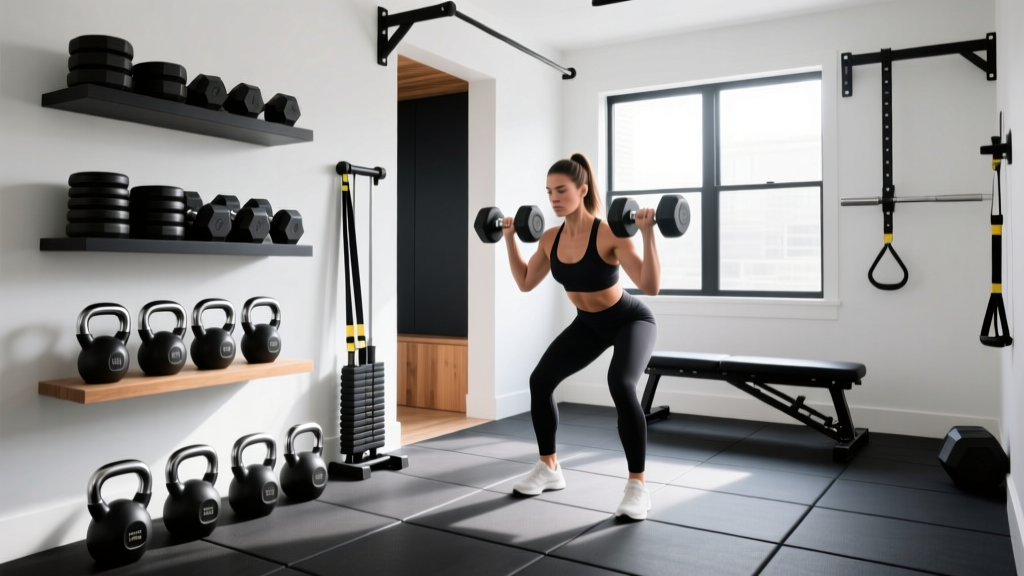
Space Optimization: Kettlebells, Dumbbell Drag Curls & Gym Layouts
Maximize your home gym footprint. We compare cast iron vs competition kettlebells and design tight zones for swings and dumbbell drag curls.

The Spatial Dilemma: Mapping Biomechanical Envelopes
Designing a high-functioning home gym in 2026 is less about how much weight you can buy and more about the geometric efficiency of your floor plan. Whether you are converting a 50-square-foot apartment alcove or a cramped two-car garage, every piece of free weight demands a specific three-dimensional "biomechanical envelope"—the physical space required to perform a movement safely without striking walls, mirrors, or furniture.
When outfitting a compact space, lifters often default to adjustable dumbbells. However, integrating kettlebells introduces unique spatial challenges and advantages. More importantly, how you store these tools and zone your floor for specific movements dictates the usability of your gym. This guide breaks down the critical cast iron vs. competition kettlebell debate strictly through the lens of space optimization, while also mapping out micro-zones for strict isolation movements that require near-zero lateral clearance.
Space Planning Rule of Thumb: Never measure your room by square footage alone. Measure by swing radius. A standard kettlebell swing requires a 72-inch by 48-inch clearance zone, whereas strict vertical isolation movements require less than 4 square feet.Cast Iron vs. Competition Kettlebells: A Storage & Layout Breakdown
Choosing between cast iron and competition kettlebells is usually framed around grip feel or sport-specific training. But from a layout and storage perspective, the differences are staggering. If you are building a dense, space-optimized rack, the physical dimensions of the bells will dictate your shelving depth, vertical stackability, and overall floor footprint.
The Predictability of Competition Bells
Competition kettlebells are manufactured to a single, universal standard regardless of weight. According to specifications from major manufacturers like Rogue Fitness, every competition bell measures exactly 280mm (11.02 inches) tall and 210mm (8.27 inches) wide. The handle window and horn thickness remain constant, while the internal cavity is filled with steel shot or lead to adjust the weight.
Space Advantage: Because the outer dimensions never change, competition bells are infinitely stackable and perfectly uniform on shallow shelving. You can design a wall-mounted rack with exactly 9-inch deep shelves and 12-inch vertical clearances, knowing that an 8kg yellow bell and a 32kg red bell will sit perfectly flush against one another. This predictability is a massive advantage for micro-gyms where every millimeter of shelf depth counts.
The Variable Footprint of Cast Iron
Cast iron kettlebells are poured into molds that scale with the weight. A 16kg (35 lb) cast iron bell might be 8.5 inches tall and 6.5 inches wide, while a 32kg (70 lb) bell balloons to 11 inches tall and 8.5 inches wide. Furthermore, the horns get thicker, and the center of mass shifts.
Space Disadvantage: You cannot stack cast iron bells neatly. A rack designed to hold your 24kg bell will waste massive amounts of vertical space when holding your 12kg bell, and may not be deep enough to safely cradle your 32kg bell. In a tight layout, cast iron bells force you to use deep, bulky floor stands or staggered wall hooks that protrude further into your walking paths.
Dimensional & Storage Comparison Matrix
| Feature | Competition Kettlebell | Cast Iron Kettlebell |
|---|---|---|
| Dimensions (16kg vs 32kg) | Identical (11" H x 8.27" W) | Variable (Scales up to 11" H x 9" W) |
| Shelving Depth Required | Uniform 9-inch minimum | Variable 7-inch to 12-inch |
| Stackability | Excellent (Flat base, uniform width) | Poor (Rounded bases, shifting widths) |
| Price Range (Per Bell) | $110 - $180 | $40 - $130 |
| Best Layout Application | Shallow wall racks, dense vertical storage | Deep floor cradles, corner bucket storage |
Designing the "Tight Clearance" Isolation Zone
Once you have optimized your storage and designated a 6x4 foot "ballistic zone" for kettlebell swings and snatches, you are often left with awkward, narrow dead spaces—such as the gap between a squat rack and a wall, or a narrow hallway alcove. These tight clearances are useless for wide-arc movements like dumbbell flyes or lateral raises, but they are perfect for strict vertical isolation.
This is where understanding the biomechanics of specific exercises saves your layout. Consider the spatial envelope required for dumbbell drag curls. Unlike a standard supinated bicep curl, which requires the weight to swing forward and away from the body (demanding up to 24 inches of forward clearance), the drag curl restricts the weight to the frontal plane of the torso.
Why Drag Curls Dominate Small Spaces
To perform a dumbbell drag curl, you pull the weight directly up the front of your body while actively dragging your elbows back behind your torso. This mechanical constraint offers two massive space-saving benefits:
- Zero Forward Arc: Because the elbows travel backward and the dumbbells graze the shirt, you can perform this exercise standing just 4 inches away from a wall or mirror without the plates clipping the surface.
- Reduced Lateral Sway: The strict, close-to-the-body path eliminates the momentum-driven swaying that often forces lifters to step wider for balance. A 20-inch by 20-inch floor tile is all the footprint you need.
By mapping out a dedicated "micro-isolation zone" in the dead space of your gym, you can effectively train biceps, shoulders (via strict overhead presses), and triceps (via overhead extensions) without encroaching on the open floor space reserved for your kettlebell work.
The 60-Square-Foot Free Weight Hub Blueprint
If you are building out a compact 6x10 foot spare room or garage corner, follow this step-by-step layout protocol to maximize utility while housing both kettlebells and dumbbells.
- Anchor the Ballistic Zone (Center-Right): Leave a 72" x 48" patch of rubber matting completely clear. This is your swing, snatch, and clean zone. Do not place any storage racks on the sides of this zone; the lateral drift of a heavy kettlebell snatch requires a 3-foot wingspan clearance.
- Install Uniform Wall Storage (Left Wall): Mount a shallow, heavy-duty steel shelf system (9 inches deep). Because you are utilizing the shallow shelf, you must purchase competition kettlebells to ensure they fit safely without overhanging the edge into your walking path.
- Carve the Micro-Isolation Corner (Back-Left): Utilize the 24-inch gap between the wall rack and the corner of the room. Mount a small, single-tier dumbbell rack here. This is your dedicated zone for dumbbell drag curls, hammer curls, and close-grip presses. Face the corner or the adjacent wall to utilize the mirror for form-checking without needing open floor space.
- Utilize Vertical Dead Space: Install wall-mounted kettlebell horns above the isolation zone. While you cannot stack cast iron bells on a shelf, hanging them by the horns on a vertical wall mount utilizes empty airspace above head height, keeping the floor clear for your drag curls and isolation work.
Expert Sourcing & Layout Philosophy
Optimizing a home gym is an exercise in architectural problem-solving. As noted by strength educators at StrongFirst, the spatial awareness required to safely manipulate a kettlebell extends far beyond the grip; it requires an understanding of the bell's apex and deceleration path. By pairing the uniform predictability of competition bells with biomechanically constrained isolation movements like the dumbbell drag curl, you can build a world-class training environment in a footprint smaller than a standard parking space.
Stop measuring your gym by the weight on the floor, and start measuring it by the efficiency of the air you move through.
More gear to consider
All reviews
Lunges with Dumbbells for Women & Power Rack vs Squat Rack vs Stand

2026 Rack Trends: Storage for the Lateral Pull Down with Dumbbells
Olympic vs Standard Plates: Sizing Your Dumbbell Preacher Curl Bench

Jayflex Hyperbell Dumbbell Converter Setup for Neoprene Home Weights
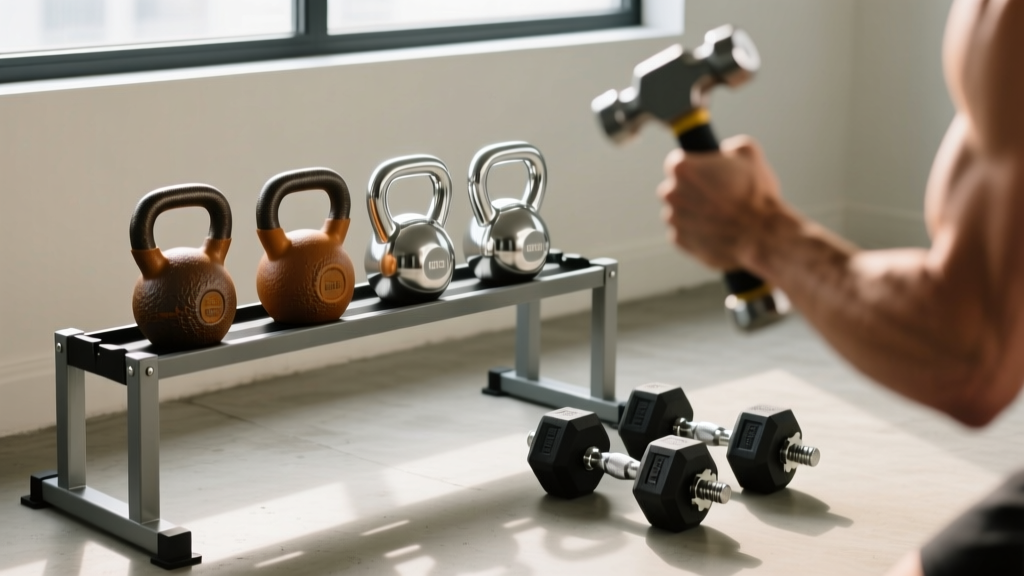
Cast Iron vs Competition Kettlebells & Hammer Curls with Dumbbells
