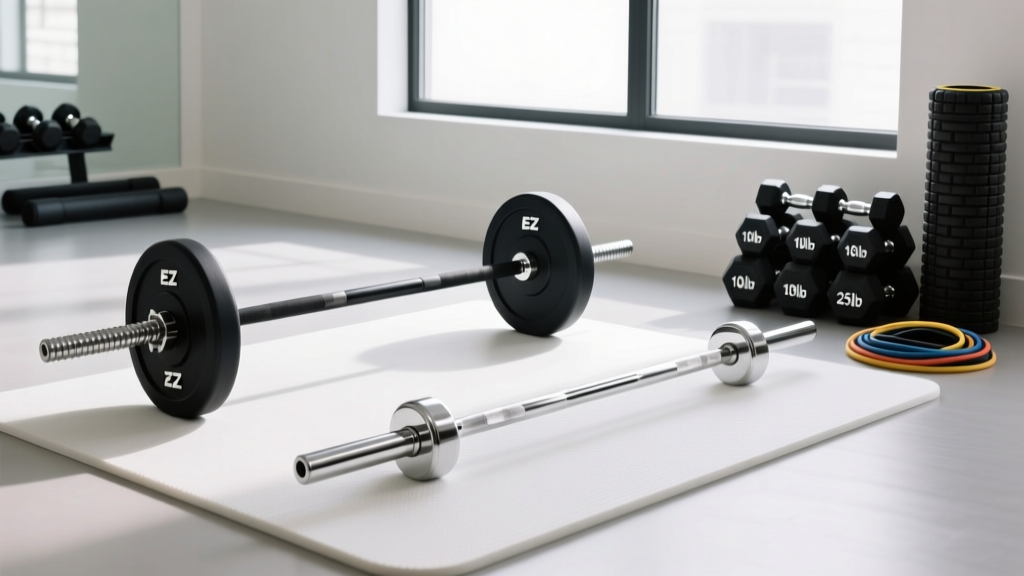
EZ Curl Bar vs Straight Bar for Your Dumbbell Home Exercise Program
Discover whether an EZ curl bar or straight bar best supplements your dumbbell home exercise program. Expert biomechanics, top picks, and 2026 pricing.

Beyond the Dumbbell: Why Upgrade Your Arm Day?
Most lifters build their foundation using a dumbbell home exercise program because of space efficiency, budget constraints, and the inherent benefits of unilateral training. Dumbbells are exceptional for identifying imbalances and allowing natural wrist rotation. However, as your strength progresses, you will inevitably hit a ceiling with dumbbell curls: your grip and forearm stabilizers will fatigue before your biceps brachii and brachialis reach true mechanical failure.
This is where introducing a dedicated curling barbell becomes essential. But when shopping for your home gym, you are immediately faced with a classic debate: the EZ curl bar versus the straight bar. Both tools offer distinct biomechanical advantages, and choosing the wrong one can lead to joint inflammation or suboptimal muscle recruitment. In this hands-on review, we break down the kinesiology, sleeve construction, and real-world pricing of the top models in 2026 to help you make the right addition to your equipment rack.
The Biomechanical Divide: Wrist Supination and Elbow Valgus
The primary difference between a straight bar and an EZ bar lies in the angle of grip and how it affects the radioulnar joint (the forearm) and the carrying angle of the elbow.
The Straight Bar: Maximum Supination
A standard 47-inch Olympic straight bar forces your wrists into full supination (palms facing directly up). According to kinesiology data from ExRx, this position places the biceps brachii in its most mechanically advantageous position for peak contraction. However, human anatomy is rarely perfectly straight. Most people have a natural 'carrying angle' (cubitus valgus) at the elbow. Forcing a supinated grip on a straight bar can place severe valgus stress on the medial epicondyle, leading to golfer's elbow (medial epicondylitis) during heavy eccentrics.
The EZ Bar: Ergonomic Angles
The EZ curl bar features angled bends—typically at 45-degree and 30-degree increments. This allows for a semi-supinated or neutral grip, which aligns the bar with your natural carrying angle. The trade-off? A semi-supinated grip shifts a portion of the load away from the short head of the biceps and onto the brachialis and brachioradialis. While you may sacrifice a fraction of bicep peak activation, the reduction in joint torque allows you to lift heavier absolute loads with significantly less connective tissue strain.
⚠️ Expert Warning: The Sleeve Torque Failure ModeWhen upgrading from dumbbells, many home gym owners buy cheap, $60 straight bars with solid or poorly bushed sleeves. When you curl 80+ lbs, the rotational inertia of the iron plates transfers directly into your wrists if the sleeves do not spin independently. This 'sleeve torque' is a primary cause of acute wrist sprains during heavy barbell curls. Always prioritize brass or composite bushings over raw steel-on-steel sleeves.
Hands-On Review: Top EZ Curl Bars for Home Gyms
We tested the most popular EZ bars on the market to see which offers the best knurling, tensile strength, and sleeve spin for a home environment.
1. Rogue Curl Bar (Cerakote) - The Premium Standard
- Price: $245.00
- Weight: 25 lbs (11.3 kg)
- Tensile Strength: 190,000 PSI
The Rogue Curl Bar remains the gold standard in 2026. The 190k PSI steel shaft provides the perfect amount of 'whip' without bending permanently under heavy loads. The Cerakote finish is virtually impervious to rust and sweat, making it ideal for humid garage gyms. The knurling is a medium volcano pattern—aggressive enough to hold onto during heavy sets of 8, but not so sharp that it tears your calluses. The composite bushings provide a smooth, silent sleeve spin.
2. Titan Fitness 35lb Olympic EZ Curl Bar - The Budget Workhorse
- Price: $159.99
- Weight: 35 lbs
- Finish: Hard Chrome
Available directly from Titan Fitness, this bar is a favorite for lifters who want a heavier starting weight. At 35 lbs, it bridges the gap between lightweight technique bars and standard Olympic bars. The hard chrome finish requires occasional wiping with a light coat of oil to prevent oxidation, but the knurl depth is excellent. The grip angles are slightly more aggressive than the Rogue, making it a better choice for lifters with excellent wrist mobility who still want some ergonomic relief.
Hands-On Review: Top Straight Bars for Bicep Isolation
If you have pristine wrist mobility and prioritize absolute bicep isolation, a straight bar is your weapon of choice.
1. CAP Barbell OB-85PB (47-Inch Standard) - The Entry-Level Pick
- Price: ~$65.00
- Weight: 30 lbs
- Sleeve Construction: Basic Bushing
The CAP 47-inch straight bar is ubiquitous in home gyms. It is cheap, functional, and fits standard plate storage. However, the sleeve spin is noticeably stiffer than premium brands. We recommend this only for lifters who plan to use bumper plates (which have less rotational mass) or who strictly perform slow-tempo curls where rotational inertia is minimized.
2. X-Mark Olympic 47-Inch Straight Curl Bar - The Mid-Tier Upgrade
- Price: $119.00
- Weight: 33 lbs
- Knurling: Medium Diamond
X-Mark offers a surprisingly smooth sleeve rotation for the price point, utilizing basic brass bushings. The shaft diameter is 28.5mm, which is slightly thinner than a standard power bar, allowing for a better closed grip when your forearms are heavily pumped. It is an excellent straight bar for supplementing a dumbbell-focused routine without breaking the bank.
Feature Comparison Matrix
| Model | Type | Price (2026) | Shaft Weight | Best For |
|---|---|---|---|---|
| Rogue Curl Bar (Cerakote) | EZ (Multi-Angle) | $245.00 | 25 lbs | Joint longevity & premium feel |
| Titan Fitness EZ Bar | EZ (Aggressive) | $159.99 | 35 lbs | Heavy load acclimation |
| CAP Barbell OB-85PB | Straight (47') | $65.00 | 30 lbs | Budget strict curls |
| X-Mark 47' Straight | Straight (47') | $119.00 | 33 lbs | Peak bicep isolation |
Programming: Integrating Bars into a Dumbbell Home Exercise Program
You do not need to abandon your dumbbell home exercise program to utilize these bars. Instead, use them strategically to target weak points and manage central nervous system (CNS) fatigue.
Strategic Exercise Swaps
- Swap Dumbbell Hammer Curls for EZ Bar Neutral Curls: Use the innermost, most vertical grips on the EZ bar. This allows you to overload the brachialis with 20-30% more weight than you could manage with individual dumbbells, driving arm thickness.
- Swap Dumbbell Concentration Curls for Straight Bar Wall Curls: Standing with your back flat against a wall and curling a straight bar eliminates the momentum and shoulder flexion cheating common in heavy dumbbell curls, providing brutal, honest tension on the biceps peak.
- Swap Dumbbell Skullcrushers for EZ Bar Floor Presses: The EZ bar is vastly superior for tricep extensions. The semi-pronated grip saves your elbows from the flaring pain often caused by heavy dumbbell tricep work.
Pro-Tip: If your home gym lacks a preacher curl bench, use your EZ bar for 'Spider Curls' by lying chest-down on an incline adjustable bench and letting the bar hang. The ergonomic angles of the EZ bar make this movement significantly safer for the wrists than a straight bar.
The Expert Verdict: Which Should You Buy?
If you are strictly supplementing a dumbbell home exercise program and want to maximize bicep growth while minimizing the risk of elbow tendonitis, the EZ Curl Bar is the undisputed winner. The Rogue Curl Bar ($245) is a lifetime investment that will outlast your home gym, but the Titan Fitness EZ Bar ($159.99) offers 90% of the performance for a much more accessible price point.
Reserve the straight bar only if you are an advanced bodybuilder with proven wrist mobility, or if you plan to use the bar for other straight-bar-specific movements like barbell rows and floor presses. For pure arm specialization, the ergonomic relief of the EZ bar allows you to push closer to true muscular failure, which is the ultimate driver of hypertrophy.
More gear to consider
All reviews
Budget Storage & Racks for Dumbbells for Women Beginners (2026)
Rubber Hex vs Urethane: 2026 Gear for Lateral Pulls with Dumbbells

Power Rack vs Squat Rack vs Stand: Rear Delt Dumbbell Exercises

Loadable Dumbbell Care to Maximize Your Dumbbell Only Exercises
Power Rack vs Squat Rack vs Squat Stand & Circle Dumbbells