EZ vs Straight Bar Footprint & Dumbbell Halo Exercise Space Hacks
Compare EZ curl vs straight bar dimensions for small home gyms. Discover space-saving storage layouts and the dumbbell halo exercise for tight clearances.

The Spatial Dilemma: Barbell Footprints in Micro-Gyms
As urban living spaces shrink and home gym conversions move into spare bedrooms, closets, and compact garage corners, the 50-to-80-square-foot 'micro-gym' has become the standard in 2026. When designing a layout for these confined areas, every inch of clearance matters. The debate between an EZ curl bar and a straight barbell is no longer just about bicep activation and wrist supination; it is fundamentally a question of spatial optimization, rack compatibility, and ceiling clearance.
While a standard Olympic straight bar demands significant horizontal and vertical real estate, shorter specialty bars offer distinct layout advantages. Furthermore, when low ceilings restrict overhead barbell paths, incorporating alternative mobility movements like the dumbbell halo exercise becomes essential for maintaining joint health without compromising your room's structural limits.
Dimensional Breakdown: EZ Curl Bar vs. Straight Bar
To optimize your floor plan, you must first understand the exact physical footprint of your equipment. A standard 86-inch Olympic barbell is a non-starter for rooms narrower than 10 feet once you factor in wall clearance and plate loading. Below is a precise comparison of the three most common barbell configurations used in compact layouts.
| Feature | Olympic Straight Bar (86') | 'Shorty' Straight Bar (71') | Olympic EZ Curl Bar (47'-52') |
|---|---|---|---|
| Total Length | 86 in (218 cm) | 71 in (180 cm) | 47-52 in (120-132 cm) |
| Shaft Length | 51.5 in | 45 in | 28-32 in |
| Sleeve Length | 16.3 in | 8.5 in | 8-10 in |
| Weight | 44-45 lbs | 30-33 lbs | 18-25 lbs |
| Min. Rack Width | 48 in | 36 in | 24 in |
| Avg. Cost (2026) | $150 - $290 | $80 - $140 | $90 - $180 |
Storage Solutions for Tight Floor Plans
Leaving barbells on the floor or permanently seated in J-cups destroys usable square footage. In a 6x8 foot room, you need dynamic storage solutions that reclaim your workout zone.
Vertical Barbell Storage
For straight bars, vertical storage is the ultimate space hack. A vertical barbell holder (such as the Titan Fitness 10-Bar Vertical Storage Rack, priced around $149) occupies a mere 20x20 inch footprint in the corner of your room. This removes the 86-inch horizontal hazard from your floor, allowing you to perform floor-based movements like deadlifts or kettlebell swings without tripping over the shaft.
Wall-Mounted Hangers for EZ Bars
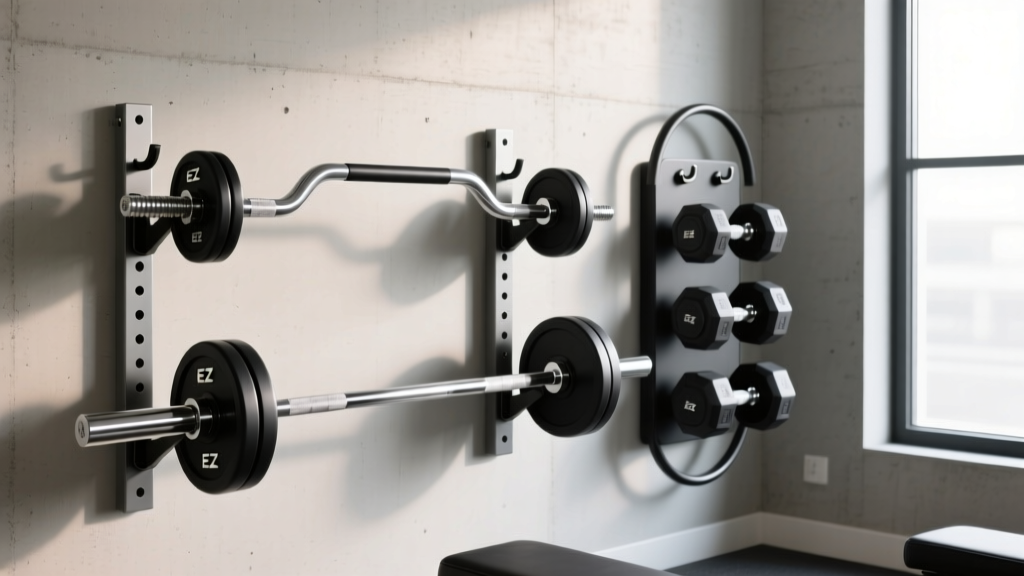
EZ curl bars are uniquely suited for wall-mounted storage due to their lighter weight (under 25 lbs) and shorter profile. Mounting a heavy-duty steel wall hanger at 60 inches high keeps the bar accessible but out of the drop zone. According to equipment specs from Rogue Fitness, their curl bars feature knurled shafts that can scratch drywall if stored improperly, so always use hangers with UHMW plastic liners to protect both your wall and your bar's finish.
Overcoming Low Ceilings: The Dumbbell Halo Exercise Alternative
One of the most overlooked spatial constraints in home gym design is vertical clearance. Standard residential ceilings are 84 to 96 inches high. If you are 6 feet tall (72 inches) and holding a 71-inch straight bar, you have virtually zero overhead clearance for movements like barbell halos, overhead presses, or high pulls.
When barbell overhead paths are restricted by the ceiling, the dumbbell halo exercise becomes your primary tool for shoulder mobility, thoracic extension, and rotator cuff warm-ups. Unlike a barbell halo, which requires a wide grip and massive lateral clearance, the dumbbell halo exercise requires only a single 15lb to 25lb dumbbell and a 20x20 inch personal footprint.
Executing the Dumbbell Halo in Confined Spaces
The dumbbell halo exercise traces an orbital path around the head, promoting synovial fluid production in the glenohumeral joint without requiring you to step backward or adjust your stance. Here is the step-by-step execution optimized for tight corners:
- The Grip: Hold a single hex or urethane dumbbell vertically by the top bell (or by the handle if using a lighter weight). Keep your elbows tucked in close to your ribs to avoid striking nearby walls or rack uprights.
- The Orbit: Slowly circle the dumbbell around your head. Keep the weight as close to your cervical spine as possible—imagine shaving the back of your head with the dumbbell.
- Cervical Alignment: Maintain a neutral spine. Do not jut your chin forward to compensate for a heavy weight. As noted by the Mayo Clinic's strength training guidelines, maintaining proper joint alignment during mobility work is critical to preventing chronic impingement.
- The Reversal: Complete 8 to 10 rotations in one direction, then reverse the orbit to ensure balanced muscular activation across the anterior and posterior deltoids.
'In micro-gyms, the dumbbell halo exercise completely replaces the need for banded overhead stretches or barbell halos. It delivers identical synovial benefits while keeping your spatial footprint strictly within your own shoulder width.' — Compact Gym Layout Principles, 2026
Biomechanics vs. Spatial Constraints: Which Bar Wins?
When deciding which bar to permanently dedicate rack space to, you must weigh biomechanical efficiency against spatial reality. The straight bar forces a fully pronated grip (palms facing up), which places maximum tension on the biceps brachii but can cause medial epicondylitis (golfer's elbow) in lifters with poor wrist mobility. The EZ curl bar features cambered angles (typically 15 to 30 degrees) that allow a semi-supinated grip, drastically reducing wrist and elbow strain.
According to kinesiology data from ExRx.net, the semi-pronated grip of the EZ bar shifts a marginally higher load onto the brachialis and brachioradialis. In a cramped home gym where you cannot easily adjust your stance width to accommodate a long straight bar's whip or bounce, the EZ curl bar's rigid, compact profile offers a much more controlled lifting experience. You won't accidentally clip the wall with the sleeves during a strict curl.
The 'Shorty' Straight Bar Compromise
If you absolutely require the fully pronated grip of a straight bar for power cleans or strict military presses, the 71-inch 'Shorty' bar is your best spatial compromise. It fits inside standard power racks (which are usually 48 inches wide on the outside, leaving 42 inches of internal clearance). However, be warned: the shorter shaft means you cannot perform wide-grip snatches or sumo deadlifts with your hands outside the collars.
Real-World Compact Gym Layout Scenarios
Scenario A: The 6x8 ft Bedroom Gym (48 Sq Ft)
Layout Reality: You have a fold-down squat rack and an 84-inch ceiling.
The Verdict: Ditch the straight bar entirely. The 86-inch length will literally touch both walls if placed horizontally. Rely on an Olympic EZ curl bar for all arm work, and use adjustable dumbbells for pressing. Utilize the dumbbell halo exercise daily for shoulder prep, as you lack the ceiling height for overhead barbell stretching.
Scenario B: The 10x10 ft Garage Corner (100 Sq Ft)
Layout Reality: You have a full 4x4 upright power rack, 96-inch ceilings, and rubber matting.
The Verdict: You can comfortably house a standard 86-inch Olympic straight bar. Store it vertically in the corner to preserve floor space for deadlifts. Keep an EZ curl bar on wall hangers near the rack for high-rep accessory work, minimizing the time you spend swapping heavy straight bars in and out of the J-cups.
Final Layout Verdict
Optimizing a home gym is an exercise in ruthless spatial prioritization. The EZ curl bar is the undisputed champion of confined spaces, offering excellent biomechanical joint relief, easy wall-mounted storage, and zero risk of sleeve-to-wall collisions. The straight bar remains king for heavy compound loading, but only if your floor plan can accommodate its 86-inch wingspan or if you invest in vertical corner storage. Finally, never let low ceilings compromise your joint mobility; when overhead clearance fails, the dumbbell halo exercise is the ultimate, zero-footprint solution to keep your shoulders healthy and your layout uncluttered.
More gear to consider
All reviews
Dumbbell Row Form Guide: Standard vs Olympic Plates

Rubber vs Urethane Care & Chin-Up Alternative with Dumbbells

Best Neoprene Incline Chest Press Dumbbells for Home Use

Neoprene Dumbbells for Home Use: Buying Guide & Dumbbell Shoulder Press Angle

Olympic Barbell Knurling & Centr Rubber Dumbbell Set Setup Guide