
EZ vs Straight Bar & Dumbbell Deadlift Form: Space-Saving Gym Layout
Optimize your compact home gym layout. Compare EZ curl bar vs straight bar dimensions and master dumbbell deadlift form for tight spaces.

The Spatial Reality: EZ Curl Bar vs. Straight Bar Comparison
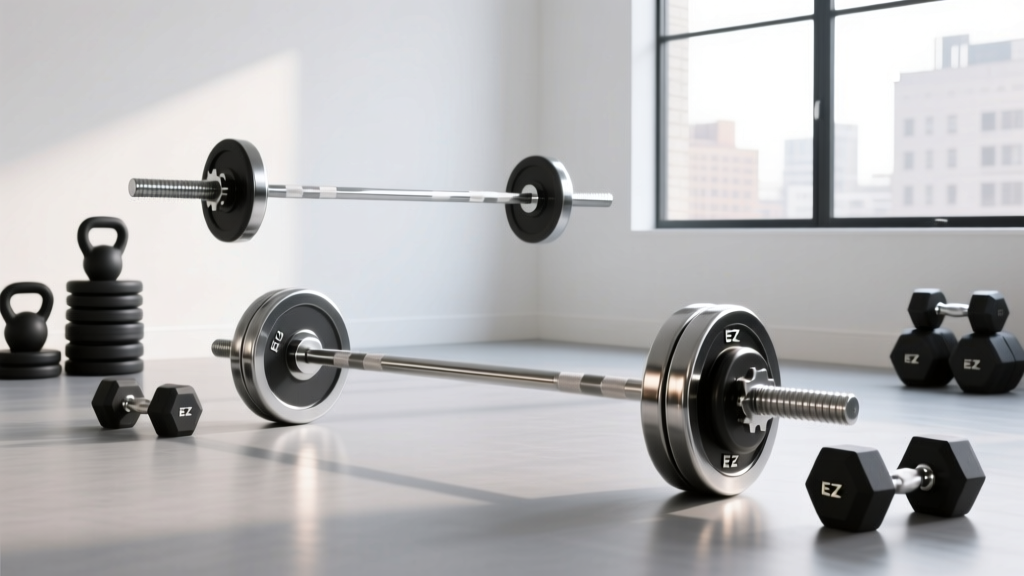
When engineering a sub-200-square-foot home gym in 2026, every linear inch dictates your training flow. The upper-body pulling debate often centers on the EZ curl bar vs. straight bar comparison, but most buyers ignore the spatial footprint until they try to rack their equipment. A standard Olympic straight bar measures 86 inches in length and weighs 45 pounds. The distance between the inner collars is exactly 51.5 inches, allowing it to rest perfectly on standard power rack hooks set at 49 inches wide.
Conversely, a standard EZ curl bar typically spans 47 to 51 inches total, weighing between 25 and 35 pounds. However, the critical spatial failure point is the shaft length between the sleeves. On most economy EZ bars, this inner shaft is only 42 to 44 inches. If you attempt to rack it on a standard 49-inch power rack, the bar will slip through the uprights, creating a severe safety hazard and damaging your rack's UHMW plastic liners.
Equipment Matrix: Dimensions and Spatial Footprint
| Equipment | Total Length | Inner Shaft Length | Rackable on 49' Uprights? | Storage Footprint |
|---|---|---|---|---|
| Standard Olympic Straight Bar | 86' | 51.5' | Yes | Requires 7'2' horizontal rack or floor stand |
| Standard EZ Curl Bar | 47' - 51' | 42' - 44' | No (Slips through) | Can be stored vertically in a 12' wall cradle |
| Shorty EZ Bar (Specialty) | 42' | 35' | No | Highly compact, fits in small cubbies |
| 5ft. Olympic Straight Bar | 60' | 41' | No | Ideal for narrow hallways and tight alcoves |
Bypassing the Barbell: Dumbbell Deadlift Form in Tight Spaces
A conventional barbell deadlift requires a minimum clear floor zone of 84 inches by 48 inches to accommodate the barbell sleeves, plate loading, and the lifter's posterior chain hinge. In a compact garage gym or apartment setup, this footprint often overlaps with squat racks, treadmills, or structural walls. This is where mastering dumbbell deadlift form becomes a non-negotiable skill for space-constrained lifters.
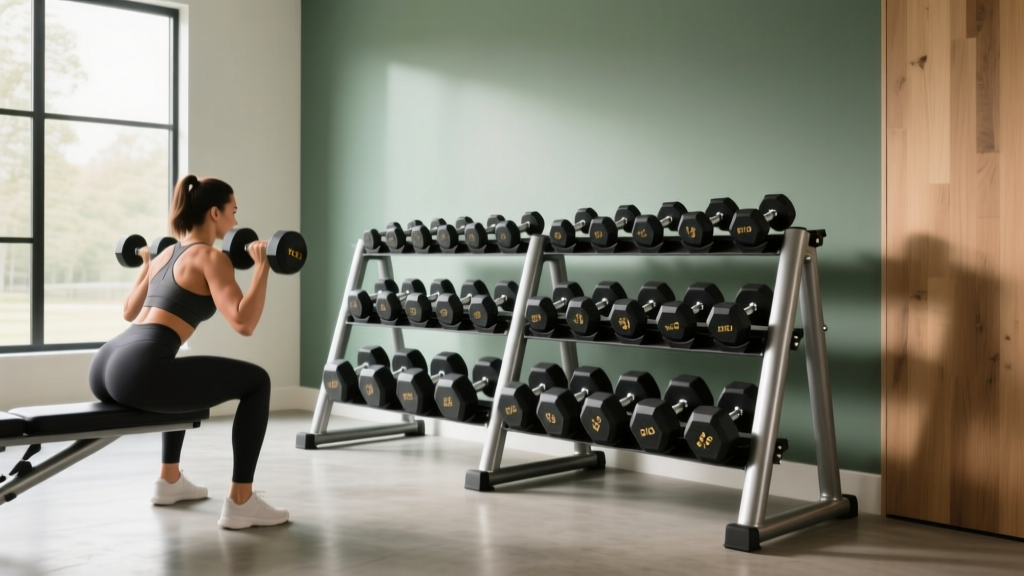
By transitioning to heavy adjustable dumbbells—like the Nuobell 80lb or PowerBlock Pro 100lb sets—you reduce your required training footprint to a mere 36-inch by 36-inch square. According to biomechanical analyses cataloged by ExRx.net, the dumbbell deadlift targets the gluteus maximus, hamstrings, and erector spinae with comparable muscle activation to the barbell variant, provided the center of mass is managed correctly.
Step-by-Step Spatial Dumbbell Deadlift Form
- The Stance & Clearance: Stand with feet hip-width apart. Unlike a barbell where the bar tracks over the mid-foot, dumbbells will track along the outside of your shins. Ensure you have at least 18 inches of clearance behind you to allow for a full hip hinge without your glutes striking a wall or rack upright.
- The Grip & Hinge: Hold the dumbbells in a neutral grip (palms facing your thighs). Push your hips back as if closing a car door with your glutes. Keep your lats engaged by imagining you are squeezing oranges in your armpits.
- The Descent: Lower the dumbbells vertically along your outer legs. Stop when the dumbbell heads touch the floor (or a low plyo box if you lack mobility). Do not round your lumbar spine to chase depth.
- The Lockout: Drive through the mid-foot, extending the knees and hips simultaneously. Squeeze the glutes at the top. Avoid hyperextending the lower back, a common error when lifters attempt to mimic the extreme lockout of a barbell.
'The dumbbell deadlift is not merely a regression; it is a spatial optimization tool. By eliminating the 7-foot barbell, lifters in micro-gyms can maintain high-intensity posterior chain loading without sacrificing room for functional movement zones.' — Adapted from NSCA strength and conditioning principles regarding equipment modification.
Edge Cases: When Space Forces Unconventional Choices
Not all home gyms are perfectly rectangular. Sloped ceilings, support pillars, and narrow hallways often force lifters into unconventional equipment choices. If your ceiling height is under 80 inches, performing standing overhead presses with a 7-foot straight bar is impossible. Here, the EZ curl bar shines as a primary overhead pressing tool due to its shorter sleeves, which won't scrape the drywall during the ascent. Priced between $85 and $150 for a quality 35lb Olympic EZ bar (like the Titan Fitness Olympic EZ Curl Bar), it offers a high ROI for low-clearance environments.
Similarly, if your layout restricts you to a narrow corridor, a 5-foot Olympic straight bar (often retailing around $110-$140) becomes your primary deadlift tool. However, because the inner shaft is only 41 inches, you must adopt a sumo stance or utilize dumbbells to maintain proper dumbbell deadlift form mechanics without your hands scraping against your knees. Always measure your available sleeve length before purchasing specialty bars; a common mistake is buying 10-inch sleeves that cannot accommodate modern thick-cast iron plates or calibrated steel plates.
Layout Design: Integrating Bars and Dumbbells
To finalize your space-optimized layout, consider the 'Triangle of Flow' concept for equipment placement:
- Zone 1 (The Anchor): Your power rack and straight bar. Place this against the primary load-bearing wall to minimize vibration and maximize safety.
- Zone 2 (The Accessory Wall): Mount vertical storage for your EZ curl bar, resistance bands, and belts. This keeps the floor clear for Zone 3.
- Zone 3 (The Hinge Zone): A 4x4 foot rubber-matted area dedicated to adjustable dumbbells. This is where your dumbbell deadlift form practice occurs, free from the tripping hazards of barbell collars and floor stands.
Frequently Asked Questions
Can I use an EZ curl bar for deadlifts to save space?
While a 5-foot straight bar can handle light deadlifts, using an EZ curl bar for deadlifts is highly discouraged. The angled grips force your wrists and forearms into supination/semi-pronation, which compromises your grip strength and alters the biomechanics of the hinge. Furthermore, the sleeves are typically too short to hold more than two 45lb bumper plates per side, limiting your progressive overload.
How do I progress the dumbbell deadlift if my adjustable dumbbells max out at 80 lbs?
When spatial constraints limit your equipment to 80lb dumbbells, utilize tempo and deficit variations. Stand on a 2-inch thick bumper plate or wooden block to increase the range of motion (deficit dumbbell deadlift). Alternatively, employ a 4-second eccentric descent to maximize time-under-tension, a proven hypertrophy stimulus endorsed by the National Strength and Conditioning Association (NSCA).
More gear to consider
All reviews
Barbell Collar Types Compared: Heavy Lifts to Dumbbell Dead Bug
EZ Curl Bar vs Straight Bar: Curls & Dumbbell Chest Press Good Weight
2026 Rack Trends: Storing Heavy Weights for Dumbbell Glute Bridges

Dumbbell Lat Pulldown GIF Guide: Neoprene Home Gym Setup

EZ Curl Bar vs Straight Bar: Budget & Dumbbell Single Leg Step Up
