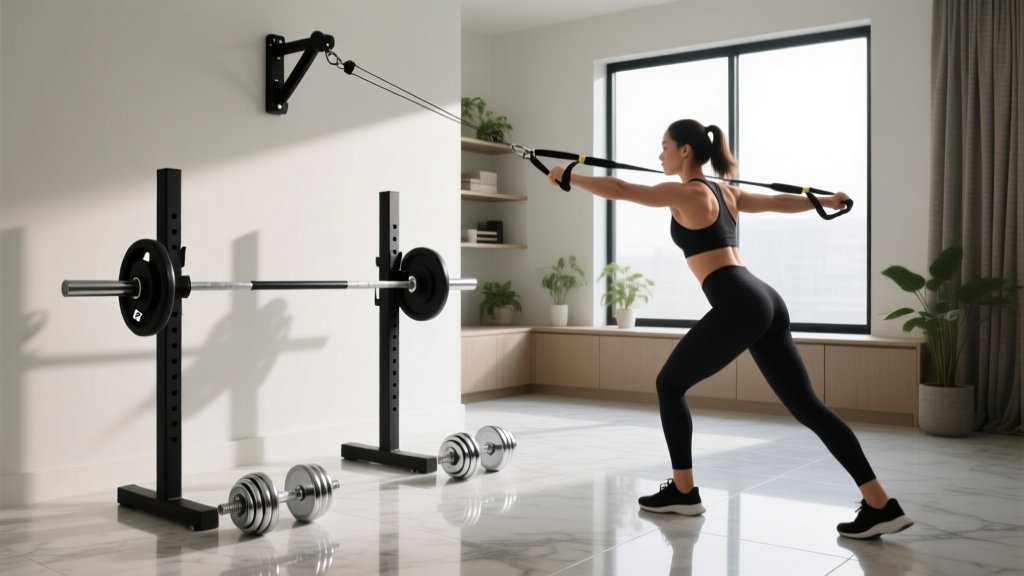
EZ Curl Bar vs Straight Bar & Cable Fly Alternative with Dumbbells
Optimize your home gym layout by comparing the EZ curl bar vs straight bar and mastering the best cable fly alternative with dumbbells.

The Micro-Gym Dilemma: Designing a High-Yield Free-Weight Station
As urban living spaces shrink and garage gym footprints become more constrained in 2026, the luxury of housing a $3,500 commercial functional trainer or a full 7-foot Olympic barbell set is increasingly rare. Space optimization is no longer just about aesthetics; it is about biomechanical efficiency per square foot. When designing a compact arm and chest training zone, two critical decisions dictate your layout and your gains: choosing between an EZ curl bar vs straight bar for your pulling movements, and engineering a viable cable fly alternative with dumbbells to replace the missing cable crossover machine.
This guide breaks down the exact spatial requirements, biomechanical trade-offs, and advanced programming techniques required to build a high-performance, small-footprint free-weight station.
Spatial Realities: EZ Curl Bar vs Straight Bar Footprints
The most common mistake in small-space gym design is purchasing a standard 7-foot (86-inch) Olympic barbell for a room that lacks the lateral clearance for sleeve rotation and plate loading. If your training bay is 9 feet wide or less, a standard bar will scrape your walls or force you to angle your bench awkwardly.
Space-Saving Pro Tip: If your rack is a standard 4x4 foot power cage (48 inches wide), a 7-foot bar overhangs by 19 inches on each side. To maintain the recommended 24-inch lateral safety clearance, your room must be at least 134 inches (11.1 feet) wide. Downgrading to a specialty bar solves this instantly.Equipment Dimension & Clearance Matrix
| Equipment Type | Model Example (2026 Pricing) | Total Length | Weight | Required Room Width (w/ 24" clearance) |
|---|---|---|---|---|
| Standard Straight Bar | Rogue Ohio Bar (~$295) | 86.0 inches | 20 kg (45 lbs) | 134 inches (11' 2") |
| Short Straight Bar | Bells of Steel 5'5" Bar (~$150) | 65.0 inches | 15 kg (33 lbs) | 113 inches (9' 5") |
| Olympic EZ Curl Bar | Rogue Curl Bar (~$225) | 47.0 inches | 15 kg (33 lbs) | 95 inches (7' 11") |
Biomechanics and Joint Torque in Tight Spaces
Beyond mere dimensions, the biomechanics of the EZ curl bar offer distinct advantages for home lifters who lack the space for multiple specialty straight bars. The semi-supinated (angled) grip of the EZ bar reduces valgus stress on the medial elbow and minimizes wrist extension limitations. According to kinesiological data mapped by ExRx.net's biomechanics archives, a straight bar forces full supination, which can impinge the radioulnar joint in lifters with poor carrying angles. For a compact gym where one bar must serve for curls, skull crushers, and close-grip bench presses, the 47-inch EZ curl bar provides superior joint longevity and fits inside virtually any folding wall rack or compact squat stand.
The Missing Machine: Executing a Cable Fly Alternative with Dumbbells
By opting for a compact EZ bar and a pair of adjustable dumbbells, you've saved roughly 12 square feet of floor space by eliminating a functional trainer. However, you now face a mechanical deficit: how do you perform a cable fly alternative with dumbbells that replicates the constant horizontal adduction tension of a cable crossover?
Standard dumbbell chest flyes suffer from a flawed resistance curve. Gravity only pulls straight down, meaning the pectoralis major experiences zero lateral tension at the top of the movement when the dumbbells are stacked over the shoulder joints. To fix this in a space-constrained gym, you must manipulate tempo and leverage.
Technique 1: The 1.5-Rep Deficit Floor Flye
If you do not have space for a large adjustable bench, the floor is your best asset. Lying on the floor limits your range of motion, protecting the rotator cuff while allowing for heavy loading.
- The Setup: Lie on a high-density EVA foam mat. Keep your knees bent and feet flat to stabilize the pelvis.
- The Descent: Lower the dumbbells with a 3-second eccentric phase until your triceps lightly touch the floor. This eliminates the stretch-reflex bounce.
- The 1.5 Rep: Press the weights halfway up, pause for 1 second to maximize mid-chest tension, lower them back to the floor, and then press them fully to the top.
- The Squeeze: At the top of the movement, do not just touch the weights together. Forcefully contract the pecs and slightly internally rotate the dumbbells (pouring the pitchers) to mimic the peak contraction of a high-pulley cable fly.
Technique 2: The Incline Hex-Squeeze Flye Hybrid
If you own a compact adjustable bench (like the Rep Fitness AB-3100 2.0, which folds down to a 10-inch profile for under-bed storage), set it to a 30-degree incline. Instead of a traditional flye, perform a hybrid movement:
- Bring the dumbbells together at the top, pressing the inner hex heads against each other.
- Maintain this crushing inward pressure as you lower the weights to your chest in a close-grip press motion.
- This continuous inward force vector perfectly replicates the horizontal adduction provided by a cable machine's weight stack, ensuring the sternal head of the pec remains under load throughout the entire range of motion.
Layout Blueprint: Arranging Your Compact Arm & Chest Zone
To seamlessly integrate your EZ curl bar, short straight bar (if applicable), and dumbbell flye station, follow this spatial layout for a standard 10x10 foot spare room or garage bay:
1. The Anchor: Folding Wall Rack
Install a folding squat rack (e.g., PRx Profile Fold-In Rack) against the primary load-bearing wall. When folded, it protrudes only 4 inches. When deployed, it requires 43 inches of depth. This leaves over 7 feet of open floor space for dumbbell flyes and stretching when the rack is stowed.
2. Vertical Barbell Storage
Never store an EZ curl bar or a 5-foot straight bar horizontally on the floor in a small gym; it creates a tripping hazard and wastes prime lateral space. Mount a 2-bar vertical wall hanger ($45-$60) directly on the adjacent side wall. The 47-inch EZ bar and a 65-inch short bar can be stored vertically in a footprint of just 6x6 inches.
3. The Dumbbell & Bench Footprint
Place a 2-tier compact dumbbell rack (approx. 24 inches wide) in the corner opposite the wall rack. Keep your adjustable bench centered in front of the rack. Ensure you maintain a minimum 36-inch clearance behind the bench headrest to allow for safe loading and unloading of the EZ bar from the J-cups during skull crushers.
Expert Verdict: What to Buy for a 2026 Compact Gym
When forced to choose between an EZ curl bar vs straight bar for a micro-gym, the EZ curl bar is the undisputed king of spatial efficiency and joint preservation. Its 47-inch profile allows you to perform heavy bicep curls, tricep extensions, and close-grip presses in a room barely wider than 8 feet. Pair this with an intelligent approach to the cable fly alternative with dumbbells—utilizing 1.5-rep tempos, deficit floor work, and hex-squeeze mechanics—and you will completely negate the need for a bulky, expensive cable tower. By prioritizing biomechanical tension over machine convenience, your compact free-weight layout will yield hypertrophy results that rival any commercial facility.
More gear to consider
All reviews
Power Rack, Squat Rack, or Stand for the Dumbbell Hang Power Clean?

EZ Bar vs Straight Bar: 2026 Trends & Dumbbell Thrust Data
Dumbbell Hammer Press Layouts: Rubber Hex vs Urethane Space Guide
Home Gym Setup: Olympic vs Standard Plates & Hammer Bicep Curls
Rubber Hex vs Urethane Dumbbells: Space Layouts for a Fly Workout
