EZ Bar vs Straight Bar & Bent Over Dumbbell Curls: Expert Guide
We compare EZ curl bar vs straight bar mechanics and review top 2026 models, plus a deep dive into bent over dumbbell curls for peak arm growth.

Arm training plateaus are rarely a failure of effort; they are usually a failure of biomechanical matching. In the free weights and racks category, the debate over which tool best isolates the biceps brachii is a cornerstone of hypertrophy programming. While the EZ curl bar vs straight bar comparison dominates the barbell rack, true arm development requires unilateral free-weight isolation to target specific muscle bellies. This is where bent over dumbbell curls become your secret weapon for long-head development.
In this 2026 expert review, we break down the exact biomechanical differences between barbell variations, provide hands-on reviews of the year's top Olympic and standard bars, and detail the precise execution of the bent over dumbbell curl to build a complete, joint-friendly arm protocol.
The Biomechanical Showdown: EZ Curl Bar vs. Straight Bar
To understand which bar belongs in your rack, we must first look at human anatomy—specifically, the cubital valgus (the natural carrying angle of the arm). When you stand relaxed, your arms do not hang perfectly straight; they angle slightly outward.
The Straight Barbell: Peak Contraction at a Cost
A standard 20kg Olympic straight bar forces your wrists and forearms into maximum supination (palms facing directly up). According to the ExRx Kinesiology Database, full supination maximizes the short head of the biceps brachii. However, forcing the radioulnar joint into this fixed position while under heavy load creates immense valgus stress on the medial elbow, frequently leading to golfer's elbow (medial epicondylitis) in lifters over 30.
The EZ Curl Bar: Anatomical Compliance
The EZ curl bar features angled grips (typically 45-degree and 30-degree inner bends) that allow for a semi-supinated grip. This aligns with your natural carrying angle, drastically reducing wrist and elbow torque. The slight pronation shifts a marginal amount of mechanical tension to the brachialis and brachioradialis, promoting overall arm thickness rather than just the biceps peak.
Expert Insight: If you have a history of wrist impingement or medial elbow pain, the straight bar should be permanently retired from your isolation work. The EZ bar is non-negotiable for joint longevity.Hands-On Gear Review: 2026 Top Barbell Picks
We tested over a dozen curl bars in our facility this year. Here are the top picks based on knurl aggression, sleeve rotation, and tensile strength.
1. Rogue Fitness Curl Bar (Best Overall)
- Price: $195.00
- Weight: 35 lbs
- Tensile Strength: 190,000 PSI
- Pros: Aggressive knurl pattern that bites through chalk; 14.5-inch loadable sleeves accommodate heavy plate loads; bronze bushings provide smooth, quiet rotation.
- Cons: Premium price point; the inner 30-degree grips are too narrow for lifters with broad shoulders.
2. Titan Fitness Olympic EZ Bar (Best Value)
- Price: $89.99
- Weight: 22 lbs
- Tensile Strength: 150,000 PSI
- Pros: Excellent budget entry point; hard chrome finish resists rust; wider grip angles suit larger frames.
- Cons: Knurl is relatively passive, requiring extra chalk for heavy 8-rep max sets; sleeve diameter is slightly under standard 50mm, causing some bumper plates to rattle.
3. CAP Barbell Super Curl Bar (Best for Home Gyms/1-Inch)
- Price: $49.99
- Weight: 12 lbs (1-inch variant)
- Pros: Ideal for standard 1-inch cast iron plates; compact footprint for apartment racks.
- Cons: Low weight capacity (maxes out around 150 lbs safely); bushings lack smooth rotation during fast eccentrics.
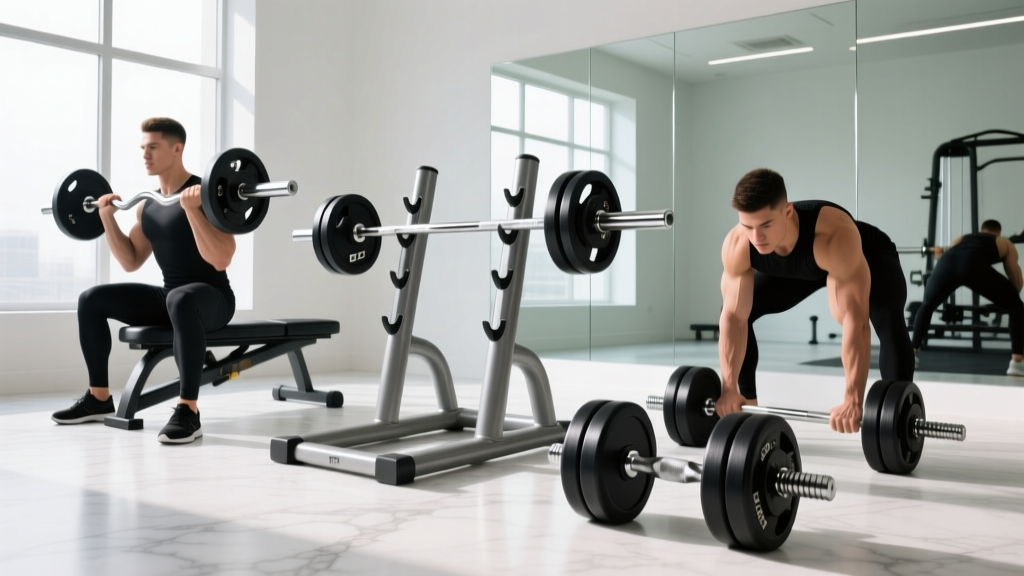
The Unilateral Finisher: Mastering Bent Over Dumbbell Curls
While the EZ curl bar vs straight bar debate settles your bilateral heavy loading, it fails to address the long head of the biceps in a stretched position. This is where bent over dumbbell curls become essential. By hinging at the hips and allowing the arms to hang perpendicular to the floor (or slightly behind the torso), you place the long head under maximum mechanical stretch—the primary driver of hypertrophy according to recent National Strength and Conditioning Association (NSCA) literature on stretch-mediated growth.
Execution and Equipment Specs
- The Hinge: Hinge at the hips to a 45-to-60-degree angle. Keep your spine neutral and core braced.
- The Grip: Use a neutral (hammer) or slightly supinated grip. Let the dumbbells hang fully so the shoulder is in extension.
- The Curl: Drive the elbows up toward the ceiling, curling the weight toward your ribcage. Do not swing the torso.
- The Eccentric: Lower the weight on a strict 3-second count to maximize the stretch-mediated hypertrophy response.
Gear Recommendation: For this movement, handle ergonomics matter. We recommend the Nuobell 552 Adjustable Dumbbells ($449). Their traditional knurled steel handles and compact center of gravity prevent the awkward wrist deviation caused by bulky dial-adjustable competitors when your arms are hanging freely.
Comparative Activation & Stress Matrix
| Exercise / Tool | Primary Target | Wrist/Elbow Stress | Best Application |
|---|---|---|---|
| Straight Barbell Curl | Short Head (Peak) | High | Overload phases (6-8 reps) |
| EZ Curl Bar | Brachialis / Short Head | Low | Hypertrophy (8-12 reps) |
| Bent Over Dumbbell Curls | Long Head (Stretch) | Moderate | Finisher / Stretch focus |
Programming the Ultimate 2026 Arm Day Protocol
Stop choosing between these tools and start sequencing them. Here is an expert-designed protocol that leverages the strengths of both the barbell rack and the dumbbell tree.
- Exercise 1: Heavy EZ Bar Curls. 4 sets of 6-8 reps. Use the Titan or Rogue EZ bar. Focus on moving heavy loads with zero hip sway. Rest 120 seconds between sets.
- Exercise 2: Bent Over Dumbbell Curls. 3 sets of 10-12 reps. Use Nuobell or PowerBlock dumbbells. Hinge to 45 degrees. Focus on the 3-second eccentric stretch. Rest 90 seconds.
- Exercise 3: Incline Hammer Curls. 3 sets of 12-15 reps. Target the brachialis to push the biceps up from underneath.
Expert Troubleshooting & Failure Modes
Failure Mode 1: Elbow Clicking on EZ Bars.
If your elbows click or ache during EZ bar curls, you are likely gripping the innermost, most angled bends. Move your hands to the outer, wider 30-degree bends to reduce the degree of pronation and align the ulna with the humerus.
Failure Mode 2: Momentum on Bent Over Curls.
Lifters often cheat the bent over dumbbell curl by standing up slightly as they lift. To fix this, perform the movement lying face-down on a 45-degree incline bench (the chest-supported variation). This completely removes the lower back and ensures pure long-head isolation.
Frequently Asked Questions
Can I use a straight bar if I have good mobility?
Yes, but only for low-rep, high-load overloads (e.g., 5 reps or fewer). For standard 8-15 rep hypertrophy ranges, the repetitive stress of full supination under fatigue is unnecessary when an EZ bar provides equal biceps activation with vastly superior joint preservation.
How heavy should I go on bent over dumbbell curls?
This is a stretch-focused isolation movement, not a power movement. Select a weight that allows you to pause for a full second at the bottom stretched position. For most intermediate lifters, this falls in the 20 lb to 35 lb dumbbell range per hand.
More gear to consider
All reviews
Oblique Dumbbell Setup: Barbell Collar and Clamp Types Compared
Olympic vs Standard Plates: Guide to Back Extensions with Dumbbells

Adjustable Dumbbell Review: Standing Dumbbell Triceps Extension (2026)

Power Rack vs Squat Rack vs Stand: Good Leg Exercises with Dumbbells

Olympic vs Standard Plates & Best Shoulder Workout with Dumbbells