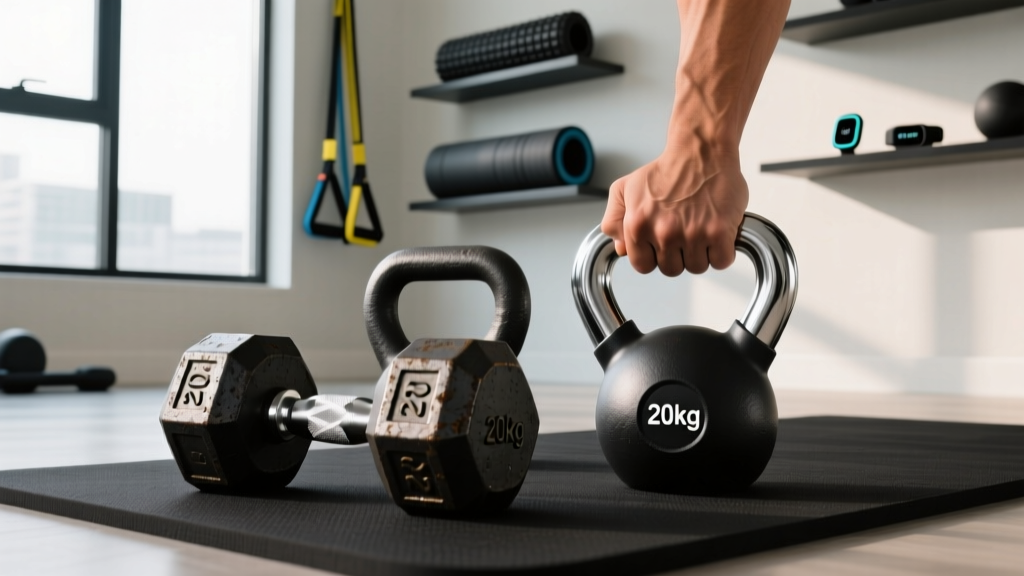
Beyond How to Use a Dumbbell: Cast Iron vs Competition Kettlebells
Transitioning from dumbbells? Discover the ultimate cast iron vs competition kettlebell buying guide with expert hands-on reviews and top 2026 picks.

The Biomechanical Shift: Why Knowing How to Use a Dumbbell Is Not Enough
For most lifters, the iron journey begins with dumbbells. Understanding how to use a dumbbell is the bedrock of traditional resistance training, offering unparalleled stability for isolation movements and bilateral pressing. However, transitioning to kettlebells requires a complete biomechanical paradigm shift. According to the American Council on Exercise (ACE), the fundamental difference lies in the center of mass (COM). A dumbbell's COM rests directly in the center of your grip, creating a balanced lever. A kettlebell's COM is offset, typically sitting 6 to 8 inches below the handle.
This offset creates a longer moment arm, drastically increasing the rotational force your grip, wrist, and core must resist. While dumbbell mechanics rely heavily on joint stabilization against symmetrical loads, kettlebell ballistics (swings, snatches, cleans) demand dynamic hip hinging and rapid deceleration. If you attempt to apply standard dumbbell pressing or curling mechanics to a kettlebell, you will quickly encounter wrist impingement and grip failure. To master this tool, you must first select the right one. In 2026, the market is strictly divided into two camps: traditional cast iron and standardized competition steel. Let us break down the exact specifications, pricing, and real-world applications of both.
Cast Iron vs. Competition: The Dimensional Data
Before diving into specific brand reviews, it is critical to understand the structural differences between these two categories. StrongFirst, the premier authority on hardstyle kettlebell training, emphasizes that the physical dimensions of the bell dictate the technical execution of the lift.
| Feature | Standard Cast Iron | Competition Style |
|---|---|---|
| Material | Solid Cast Iron | Hollow Steel Shell (Filled with shot/lead) |
| Handle Diameter | Varies (32mm - 35mm based on weight) | Standardized (Strictly 33mm or 35mm) |
| Horn Width | Narrower, scales with bell size | Wider, optimized for the rack position |
| Window Size | Smaller (can cramp two-handed grips) | Larger (accommodates two hands or double KB) |
| Bell Dimensions | Scales up as weight increases | Uniform (an 8kg bell is the same size as a 32kg) |
| Average Price per kg | $3.50 - $5.00 | $7.00 - $11.00 |
Hands-On Review: Top Cast Iron Kettlebells
Cast iron bells are the gold standard for hardstyle training, focusing on explosive power, heavy grinds, and general physical preparedness (GPP). Because the physical size of the bell grows with the weight, they are ideal for single-arm work where the changing dimensions provide natural feedback on your strength progression.
1. Rogue E-Coat Kettlebell
Rogue's E-Coat line remains the benchmark for premium cast iron in 2026. Unlike traditional powder coating, which can add up to 3 mils of thickness and create a slick, plastic-like feel, electrocoating (e-coat) is an immersion process that deposits a micro-thin layer of rust protection (typically under 1 mil).
- Price: ~$89.00 for the 24kg (53 lb) model.
- Handle Specs: The 24kg features a 33mm handle, while the 16kg is slightly thinner at 32mm.
- Real-World Insight: The e-coat finish preserves the natural 'grain' of the cast iron. You can perform high-rep snatches without chalk, and the handle will not tear your calluses like aggressive powder coats. However, the base is slightly convex on older molds, meaning it can wobble during renegade rows. Ensure you are buying the latest flat-base batch.
2. REP Fitness KG Cast Iron
REP Fitness offers a highly accessible, durable matte powder coat that takes chalk exceptionally well. This is the workhorse bell for commercial gyms and garage setups.
- Price: ~$65.00 for the 24kg model.
- Handle Specs: Uniformly thick across most weights, hovering around 34mm.
- Real-World Insight: The horns on the REP bells are slightly wider than Rogue's, making them more forgiving during the clean phase. The powder coat is thick; if you train in a humid environment and drop the bell on concrete, the coating can chip, exposing raw iron that requires immediate 3-in-1 oil treatment to prevent oxidation.
Hands-On Review: Top Competition Kettlebells
Competition kettlebells are engineered for Kettlebell Sport (GS) and complex double-kettlebell routines. Because the dimensions remain identical regardless of weight, your technique, grip placement, and rack position never have to adjust when you move up in load. The ExRx.net exercise directory notes that standardized equipment is vital for motor pattern retention in high-repetition endurance sets.
1. Kettlebell Kings Competition Line
Kettlebell Kings dominates the competition space with single-cast steel shells that eliminate the weak weld points found in cheaper, multi-piece bells.
- Price: ~$135.00 for the 24kg model.
- Handle Specs: Strictly 33mm across all weights from 8kg to 32kg.
- Real-World Insight: The window (the gap between the handle and the bell) is massive. This allows you to easily hook your fingers for hook grip during jerks and snatches. The 33mm handle is thick enough to prevent grip fatigue during 10-minute GS sets, but the steel is incredibly smooth. You will need to sand the handle lightly with 120-grit sandpaper upon arrival to give it some 'tooth' for chalk adherence.
2. Bells of Steel Competition
A more budget-friendly entry into the steel shell market, Bells of Steel offers vibrant, color-coded competition bells that meet IUKL (International Union of Kettlebell Lifting) standards.
- Price: ~$110.00 for the 24kg model.
- Handle Specs: 33mm standard, with a slightly flatter top to the handle compared to Kettlebell Kings.
- Real-World Insight: The flat handle top is excellent for overhead pressing stability but can dig into the palm during heavy double cleans. The painted steel shells are prone to chipping when the bells clash together during double front squats. Keep a bottle of matching Rust-Oleum touch-up paint in your gym bag.
Expert Decision Matrix: Which Style Fits Your Training?
Buy Cast Iron If: Your training focuses on Hardstyle ballistics (heavy swings, Turkish get-ups, single-arm snatches), you are on a strict budget, or you primarily perform unilateral work where the changing size of the bell does not disrupt your rack position.
Buy Competition If: You are training for Kettlebell Sport, you regularly program double kettlebell complexes (e.g., double cleans, double front squats, jerks), or you suffer from wrist bruising caused by the narrow horns and small windows of lighter cast iron bells.
The Rack Position: Where the Battle is Won or Lost
The most critical differentiator between these two styles reveals itself in the 'rack position'—the resting point of the kettlebell against your forearm, chest, and hip crease between repetitions. When executing double kettlebell front squats, a 16kg cast iron bell has a small window and narrow horns. This forces the wrist into extreme extension and causes the narrow steel horn to dig directly into the radial artery and forearm fascia, leading to rapid bruising and restricted breathing.
Conversely, a 16kg competition bell shares the exact same wide, flared horns and large window as a 32kg competition bell. The weight rests flush against the meat of the forearm and the iliac crest, allowing the lifter to maintain a neutral wrist and breathe deeply into the diaphragm. If your programming includes double kettlebell grinds, investing in competition steel is not a luxury; it is an anatomical necessity.
Edge Cases and Maintenance Realities
Owning kettlebells requires accepting specific maintenance realities that dumbbell owners rarely face. Dumbbells sit quietly on a rack; kettlebells are routinely dropped, dragged, and slammed together.
- Cast Iron Rust Prevention: If you opt for raw or lightly coated cast iron, sweat is your enemy. The chloride in human sweat accelerates iron oxidation rapidly. Wipe your bells down with a microfiber towel after every session and apply a light coat of mineral oil or 3-in-1 oil once a month.
- Competition Bell Rattling: Because competition bells are hollow and filled with steel shot or lead to achieve target weights, dropping them on concrete can fracture the internal filler matrix. Over time, a 24kg bell might begin to rattle or feel slightly off-balance. Always use horse stall mats (minimum 3/4 inch thick) in your training space to absorb the kinetic shock and preserve the internal calibration of your steel bells.
Final Verdict
Moving beyond the foundational mechanics of the dumbbell opens up a vast landscape of ballistic and grinding strength adaptations. For the generalist looking to build explosive power and grip strength on a budget, the Rogue E-Coat Cast Iron kettlebell is the undisputed champion of the home gym. However, for the technical lifter dedicated to double-kettlebell complexes, high-rep endurance sets, and strict anatomical positioning, the Kettlebell Kings Competition line provides the standardized, unyielding dimensions required to master the sport. Choose the tool that matches your biomechanical goals, respect the offset center of mass, and let the iron dictate the adaptation.
More gear to consider
All reviews
Barbell Collar Comparison & Neutral Grip Dumbbell Row Setup Guide
Compact Kettlebells & Dumbbells for Seniors: Cast vs Competition
Mastering Full Body Weight Training With Dumbbells: Loadable Picks
10 lbs Dumbbell Set Care: Rubber Hex vs Urethane Longevity

Rogue vs Rep Barbell Knurling & Supinated Dumbbell Curls
