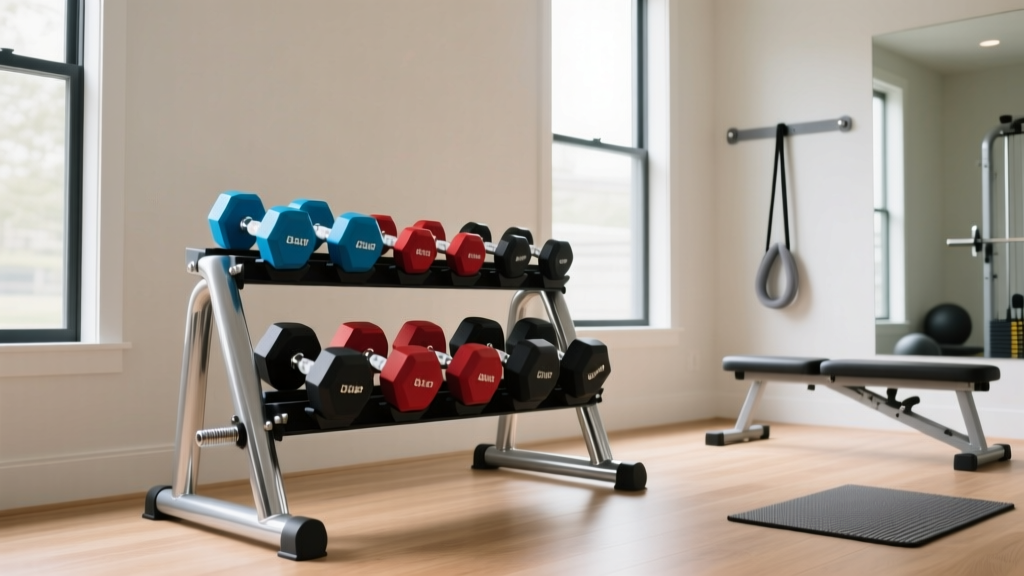
Smart Storage for Strength Training at Home With Dumbbells
Maximize your workout space with the best dumbbell racks and storage solutions for strength training at home with dumbbells. Expert layout tips inside.

The Spatial Reality of Home Dumbbell Training
When committing to strength training at home with dumbbells, the most overlooked bottleneck is not the weight of the iron, but the footprint of the storage. A complete set of rubber hex dumbbells ranging from 5 to 50 pounds (in 5-pound increments) consists of 20 individual dumbbells. Left on the floor, this creates a severe tripping hazard and effectively destroys the usable square footage of your gym. Proper space optimization requires treating your dumbbell rack not just as a storage unit, but as a structural anchor in your room's layout.
The Minimum Clearance Formula
According to ergonomic guidelines supported by the American Council on Exercise (ACE), a safe home gym layout requires a minimum 'strike zone' of 6 feet wide by 8 feet long for floor-based dumbbell movements. Your storage solution must exist outside this zone, while still allowing 18 inches of clearance in front of the rack for safe loading and unloading of heavy weights.
Storage Matrix: Tiered vs. A-Frame vs. Wall-Mounted
Choosing the right rack depends entirely on your room's geometry. Below is a comparison of the three primary storage architectures available in 2026, analyzing their spatial efficiency and structural integrity.
| Rack Architecture | Footprint (W x D) | Max Capacity | Best Layout Scenario | Avg. Price Range |
|---|---|---|---|---|
| 3-Tier Horizontal | 34' x 22' | 1,000+ lbs | Garage bays, dedicated rooms | $250 - $400 |
| A-Frame Vertical | 24' x 14' | 600 lbs | Tight corners, spare bedrooms | $80 - $150 |
| Wall-Mounted Cradles | Varies (0' floor depth) | 300 lbs (per stud) | Studio apartments, multi-use spaces | $120 - $200 |
Top Tier Storage Solutions for 2026 Layouts
To achieve true space optimization, you must match the equipment to the environment. Here is a deep dive into the most effective storage systems currently on the market, evaluated on structural gauge, spatial footprint, and long-term durability.
1. The Garage Standard: Rogue 3-Tier Dumbbell Rack
For those with a dedicated garage gym or a basement setup, the Rogue 3-Tier Dumbbell Rack remains the gold standard. Constructed from 11-gauge steel, it features a 34-inch width and a 22-inch depth. The critical design feature here is the UHMW plastic lining on the shelves, which protects the knurling and rubber coating of your dumbbells from tearing upon impact.
- Spatial Advantage: The 22-inch depth is shallow enough to push against a wall while leaving room for baseboard heaters and outlets.
- Edge Case Warning: If you own urethane-coated dumbbells with wide heads (like some Eleiko or Ivanko models), verify the shelf width. Standard 3-tier racks accommodate heads up to 7 inches wide; wider heads will overlap and scratch.
2. The Space-Saver: A-Frame Racks (Yes4All & Core Home Fitness)
A-Frame racks utilize verticality over horizontality, occupying a mere 24 by 14-inch footprint on the floor. They are ideal for spare bedrooms or living room corners where floor space is premium. However, as noted by equipment testing experts at Garage Gym Reviews, A-frames introduce a distinct center-of-gravity risk.
'The primary failure mode of budget A-Frame racks is forward-tipping. If a user loads 50-pound dumbbells on the top tier while the bottom tier remains empty, the rack's center of mass shifts outside its base of support, creating a severe tipping hazard during extraction.'
Optimization Tip: Always load A-Frame racks from the bottom up. Place your heaviest dumbbells (35-50 lbs) on the lowest tier, and your lightest (5-15 lbs) on the top tier to maintain a grounded center of gravity.
3. The Zero-Footprint Solution: Wall-Mounted Cradles
If your home gym doubles as a home office or guest room, floor space is non-negotiable. Wall-mounted dumbbell cradles, such as the Rep Fitness PR-4000 Dumbbell Holder attachments or standalone heavy-duty steel wall brackets, eliminate the floor footprint entirely.
- Stud Finding is Mandatory: You must mount these directly into 16-inch-on-center wooden studs or use toggle bolts rated for 250+ lbs in drywall. Never use standard drywall anchors for dynamic weight loading.
- Height Placement: Mount the heaviest cradles at hip-height (approx. 36 inches from the floor) to minimize spinal shear force when picking up and racking heavy loads.
Layout Frameworks by Square Footage
Optimizing your room requires a deliberate layout strategy. Use these frameworks based on your available square footage to ensure safe, unobstructed strength training at home with dumbbells.
Framework A: The 50 Sq. Ft. Bedroom Corner
Equipment: Adjustable dumbbells (e.g., PowerBlock Elite or Nuobell) + Wall-mounted shelf.
Strategy: Adjustable dumbbells reduce 10 pairs of weights into a single 18x8 inch footprint. Mount a heavy-duty floating shelf at waist height in the corner of the room. Lay down a single 4x6 foot horse stall mat (3/4-inch thick vulcanized rubber) to protect the flooring and dampen acoustic vibration. This leaves 80% of the room completely open for movement.
Framework B: The 150+ Sq. Ft. Garage Bay
Equipment: Full rubber hex set (5-50 lbs) + 3-Tier Horizontal Rack.
Strategy: Position the 3-tier rack against the longest uninterrupted wall. Leave exactly 18 inches of clearance in front of the rack. Place your adjustable bench 4 feet away from the rack, parallel to it. This creates a 'corridor' of movement, allowing you to grab weights, step back, and perform walking lunges or goblet squats without hitting walls or tripping over the rack's feet.
Critical Failure Modes and Safety Edge Cases
⚠️ Avoid the 'Rubber Degradation' Trap
If your storage rack is placed in a garage or shed that experiences high UV exposure or extreme temperature fluctuations, avoid storing cheap PVC-filled or low-grade rubber dumbbells on the top tier. UV rays and heat cause cheap rubber to dry rot, crack, and eventually split open, spilling concrete or sand onto your floor. Store premium urethane or cast-iron dumbbells on open-tier racks, and keep rubber hex sets in climate-controlled environments or covered with a UV-resistant tarp when not in use.
Another common layout failure is acoustic coupling. If your dumbbell rack is pushed flush against a shared wall (especially in a townhouse or multi-story home), the metallic 'clink' of racking heavy weights will transmit directly through the studs. Always leave a 1-inch gap between the rack and the drywall, and place a high-density foam pad behind the rack's uprights to decouple the vibration.
Expert FAQ: Dumbbell Storage & Space Optimization
Can I store my adjustable dumbbells on a standard 3-tier hex rack?
No. Standard 3-tier racks are designed for the cylindrical or hexagonal ends of traditional dumbbells. Adjustable dumbbells (like Bowflex SelectTech or PowerBlock) have square or elongated profiles that will not sit securely on tiered shelves, creating a severe fall hazard. Always use the manufacturer's specific storage tray or a flat, reinforced utility bench.
What is the best flooring to put under a heavy dumbbell rack?
A fully loaded 3-tier rack can easily exceed 800 pounds, concentrating massive point-load pressure on its four feet. Do not place this directly on luxury vinyl plank (LVP) or hardwood, as it will dent and crack the subfloor. Use 3/4-inch thick vulcanized rubber horse stall mats underneath the rack to distribute the weight and protect your flooring.
How do I organize dumbbells for the fastest workout transitions?
Organize your rack by movement priority, not just numerical order. Place the weights you use for your heaviest compound movements (typically 25-40 lbs for goblet squats and floor presses) at waist height on the middle tier. Place lighter isolation weights (10-15 lbs for lateral raises) on the top tier, and heavy odd-objects or grip-work dumbbells on the bottom. This minimizes bending and reaching during high-intensity circuits.
More gear to consider
All reviews
Loadable Biceps Dumbbell Setups: 2026 Budget & Value Analysis

Loadable Dumbbells & The Sitting Dumbbell Curl: 2026 Cost Analysis

EZ Bar vs Straight Bar & Dumbbell Bench Press or Floor Press

2026 Trend: Loadable Dumbbells for Leg Day Dumbbells Only Routines
Good Shoulder Exercises With Dumbbells: Loadable Plate Layouts
