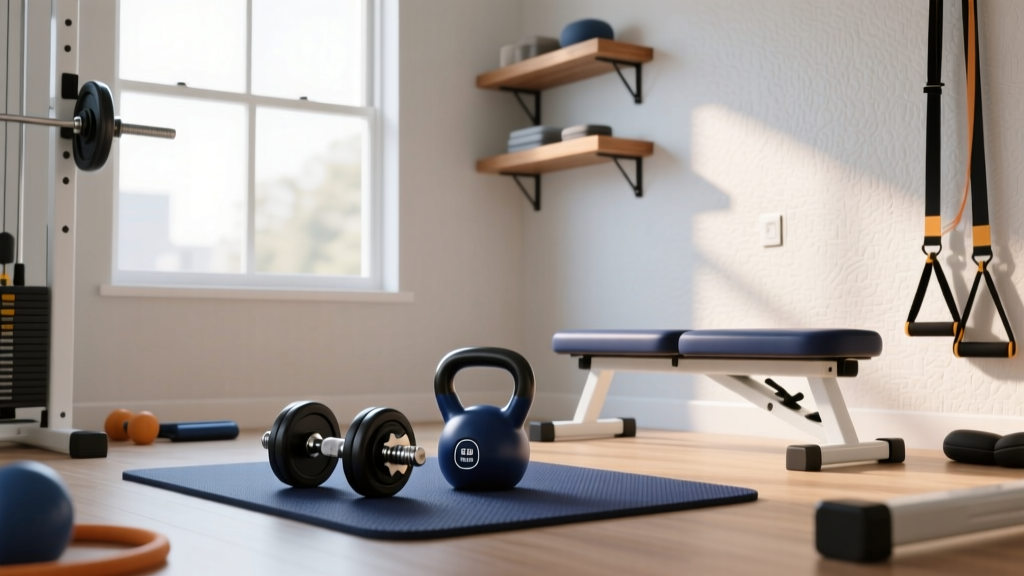
Compact Senior Gyms: Dumbbell Squats for Seniors & Kettlebell Buying Guide
Discover space-saving layout designs for senior home gyms, featuring safe zones for dumbbell squats for seniors and a cast iron vs competition kettlebell guide.

The Spatial Reality of Senior Home Gyms
Designing a home gym for aging adults requires a radical departure from standard fitness layout principles. When optimizing for seniors, the primary metrics shift from maximum equipment density to fall prevention, spatial predictability, and joint-friendly biomechanics. According to the CDC's STEADI (Stopping Elderly Accidents, Deaths & Injuries) initiative, environmental hazards and cluttered pathways are leading contributors to falls in older adults. Therefore, a space-optimized senior gym is not just about saving square footage; it is about engineering a safe, unobstructed environment that encourages consistent movement.
In this comprehensive layout guide, we will explore how to safely integrate lower-body functional training—specifically focusing on the spatial requirements for dumbbell squats for seniors—while navigating the nuances of our kettlebell buying guide: cast iron vs competition models. By understanding the physical footprints, storage dimensions, and ergonomic profiles of these free weights, you can design a compact, highly effective training zone that respects the unique physiological and spatial needs of older adults.
Spatial Mapping for Dumbbell Squats for Seniors
The squat is a foundational movement pattern essential for maintaining independence, directly translating to the ability to rise from a chair or toilet. However, executing dumbbell squats for seniors in a home environment requires careful spatial planning to accommodate mobility aids, caregivers, and balance recovery zones.
The "Anchor & Clearance" Layout Protocol
Unlike traditional barbell squats that require a massive 4x4 foot power rack (which introduces severe trip hazards and visual clutter), dumbbell squats rely on a decentralized footprint. To optimize space while maintaining safety, implement the Anchor & Clearance protocol:
- The Anchor Point: Position a heavy-duty, flat utility bench or a reinforced wooden chair against a load-bearing wall. This serves as the tactile "bottom" of the squat (sit-to-stand progression) and provides a psychological safety net.
- The 360-Degree Clearance Zone: You must maintain a minimum 6x6 foot open rubberized zone around the anchor. This allows a caregiver or physical therapist to stand adjacent to the senior without crowding their proprioceptive space.
- Weight Storage Proximity: Adjustable dumbbells must be stored on a low-profile rack no higher than 24 inches from the floor, positioned exactly two steps away from the anchor point to minimize carrying heavy loads over distance.
For senior home gyms, avoid dial-based adjustable dumbbells with fragile plastic cages. Opt for the Nuobell 80 (approx. $429/pair in 2026) or PowerBlock Sport 24. Their solid steel construction and compact, blocky footprint prevent the awkward weight distribution that can strain senior wrists during the pick-up phase of the squat.
Kettlebell Buying Guide: Cast Iron vs Competition in Compact Spaces
While dumbbells are excellent for bilateral loading, kettlebells offer an offset center of mass that is unparalleled for building core stabilization and grip strength in aging populations. However, when space optimization is the goal, the physical dimensions of the kettlebell dictate your storage solutions and the senior's biomechanical consistency. This brings us to a critical juncture in our kettlebell buying guide: cast iron vs competition models.
The Cast Iron Conundrum: Variable Dimensions
Traditional cast iron kettlebells (like the popular Rogue Powder Coat series, ranging from $40 to $130 depending on weight) are manufactured by pouring molten iron into molds. As the weight increases, the physical size of the bell, the thickness of the handle, and the width of the "horns" increase proportionally.
The Senior Failure Mode: For an older adult with declining proprioception and joint stiffness, this variability is a significant drawback. A senior mastering the goblet squat with a 10kg cast iron bell will experience a completely different handle diameter and horn spacing when they progress to a 14kg bell. This forces the wrist and elbow into new, unpracticed angles, increasing the risk of tendinitis and disrupting spatial memory. Furthermore, cast iron bells have varied base diameters, making them notoriously difficult to organize on narrow, wall-mounted shelving units.
The Competition Advantage: Uniform Predictability
Competition kettlebells (such as those from Kettlebells USA or Onnit, typically $110 to $180 per bell) are engineered to exact International Kettlebell Sport Federation (IKSF) standards. Regardless of whether the bell weighs 8kg or 32kg, the dimensions are strictly locked at 280mm in height and 210mm in width, with a uniform handle diameter of 33mm.
The Space & Ergonomic Benefit: From a layout perspective, competition bells are a space-optimizer's dream. Their uniform 210mm base allows for the installation of precise, flush-mounted wall shelves that can hold an entire senior progression set (e.g., 8kg, 12kg, 16kg) in a perfectly straight, predictable line. Ergonomically, the 33mm handle and consistent window size mean the senior's grip mechanics never change, allowing them to focus entirely on the movement pattern rather than adjusting to a new piece of equipment.
"Uniform equipment dimensions are critical for older adults. When the physical interface of the tool remains constant, the brain can dedicate more neural resources to balance and postural control rather than grip recalibration."
— Adapted from principles in the National Institute on Aging (NIA) Exercise Guidelines
Equipment Footprint & Senior Usability Matrix
To assist in your spatial planning, refer to the following comparison matrix detailing how these free weights interact with a compact senior home gym layout.
| Equipment Type | Physical Footprint / Dimensions | Spatial Predictability for Seniors | Optimal Space-Saving Storage |
|---|---|---|---|
| Adjustable Dumbbells (e.g., Nuobell 80) | 15" x 8" x 7" (per pair on cradle) | High (if block-style); handle remains constant. | Low-profile floor cradle tucked under bench. |
| Cast Iron Kettlebells (e.g., Rogue Powder Coat) | Variable (Base ranges from 5" to 8" wide) | Low. Handle thickness and horn width change with weight. | Heavy-duty floor rack; difficult to wall-mount safely. |
| Competition Kettlebells (e.g., Kettlebells USA) | Uniform 8.2" x 11" (210mm x 280mm) | Exceptional. 33mm handle and identical window size. | Flush wall-mounted shelving; highly organized. |
Layout Flow & Fall Prevention Strategies
Integrating the right equipment is only half the battle; the flow of the room dictates safety. When mapping out a space for dumbbell squats for seniors and kettlebell swings, adhere to these 2026 layout standards:
- Flooring Thickness: Avoid standard 3/4-inch horse stall mats. The thick seams create severe trip hazards for shuffling feet. Instead, install 3/8-inch vulcanized rubber interlocking tiles with a 50% bevel edge ramp at the doorway. This provides ample shock absorption for dropped kettlebells while maintaining a wheelchair- and walker-friendly transition.
- The "Triangle of Safety": Arrange the room in a triangle. Point A is the Anchor (chair/bench for squats). Point B is the Weight Storage (wall-mounted competition bells). Point C is the Open Movement Zone (minimum 8x8 feet for kettlebell deadlifts or carries). Never place storage racks in the direct line of sight or walking path between the Anchor and the Open Zone.
- Visual Anchoring: Install a shatterproof acrylic mirror on the wall facing the Anchor Point. This is not for vanity; it provides vital spatial feedback for seniors with peripheral vision degradation, allowing them to monitor their spinal alignment during dumbbell squats without twisting their necks.
2026 Cost & Space-to-Value Analysis
When budgeting for a space-optimized senior gym, consider the longevity and spatial efficiency of your investment. A full set of cast iron kettlebells (8kg to 20kg) might cost around $350, but the floor space required for a multi-tiered rack (approx. 4 square feet) and the ergonomic inconsistency makes it a poor choice for aging joints. Conversely, investing $360 in three core Competition Kettlebells (8kg, 12kg, 16kg) from a brand like First Place Fitness allows for sleek, zero-footprint wall storage and guarantees biomechanical consistency. Paired with a $429 set of adjustable dumbbells, you can fully equip a highly functional, 10x10 foot senior home gym for under $1,000, prioritizing safety, spatial flow, and joint longevity above all else.
More gear to consider
All reviews
Olympic vs Standard Plates: Does Size Affect Dumbbell Rows Form?
EZ vs Straight Bar Maintenance & How to Work Out Lats With Dumbbells
Olympic vs Standard Plates for Your 100 Pound Dumbbell Press
Olympic Barbell Buying Guide & Trapezius Workout with Dumbbells

Bumper vs Iron Plates: Space Layouts & Leg Day Workout With Dumbbells
