How to Exercise Shoulders with Dumbbells: Rack Guide
Learn how to exercise shoulders with dumbbells safely. We compare power racks, squat racks, and squat stands for your home gym shoulder setup.

Bridging Dumbbell Shoulder Training and Home Gym Racks
If you are researching how to exercise shoulders with dumbbells, you have likely realized that building boulder shoulders requires progressive overload. Moving from 20-pound to 70-pound dumbbells introduces a unique set of logistical and safety challenges. Getting heavy dumbbells into the starting position for a seated overhead press, maintaining proper scapular retraction, and safely bailing out of a failed rep all require a dedicated, stable environment.
While barbells often steal the spotlight in home gym discussions, dumbbell shoulder work demands specific rack configurations. A rack provides a spotter-equivalent safety system, an anchor for adjustable benches, and vital storage for your growing dumbbell collection. In this step-by-step beginner guide, we will break down the best dumbbell shoulder movements and critically compare a power rack vs squat rack vs squat stand to help you choose the exact setup for your 2026 home gym.
Biomechanics Alert: The shoulder joint (glenohumeral joint) is highly mobile but inherently unstable. According to the Cleveland Clinic, improper overhead pressing mechanics can easily lead to shoulder impingement syndrome. A stable rack-and-bench setup ensures your torso remains locked at a 75-to-90-degree angle, preventing lower back hyperextension and isolating the medial and anterior deltoids.Step 1: Master the Core Dumbbell Shoulder Movements
Before investing in steel, you must understand the spatial requirements of your workouts. Here is how to exercise shoulders with dumbbells using the three foundational movements, along with their specific rack-space needs:
- Seated Dumbbell Overhead Press: The primary mass builder. Requires an upright bench (75-85 degrees). Rack Need: Lateral safety spotter arms are critical here. If you fail a rep with 70lb dumbbells, you cannot safely drop them behind you without risking clavicle or rotator cuff injury.
- Standing Dumbbell Lateral Raises: Essential for medial deltoid width. Rack Need: Requires clearance. If your rack is too narrow (e.g., 43-inch interior), your elbows will clip the uprights during the eccentric phase.
- Chest-Supported Rear Delt Flyes: Performed face-down on an incline bench. Rack Need: Requires a rack long enough to accommodate an incline bench setup without the barbell safeties getting in the way.
Step 2: Evaluating Your Rack Options for Dumbbell Training
Not all racks are created equal when it comes to dumbbell work. Below is a comparison matrix tailored specifically for dumbbell shoulder training in the current 2026 equipment market.
| Feature | Power Rack (Full Cage) | Squat Rack (Half-Rack) | Squat Stand |
|---|---|---|---|
| Footprint | Large (approx. 48" x 48") | Medium (approx. 48" x 30") | Small (approx. 24" x 24") |
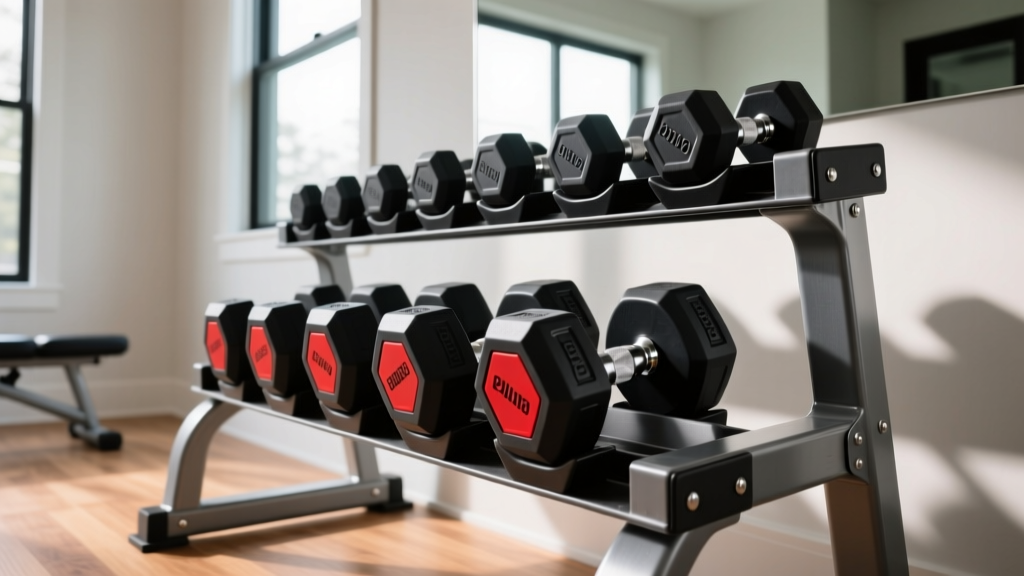
| DB Storage Integration | Excellent (Multiple peg options) | Good (Horn attachments available) | Poor (Limited vertical space) |
| Seated Press Safety | Maximum (4-point safety straps/bars) | High (Front spotter arms) | Dangerous (No lateral safeties) |
| Elbow Clearance | High (49" interior width standard) | Unrestricted (Open sides) | Unrestricted (Open sides) |
| 2026 Avg. Price Range | $650 - $1,400 | $450 - $900 | $180 - $350 |
Step 3: Deep Dive into Rack Types (With 2026 Model Examples)
The Power Rack (Full Cage)
A full power rack is the undisputed champion for heavy dumbbell shoulder work. Models like the Titan T-2 Power Rack or the Rogue RM-390F feature 3x3-inch 11-gauge steel uprights with a 49-inch interior width. This width is crucial: it allows you to sit on a standard 48-inch bench and perform lateral raises or overhead presses without your elbows striking the steel uprights.
Furthermore, full cages allow you to install safety spotter straps at waist height. If you fail a heavy seated dumbbell press, you simply drop the weights onto the straps, saving your shoulders from extreme eccentric tearing. You can also attach dumbbell storage pegs directly to the rear uprights, keeping your workout area clear of tripping hazards.
The Squat Rack (Half-Rack / Fold-Away)
Half-racks, such as the Bells of Steel Fold-Away Rack, offer a brilliant compromise for garage gyms with limited square footage. When folded against the wall, they protrude only about 4 inches. For dumbbell shoulder training, half-racks provide front-facing spotter arms. While not as encompassing as a full cage, they allow you to position an adjustable bench just inside the arms, providing a safe bail-out zone for overhead pressing.
"The primary failure mode of half-racks for dumbbell work is weight storage. Because they lack a full rear cage, adding heavy dumbbell storage horns can make the unit front-heavy. Always ensure your half-rack is bolted to a reinforced wall stud or concrete floor before loading 100+ lbs of dumbbells onto front-facing horns."
The Squat Stand
Squat stands like the Rogue SML-1 Monster Lite Squat Stand are phenomenal for barbell squats and bench presses in tight spaces. However, they are highly discouraged for heavy seated dumbbell shoulder presses. Squat stands lack lateral safety mechanisms. If you lose your balance backward while pressing 60-pound dumbbells overhead, there is nothing to catch the weights, leading to a high risk of severe shoulder or neck injury. Use squat stands for standing lateral raises and front raises, but move to a flat floor for heavy seated pressing if a full rack is unavailable.
Step 4: Configuring Your Rack for Shoulder Day
Follow this step-by-step setup to optimize your rack for a safe, effective dumbbell shoulder session. The Mayo Clinic's Weight Training Guidelines emphasize the importance of controlled breathing and joint alignment, which starts with your physical setup.
- Set the Bench Angle: Adjust your FID (Flat/Incline/Decline) bench to 75 or 80 degrees. A perfectly vertical 90-degree bench forces the humerus to impinge against the acromion process during the press.
- Position Safety Straps (Power Rack Only): Set the safety spotter straps roughly 6 inches below your bottom pressing position. This allows you to drop the weights safely if your triceps fail, without the straps interfering with your range of motion.
- The "Knee-Kick" Technique: For dumbbells over 50 lbs, do not attempt to curl them up to your shoulders. Sit on the bench, rest the dumbbells on your thighs, and use a forceful knee-kick to launch each dumbbell to your shoulders one at a time as you lean back.
- Clear the Perimeter: Ensure no loose weight plates or kettlebells are within a 4-foot radius of your bench. Dropped dumbbells will bounce and roll, creating a severe ankle-sprain hazard.
Frequently Asked Questions
Can I build massive shoulders using only dumbbells and a squat stand?
Yes, but with caveats. A squat stand is perfectly fine for standing overhead presses, lateral raises, and upright rows. However, as you advance, the seated dumbbell press becomes vital for isolating the anterior deltoid without lower-back fatigue. Without a power rack or half-rack to provide safety arms, you will eventually hit a ceiling on how heavy you can safely press while seated.
What is the best dumbbell storage attachment for a power rack?
Look for "saddle" style dumbbell storage pegs rather than straight smooth pegs. Saddle pegs (often sold by Titan Fitness and Rogue) cradle the hexagonal heads of rubber or urethane dumbbells, preventing them from sliding off the rack when you are aggressively racking or un-racking adjacent weights.
How much space do I need around my rack for dumbbell lateral raises?
You need a minimum of 24 inches of clearance on the left and right sides of your rack. If you are using a 43-inch interior width rack (common with 2x2-inch upright budget models), you will likely need to step completely outside the cage to perform standing lateral raises with a full range of motion without clipping the steel uprights.
More gear to consider
All reviews
Sam's Club Dumbbells: Rubber Hex vs Urethane Space Guide
Best Dumbbell Weight for Beginners: Rubber vs Urethane 2026 Trends

EZ vs Straight Bar Care for Overhead Cable Dumbbell Extensions

Standard vs Olympic Plates: Optimizing the Dumbbell Triceps Pushdown
Barbell Collar Comparison: Securing the Dumbbell Row Without Bench