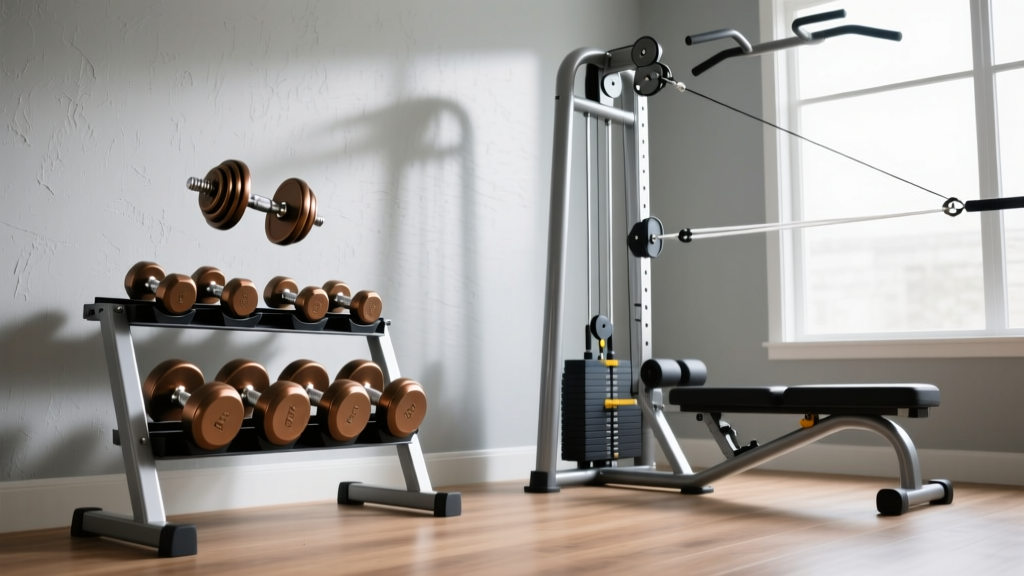
Dumbbell Rows vs Cable Rows: Budget & Dumbbell Rack Value Guide
Choosing between dumbbell rows vs cable rows? We break down the true budget, space footprint, and dumbbell rack storage solutions to maximize home gym value.

When building a home gym, the debate over dumbbell rows vs cable rows usually centers on biomechanics, muscle activation, and joint health. Fitness experts and publications like BarBend frequently highlight that while cable rows offer constant tension and a fixed path, dumbbell rows demand core stabilization and allow for a greater range of motion. However, there is a massive, often overlooked factor in this decision: the economics of equipment storage.
If you choose to prioritize free weights for your back training, you are not just buying dumbbells; you are committing to the spatial and financial footprint of dumbbell rack and storage solutions. Conversely, opting for cable rows means investing in a functional trainer or lat pulldown machine. In 2026, with home gym real estate at a premium and steel prices fluctuating, analyzing the budget breakdown and value proposition of your storage infrastructure is just as critical as the exercise selection itself.
The True Cost of Free Weight Back Training
To perform heavy, progressive dumbbell rows, you need a comprehensive set of dumbbells ranging from 20 lbs to 100+ lbs. A full commercial-grade fixed hex dumbbell set (5 to 100 lbs in 5 lb increments) will cost between $1.50 and $2.50 per pound. For a 400-pound set, you are looking at $600 to $1,000 just for the weights. But leaving these on the floor is a tripping hazard, degrades the rubber or urethane coating, and makes weight changes inefficient.
This is where dumbbell rack and storage solutions become a mandatory line item in your budget. A high-quality rack is not merely an organizational tool; it is a structural necessity designed to handle dynamic loading, prevent floor damage, and protect your equipment investment. Let us break down the storage solutions by budget tier to help you maximize your home gym's value.
Dumbbell Rack and Storage Solutions: A Tiered Budget Breakdown
Tier 1: The Space-Saver A-Frames (Under $175)
For garage gyms where square footage is dictated by parked cars and lawnmowers, the A-Frame rack is the undisputed king of spatial efficiency. The Rep Fitness A-Frame Dumbbell Rack (priced around $149) is a benchmark in this category. Constructed from 14-gauge steel, it holds up to 10 pairs of dumbbells while occupying a footprint of just 2.2 square feet.
Expert Insight: The A-Frame Trade-offWhile A-frames save floor space, their vertical stacking means you must squat or bend deeply to retrieve heavier pairs from the bottom tiers. If your dumbbell row routine involves heavy drop-sets (e.g., dropping from 80 lbs to 50 lbs to 30 lbs), the ergonomic friction of an A-frame can disrupt your workout flow compared to a horizontal tier system.
Tier 2: The Commercial Horizontal Standard ($250 - $450)
If you have a dedicated 10x10 room and prioritize ergonomic weight selection, a 3-tier horizontal rack is the gold standard. The Rogue Fitness 3-Tier Dumbbell Rack remains the industry benchmark in 2026. Built from 11-gauge steel with 3x3-inch uprights, it boasts a weight capacity exceeding 1,000 lbs. Priced between $295 and $395 (depending on the number of pairs it holds), it features laser-cut UHMW plastic liners to protect your dumbbell handles from scratching.
- Pros: Unmatched durability, easy weight visibility, commercial-grade 11-gauge steel, modular expandability.
- Cons: Large footprint (approx. 12 to 15 square feet), heavy shipping weight, premium price point.
Tier 3: Wall-Mounted and DIY Solutions (Under $100)
For the ultra-budget-conscious lifter who still wants the benefits of dumbbell rows without the floor footprint of a rack, wall-mounted brackets or custom-built wooden tiered shelves are viable. Heavy-duty steel wall brackets (rated for 300 lbs per pair) cost about $40 to $60. However, this requires drilling into structural wall studs. Drywall anchors will inevitably fail under the sheer force of 50-pound dumbbells being slammed onto a bracket.
Storage Footprint vs. Cable Machine Economics
To truly evaluate the dumbbell rows vs cable rows debate from a budget and space perspective, we must compare the total cost of ownership for a free-weight storage setup against a dedicated cable machine. Below is a 2026 market comparison matrix.
| Equipment Setup | Est. Cost (Weights + Storage/Machine) | Floor Footprint | Maintenance & Upkeep |
|---|---|---|---|
| Fixed Dumbbells (5-50 lbs) + 3-Tier Rack | $850 - $1,100 | ~18 sq. ft. | Low (Wipe down, check bolts) |
| Adjustable Dumbbells (5-52 lbs) + A-Frame Stand | $550 - $700 | ~4 sq. ft. | Medium (Dial/pin mechanism care) |
| Entry-Level Functional Trainer (Cable Rows) | $1,200 - $1,800 | ~25 sq. ft. (plus clearance) | High (Cable fraying, pulley lube) |
The Space Multiplier Effect: Remember that a cable machine requires operational clearance. While the machine base might take up 25 square feet, you need an additional 15 to 20 square feet of clear floor space in front of it to perform bent-over cable rows or seated rows safely. Dumbbell racks, conversely, only require a 3-foot retrieval radius.
Critical Failure Modes in Dumbbell Storage
When budgeting for a dumbbell rack, do not simply buy the cheapest option on Amazon. Budget racks often suffer from catastrophic failure modes that can ruin your equipment or cause injury. According to equipment reviews aggregated by BarBend's rack testing database, structural integrity is paramount when storing hundreds of pounds of dead weight.
1. Welding Shear and Gauge Deception
Many sub-$100 horizontal racks advertise 'heavy-duty steel' but utilize 16-gauge or 18-gauge tubing. When loaded with 500+ lbs of iron, the horizontal support beams on these cheaper racks will begin to bow. Over time, the spot welds at the upright joints will experience shear stress and snap. Always look for a minimum of 14-gauge steel for A-frames and 11-gauge or 12-gauge steel for horizontal 3-tier racks.
2. Rubber Off-Gassing and Shelf Degradation
If you are storing rubber-coated hex dumbbells on a metal rack, the friction of picking up and dropping the weights will eventually tear the rubber. More importantly, cheap rubber off-gasses volatile organic compounds (VOCs) that can degrade the powder coating on lower-tier racks. Investing in a rack with UHMW (Ultra-High Molecular Weight) polyethylene liners on the shelves—not just the uprights—will extend the life of both your rack and your dumbbells.
3. Floor Joist Overloading
A fully loaded 3-tier dumbbell rack holding pairs from 10 to 100 lbs weighs over 1,100 lbs. Concentrating 1,100 lbs into a 12-square-foot footprint creates a massive point-load on your floor. If your home gym is on a second floor or over a crawlspace with standard 2x10 joists spaced 16 inches apart, this point load can cause structural sagging. Always place heavy horizontal racks perpendicular to the floor joists, directly over load-bearing walls, or on a ground-level concrete slab.
Final Verdict: Funding Your Back Day
The dumbbell rows vs cable rows debate ultimately comes down to your home gym's spatial and financial constraints. If you have the budget ($1,500+) and the square footage (50+ sq ft) for a high-quality functional trainer, cable rows offer unparalleled versatility and constant tension without the need for weight storage infrastructure.
However, if you are optimizing for pure value, space efficiency, and functional athleticism, free weights win. By investing in a robust, 11-gauge 3-tier dumbbell rack or a space-saving A-frame, you secure a lifetime storage solution that supports not just your dumbbell rows, but your presses, lunges, and goblet squats. Do not treat your dumbbell rack as an afterthought; treat it as the foundational anchor of your free-weight training ecosystem.
More gear to consider
All reviews
Power Rack vs Squat Rack vs Stand: Alternate Dumbbell Curl

Bicep Dumbbell Workouts: Troubleshooting & Adjustable Dumbbell Reviews

Barbell Collar Types: One Arm Dumbbell Bench Press Alternatives
Olympic vs Standard Plates Setup for Your Dumbbell Weekly Routine

Bumper vs Iron Plates: Budget Guide & Dumbbells for Back Muscles
