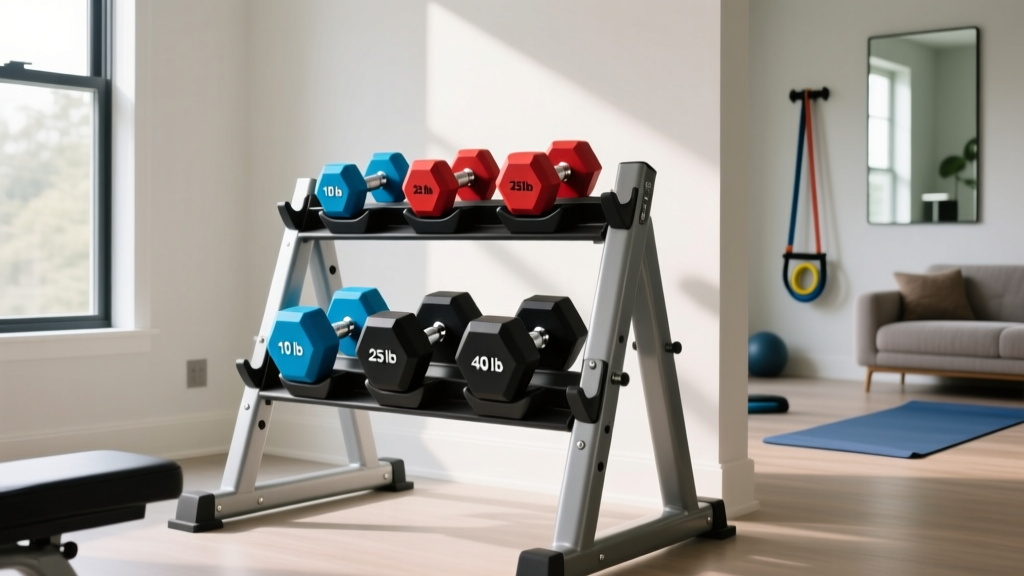
Best Dumbbell Racks for Bench Pressing with Dumbbells (2026)
Discover the best dumbbell racks to optimize bench pressing with dumbbells. Our 2026 hands-on review covers 3-tier, A-frame, and wall-mount storage.

There is a distinct, often overlooked danger zone in any home or commercial gym: the three seconds between picking up a heavy dumbbell from the floor and getting it into position for a press. When bench pressing with dumbbells in the 70 to 120-pound range, the initial pickup is essentially an awkward, unilateral deadlift that pre-fatigues your central nervous system and places immense shear force on your lumbar spine. A dedicated, ergonomically designed dumbbell rack isn't just about keeping your gym tidy; it is a critical piece of safety and performance equipment.
In this 2026 hands-on review, we evaluate the top dumbbell storage solutions specifically through the lens of the bench press setup. We tested shelf angles, liner materials, and footprint clearances to find the racks that seamlessly integrate with your flat or incline bench, allowing for the safest "knee-scoop" technique possible.
The Biomechanics of the Dumbbell Pickup (And Why Racks Matter)
According to kinesiology data from ExRx, the dumbbell bench press requires significant stabilization from the rotator cuff and anterior deltoids before the concentric phase even begins. If you are bending over to pick 90-pound hex dumbbells off a flat floor, you are exhausting your lower back and grip before your pecs do any work.
The "Knee-Scoop" Requirement
To safely initiate a heavy dumbbell bench press, you must sit on the edge of the bench, rest the dumbbell heads on your distal thighs, and use a controlled knee-kick to guide the weights to your shoulders as you roll back. A proper 3-tier dumbbell rack positions the middle tier exactly at knee-height when seated, allowing you to grab the handles with a neutral spine and zero lower-back flexion.
Key Specs for Bench-Adjacent Dumbbell Storage
Not all racks are created equal. Through our testing of over a dozen models this year, we identified three non-negotiable specifications for a rack that will sit adjacent to your weight bench:
- Shelf Angle (30 to 35 Degrees): Flat shelves are a liability. Heavy round or hex dumbbells can vibrate and roll off during heavy drops. A 35-degree incline keeps the weights seated securely against the backstop.
- UHMW Plastic Liners: Dropping steel or rubber-coated dumbbells onto bare steel shelves destroys the knurling and creates deafening noise. Ultra-High Molecular Weight (UHMW) polyethylene liners absorb impact and protect your equipment.
- Vertical Clearance (Minimum 7.5 Inches): Modern heavy-duty dumbbells (like PowerBlock or large urethane hex sets) have massive head diameters. Racks with tight 6-inch tier spacing will cause the handles to scrape against the shelf above.
Hands-On Reviews: Top 3 Dumbbell Racks for 2026
1. Rogue Fitness 3-Tier Dumbbell Rack (The Heavy-Duty Standard)
Rogue continues to dominate the commercial and high-end home gym space. Their 3-Tier Dumbbell Rack is built from 11-gauge steel and features a 35-degree shelf angle that perfectly aligns with a seated lifter's thighs. The UHMW plastic liners are pre-installed and cover the entire shelf depth, meaning you won't scrape your urethane dumbbells when racking them post-set.
Price: ~$495.00
Footprint: 35" x 33"
Max Capacity: 1,500+ lbs
Expert Take: "The weld quality on the Rogue 3-Tier is flawless. When bench pressing with dumbbells over 100 lbs, you need absolute confidence that the rack won't tip if you rack the weights aggressively. The 33-inch depth and wide base make this virtually immovable."
Pros:
- Commercial-grade 11-gauge steel construction
- Perfect 35-degree angle for the knee-scoop setup
- UHMW liners protect expensive knurling and urethane
Cons:
- Premium price point
- Heavy and difficult to move once assembled (135 lbs shipping weight)
2. Rep Fitness 3-Tier Dumbbell Rack (Best Value & Customization)
Rep Fitness has aggressively captured the 2026 market by offering 90% of Rogue's performance at a 30% discount. Their 3-Tier rack uses 12-gauge steel, which is slightly thinner but more than adequate for sets up to 120 lbs. The standout feature is the modular design; you can swap the top tier for a kettlebell tray or add a 4th tier for lighter neoprene sets.
Price: ~$349.00
Footprint: 34" x 29"
Max Capacity: 1,200 lbs
Pros:
- Excellent price-to-performance ratio
- Modular tier options (crumb rubber or UHMW liners available)
- Slightly narrower footprint for tight home gyms
Cons:
- 12-gauge steel exhibits minor flex under 1,500+ lb total loads
- Assembly takes slightly longer due to modular bolt-on brackets
3. Titan Fitness A-Frame Dumbbell Rack (The Space-Saver)
If your home gym lacks the 8-square-foot footprint required for a horizontal 3-tier rack, the Titan Fitness A-Frame is the premier vertical alternative. However, we must issue a caveat: A-frames are not ideal for heavy bench pressing setups. Because the weights are stored vertically, retrieving an 80 lb dumbbell from the bottom tier requires a deep squat or hinge, defeating the purpose of an ergonomic bench press setup. It is best suited for lighter sets (5-50 lbs) used for incline flyes or lateral raises.
Price: ~$249.00
Footprint: 24" x 30"
Max Capacity: 800 lbs
Pros:
- Minimal floor space required
- Great for organizing lighter accessory dumbbells
Cons:
- Poor ergonomics for heavy bench press dumbbell retrieval
- Center of gravity shifts dangerously if loaded unevenly
Comparison Matrix: Which Rack Fits Your Bench Press Setup?
| Feature | Rogue 3-Tier | Rep Fitness 3-Tier | Titan A-Frame |
|---|---|---|---|
| Steel Gauge | 11-Gauge | 12-Gauge | 11-Gauge |
| Shelf Angle | 35 Degrees | 30 Degrees | Vertical (90 Degrees) |
| Liner Material | UHMW Plastic | Rubber / UHMW Options | Bare Steel / Rubber Mat |
| Bench Press Ergonomics | Excellent (Knee-Scoop Ready) | Very Good | Poor (Requires Hinging) |
| 2026 Est. Price | $495 | $349 | $249 |
Pro Tips for Organizing Your Rack for Heavy Pressing
Buying the right rack is only half the battle. How you load it dictates the safety and flow of your workout. Follow this organizational framework:
- The Bottom Tier is for Heavy Compounds: Store your 60 lb to 120+ lb dumbbells here. This keeps the rack's center of gravity low, preventing tipping when you aggressively rack a heavy set after a grueling AMRAP set of bench presses.
- The Middle Tier is the "Strike Zone": Place your 35 lb to 55 lb dumbbells on the middle tier. This is the ergonomic sweet spot for grabbing weights while seated on the bench without twisting your thoracic spine.
- The Top Tier is for Accessories: Reserve the top shelf for 5 lb to 30 lb dumbbells used for tricep extensions, lateral raises, or bench press drop-sets.
- Maintain the 3-Inch Rule: Leave at least 3 inches of lateral space between dumbbell pairs. When your forearms are pumped and shaking after a heavy set of bench pressing with dumbbells, you need a wide margin of error to rack the weights safely without pinching your fingers.
Frequently Asked Questions
Can I just use a weight bench with an integrated dumbbell rack?
Generally, no. Benches with attached dumbbell racks usually feature a narrow, flat shelf situated directly under the bench pad. This design forces you to bend over and deadlift the weights from a low, flat surface, which is terrible for your lower back. Furthermore, the uprights of the integrated rack often interfere with your elbows during the eccentric phase of the bench press, limiting your range of motion.
Are wall-mounted dumbbell racks safe for heavy bench press sets?
Wall-mounted racks are excellent for light, neoprene, or vinyl-coated dumbbells (typically 5 to 25 lbs) used for rehab or high-rep accessory work. However, we strongly advise against wall-mounting heavy urethane or rubber hex dumbbells. The dynamic force of racking an 80 lb dumbbell can easily rip standard lag bolts out of drywall or even compromise wooden studs, creating a severe crush hazard in your gym.
How far should the dumbbell rack be placed from the bench?
Position the rack exactly 18 to 24 inches away from the head or side of your bench. This allows you to sit on the edge of the bench, reach out with a neutral spine to grasp the dumbbells, and pull them back to your thighs in one fluid motion without having to stand up, turn around, and walk back to the bench while holding 100+ lbs of dead weight.
More gear to consider
All reviews
Adjustable Dumbbells for a Strength Training Dumbbell Workout (2026)

Barbell Buying Guide: Knurling, Weight & Alternating Dumbbell Snatch

EZ Curl Bar vs Straight Bar: Arm Guide & Step Up with Dumbbell

Bumper vs Iron Plate Care: Beyond Dumbbell Max Bench Calculators
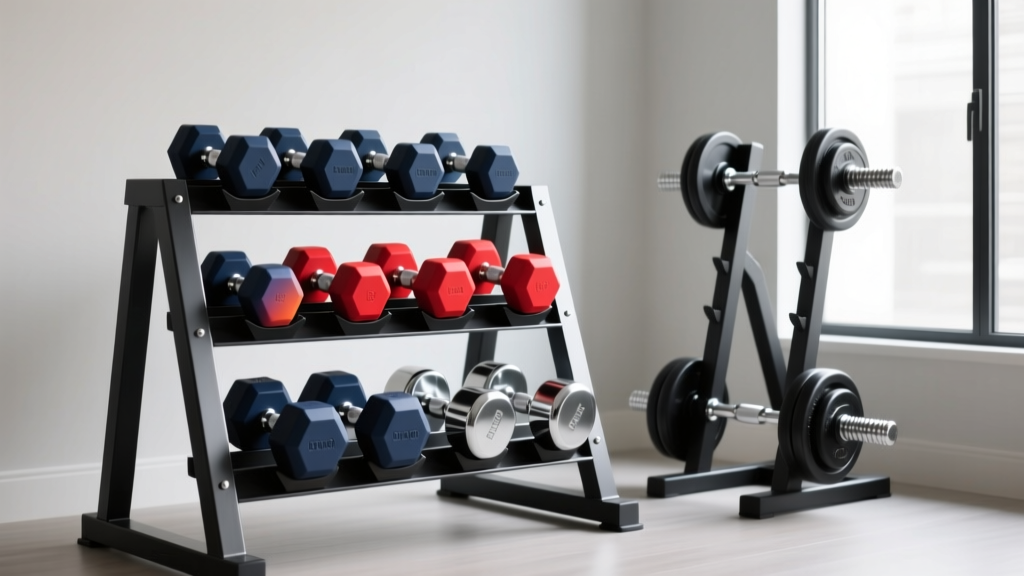
Essential Gym Dumbbells Accessories: Rack Maintenance & Storage Care
