Dumbbell Pectoral Exercises No Bench: Space-Saving Rack Layouts
Optimize your home gym for dumbbell pectoral exercises (no bench) with low-profile racks, floor clearance metrics, and space-saving storage layouts.

Many lifters assume that building a massive, well-developed chest requires a bulky flat or incline bench. However, if your 2026 training block focuses on dumbbell pectoral exercises no bench routines, your equipment layout must prioritize floor accessibility, ergonomic weight retrieval, and precise spatial geometry. As micro-gyms and apartment fitness setups continue to dominate home workout trends, the traditional bench has become the first piece of equipment to get cut. In its place, the floor press, floor flye, and squeeze press have emerged as elite hypertrophy builders that simultaneously protect the shoulder capsule and save precious square footage.
But removing the bench introduces a unique logistical challenge: how do you safely store, retrieve, and return heavy dumbbells when your primary working surface is the floor? Standard vertical dumbbell racks are designed for standing movements. For floor-based training, your storage solution must bridge the gap between heavy iron and ground-level ergonomics. This guide breaks down the exact layout metrics, low-profile rack models, and safety protocols required to optimize your space for benchless chest training.
The 'No-Bench' Floor Zone: Clearance & Layout Metrics
When designing a layout for floor-based pectoral work, you are no longer just storing equipment; you are designing a 'drop zone.' The spatial relationship between your dumbbell rack and your lifting mat dictates the safety and efficiency of your workout.
Calculating Your Floor Press Footprint
According to biomechanical guidelines for resistance training, lateral arm extension during a dumbbell floor flye requires significant clearance. For an average male lifter (5'9" to 6'0"), the wingspan with arms extended laterally is roughly 70 to 75 inches. Therefore, your minimum safe clearance zone is a 6-foot by 6-foot square.
- The Mat: Use a 3/4-inch thick vulcanized rubber horse stall mat (typically 4x6 feet). Thinner yoga or EVA foam mats will compress under the elbow during heavy floor presses, leading to joint bruising and unstable force transfer.
- The Rack Placement: Position your dumbbell rack exactly 18 to 24 inches from the edge of the mat. This specific distance allows you to sit on the edge of the mat, reach the dumbbells, and perform the 'thigh-pop' technique without overextending your lumbar spine.
- The Triangle Workflow: Your layout should form an equilateral triangle between the rack, your seated starting position, and your supine working position. Never place the rack directly behind your head, as retrieving heavy weights from behind the neck while seated on the floor is a primary cause of cervical strain.
Top Low-Profile Dumbbell Racks for Floor Accessibility
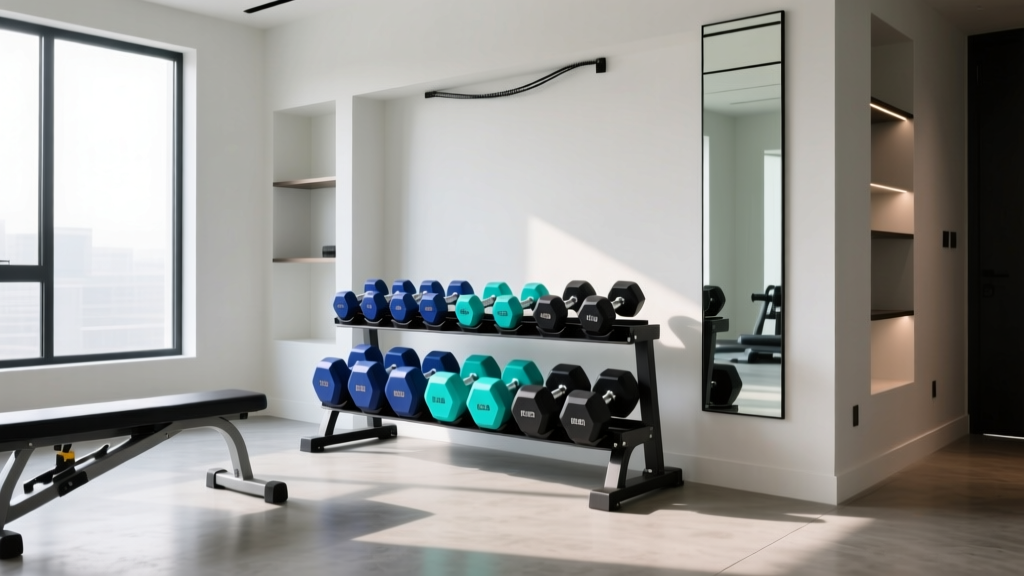
Not all dumbbell racks are created equal when it comes to floor work. A towering 5-tier commercial rack forces you to stand and bend down to grab weights, which is highly dangerous when you are fatigued and need to transition to the floor. For benchless routines, 2-tier and 3-tier low-profile racks are mandatory. Below is a comparison of the top models optimized for this specific workflow in 2026.
| Rack Model | Tiers | Capacity | Footprint (W x D) | Top Tier Height | Est. Price |
|---|---|---|---|---|---|
| Rogue 3-Tier Dumbbell Rack | 3 | 10 Pairs | 32" x 30" | 38" | $295 |
| Bells of Steel 2-Tier Rack | 2 | 6 Pairs | 24" x 22" | 25" | $149 |
| Titan Fitness 2-Tier Dumbbell Stand | 2 | 6 Pairs | 26" x 20" | 24" | $129 |
| CAP Barbell A-Frame Rack | 2 (Slanted) | 6 Pairs | 20" x 18" | 22" | $79 |
Why Top-Tier Height Matters for the 'Thigh-Pop'
The dumbbell floor press requires a specific setup technique to protect the rotator cuff. You must sit on the floor, rest the dumbbell heads on your thighs, and use your leg drive to 'pop' the weights backward as you roll into a supine position. If your rack's top tier is higher than 30 inches, lifting a 70 lb dumbbell from the rack to your seated thighs places excessive shear force on the lower back. The Bells of Steel 2-Tier and Titan 2-Tier models keep the heaviest weights below 25 inches, allowing for a safe, hip-hinge retrieval directly into the seated floor position.
Strategic Storage: Hex vs. Round & Mat Integration
When optimizing for floor exercises, the physical design of the dumbbells themselves dictates your storage solution.
Expert Insight: 'For floor-based pressing and flyes, rubber-coated hex dumbbells are vastly superior to urethane round dumbbells. Hex bells will not roll away when placed on the floor mid-set, and their flat edges allow for secure stacking on the mat during drop-sets or rest periods.'
If you are using hex dumbbells, consider integrating a horizontal floor tray alongside your primary rack. While vertical racks save floor space, a low-profile wooden or steel floor tray (typically 6 inches high) placed at the foot of your mat allows you to kick the dumbbells directly into the tray after a grueling set of floor flyes, eliminating the need to immediately stand up and re-rack heavy weights while fatigued.
⚠️ Safety Warning: The Rack-to-Floor TransitionNever attempt to lift heavy dumbbells directly from the floor into a floor press position by bending over and curling them up. According to guidelines published by the National Strength and Conditioning Association (NSCA), lifting heavy loads from the ground with a rounded thoracic spine is a primary mechanism for herniated discs. Always retrieve weights from a rack using a proper hip hinge, sit on your mat, and use the thigh-pop technique to position the weights.
Step-by-Step: The Perfect Floor Press Layout
To maximize space and safety in a room under 150 square feet, follow this exact layout sequence:
- Anchor the Mat: Place your 3/4" rubber mat against a load-bearing wall. This prevents the mat from sliding backward when you push your feet into the ground during heavy floor presses.
- Position the Rack: Place your 2-tier or 3-tier rack 18 inches to the right side of the mat (if right-hand dominant). Ensure the rack's rubber feet are on a hard surface, not overlapping the mat, to prevent tipping.
- Create a 'Drop Zone': Leave a 12-inch gap between the side of the mat and the wall. This is where you will safely roll the dumbbells after completing a set, keeping them out of your walking path.
- Organize by Tier: Store your heaviest pressing dumbbells (e.g., 60-90 lbs) on the bottom tier. Store lighter flye and accessory weights on the top tier. This lowers the center of gravity of the rack and prevents tipping when pulling heavy loads from the bottom.
Frequently Asked Questions (FAQ)
Can I do dumbbell flyes on the floor without a bench?
Yes, the dumbbell floor flye is an exceptional variation. Because the floor physically stops your elbows from dropping below your torso, it significantly reduces the risk of anterior shoulder capsule tears. However, you must use a thick rubber mat to prevent elbow bruising, and you will need to reduce the weight by roughly 15-20% compared to bench flyes due to the shortened range of motion and altered leverage.
What is the best dumbbell rack for a very small apartment?
For tight spaces where a traditional rack footprint is impossible, wall-mounted dumbbell cradles or vertical dumbbell trees (like the CAP Barbell Vertical Tree) are viable. However, for floor exercises, a vertical tree is dangerous as it requires bending and twisting to retrieve weights. A compact 2-tier rack like the Titan Fitness 2-Tier (26" x 20" footprint) remains the safest compromise between space-saving and floor-workout ergonomics.
How do I safely return heavy dumbbells to the rack after a floor set?
Do not roll onto your stomach and try to stand up with the weights. Instead, bring the dumbbells to your thighs, tuck your chin, and use your core to roll forward onto your knees. From the kneeling position, perform a controlled hip hinge to stand up, and immediately return the weights to the lowest available tier of your rack.
More gear to consider
All reviews
Power Rack vs Squat Rack vs Stand: The Fair Haired Dumbbell

Rack Longevity: Storing Weights After a Tricep Press with Dumbbells

Cast Iron vs Competition: Are Kettlebells Better Than Dumbbells?
Maintaining Loadable Dumbbells for Flawless Cross Body Dumbbell Curls

Olympic vs Standard Plates: Why Add a 30 lb Dumbbell Set?