Dumbbell Only Upper Body Workout Upgrade: Kettlebell Budget Analysis
Upgrade your dumbbell only upper body workout. We break down the budget, value, and ROI of cast iron vs competition kettlebells for your home gym.

The Limitations of a Dumbbell Only Upper Body Workout
If you have been strictly following a dumbbell only upper body workout routine, you are likely familiar with the bilateral symmetry and predictable center of mass that dumbbells provide. While excellent for traditional hypertrophy, dumbbells lack the offset load and thick, curved handles required to build elite grip strength and rotational core stability. According to research published by the National Institutes of Health (NIH), kettlebell training uniquely recruits posterior chain and stabilizer muscles that traditional dumbbells fail to activate to the same degree.
However, transitioning from dumbbells to kettlebells introduces a complex purchasing decision: Cast Iron vs. Competition. In 2026, with freight costs stabilizing but raw steel prices fluctuating, the budget breakdown between these two categories is more nuanced than ever. This guide provides a forensic value analysis to help you allocate your home gym budget effectively.
💡 Budget Pro-Tip: Never buy enamel-coated or painted cast iron kettlebells for dynamic movements. The finish will chip within 3 months of snatches, leaving sharp edges that tear calluses. Always opt for powder-coat or bare machined steel.Cast Iron Kettlebells: The Budget-Friendly Workhorse
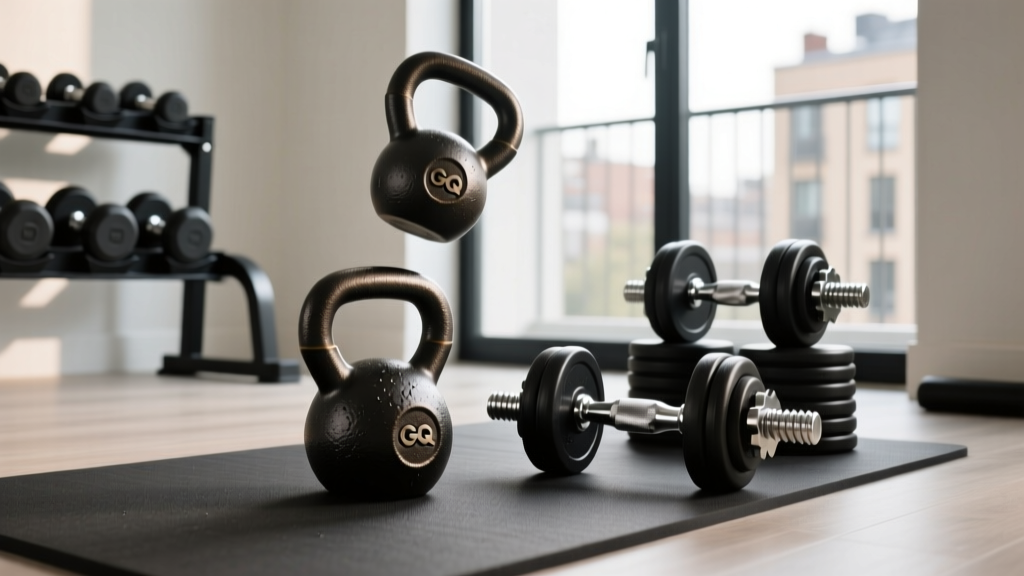
Cast iron bells are poured into sand or gravity molds. They are the traditional, teardrop-shaped weights you see in most commercial gyms. For lifters upgrading their dumbbell only upper body workout on a strict budget, cast iron offers the lowest barrier to entry.
Pricing Breakdown & Value
As of early 2026, high-quality cast iron kettlebells (from reputable brands like Rep Fitness or Rogue) cost between $1.60 and $2.50 per pound. A foundational set (16kg, 20kg, 24kg) will cost approximately $140 to $200, excluding shipping. This makes it an incredibly accessible entry point for home gym owners.
Edge Cases and Failure Modes
- Dimensional Inconsistency: Unlike competition bells, cast iron bells scale in physical size as the weight increases. A 12kg bell might have a 32mm handle diameter, while a 32kg bell features a 38mm diameter. This forces your grip to adapt to different thicknesses, disrupting muscle memory for cleans and snatches.
- Handle Pitting: Cheaper, mass-market cast iron bells often have rough, un-machined handles with microscopic pits from the sand-casting process. These act like cheese graters on your palms during high-rep ballistic work.
- Horn Width Variance: The distance between the horns (the sides of the handle) varies by brand and weight, making two-handed swings feel drastically different across your weight range.
Competition Kettlebells: The Premium Investment
Competition kettlebells are engineered to exact International Kettlebell Sport Federation (IKSF) standards. They are made from a hollow steel shell, filled with steel shot or sand to achieve the target weight. As StrongFirst notes, the primary advantage of competition bells is uniformity, which is critical for technical mastery and injury prevention.
Pricing Breakdown & Value
The premium manufacturing process commands a premium price. Expect to pay between $4.50 and $7.50 per pound in 2026. That same foundational 3-bell set (16kg, 20kg, 24kg) will cost between $380 and $550. While the upfront cost is steep, the cost-per-use over a decade of dedicated training remains highly justifiable for serious athletes.
The Uniformity Advantage
Every single competition kettlebell, from 8kg to 48kg, shares the exact same dimensions:
- Handle Diameter (Grip Thickness): Strictly 35mm.
- Handle Width (Inner Horns): Approximately 130mm.
- Total Height: 210mm.
- Body Diameter: 210mm.
When you master the rack position or the snatch drop on a 16kg competition bell, the exact same biomechanical groove applies to a 32kg bell. You are only adapting to the load, not the geometry.
Head-to-Head Value Matrix
| Feature | Cast Iron (Powder Coat) | Competition (Steel Shell) |
|---|---|---|
| Cost per Pound (2026) | $1.60 - $2.50 | $4.50 - $7.50 |
| Handle Consistency | Poor (Scales with weight) | Perfect (Always 35mm) |
| Durability | High (Solid iron) | Medium (Can dent if dropped on concrete) |
| Space Efficiency | Low (Larger bells take more space) | High (Uniform footprint) |
| Resale Value | ~50% of retail | ~75% of retail |
The Hidden Cost: Freight and Shipping Realities
When analyzing the budget breakdown of heavy iron, the sticker price is only half the equation. In 2026, freight surcharges for dense, compact items like kettlebells remain a significant factor. Cast iron bells are often shipped directly from foundries or massive distribution hubs, meaning shipping can add $30 to $60 to a multi-bell order. Competition bells, often imported from specialized steel manufacturers in Europe or Asia, may carry higher base shipping rates but are frequently subsidized by premium fitness brands to maintain a 'free shipping' threshold over $200. Always calculate the landed cost (Item Price + Shipping + Tax) before declaring one option cheaper than the other.
Integrating Kettlebells into Your Dumbbell Only Upper Body Workout
Once you have selected your kettlebell style based on your budget, it is time to replace specific dumbbell movements to exploit the offset center of mass. Here is how to upgrade your split:
1. The Bottoms-Up Press (Replaces DB Shoulder Press)
Hold the kettlebell upside down (handle facing the floor, bell resting on your forearm). Press overhead. This eliminates the stability crutch of a dumbbell and forces immense rotator cuff engagement and grip crushing. Start with a weight 30% lighter than your standard dumbbell press.
2. The Gorilla Row (Replaces DB Bent-Over Row)
Place two kettlebells between your feet in a wide sumo stance. Hinge at the hips and row one bell to your ribcage while pressing the other into the floor. The anti-rotational core demand far exceeds what a standard dumbbell row provides.
3. The Crush-Grip Floor Press (Replaces DB Chest Press)
Lie on the floor and press two kettlebells upward, actively squeezing the handles toward each other throughout the movement. This creates continuous adductor tension that dumbbells cannot replicate at the top of the range of motion.
Final Verdict: Where Should Your Money Go?
If your primary goal is general fitness, occasional swings, and you are strictly budget-constrained, powder-coated cast iron is the undisputed value champion. The cost-per-use over a decade of training is pennies, and it will easily survive decades of abuse.
However, if you are serious about kettlebell sport, high-rep ballistic conditioning, or you frequently train complex flows where handle geometry dictates your safety and performance, the competition kettlebell is a non-negotiable investment. The higher upfront cost is offset by superior resale value and the elimination of technical inconsistencies.
Upgrading from a dumbbell only upper body workout to a hybrid dumbbell-kettlebell routine is one of the highest-ROI decisions you can make for your home gym in 2026. Choose the tool that matches your biomechanical goals, and respect the budget math.
More gear to consider
All reviews
EZ Curl Bar vs Straight Bar: Space & Kettle Dumbbells

Loadable Dumbbell Care for Rear Delt Workouts with Dumbbells

Barbell Collar Types: Beyond the Walking Lunge with Dumbbells

Brachialis Dumbbell Workout: Dumbbell Rack Budget Guide

Dumbbell Shoulder Press Arnold vs Barbell: Weight & Knurling