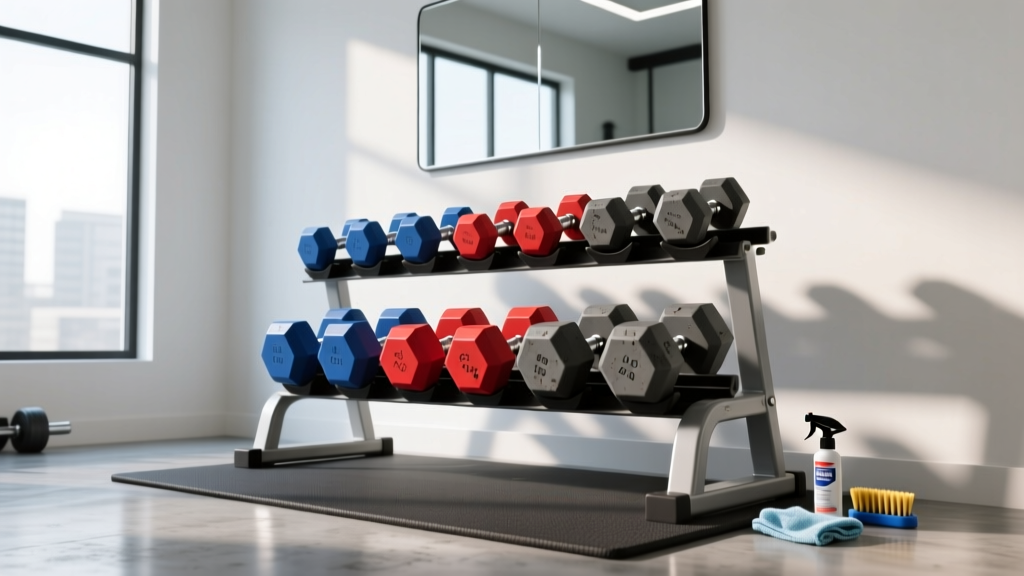
Dumbbell Front Squat Ergonomics: 2026 Rack Market Trends
Discover how the heavy dumbbell front squat is driving 2026 market trends in gym storage. We analyze 3-tier racks, pickup ergonomics, and top brands.

The Biomechanical Catalyst: Why the Dumbbell Front Squat is Reshaping Storage
Over the past few years, the fitness industry has witnessed a massive shift away from machine-based isolation work toward functional, free-weight movements. At the center of this renaissance is the dumbbell front squat. Unilateral and bilateral dumbbell front squats offer immense core stabilization benefits, reduced spinal compression compared to heavy barbell back squats, and superior carryover to athletic performance. However, as lifters push their dumbbell front squat PRs into the 80 lb, 100 lb, and even 120 lb per-hand territories, a critical bottleneck has emerged: the storage and retrieval of the weights.
In 2026, the market for dumbbell racks and storage solutions is no longer just about keeping the gym floor tidy. It is fundamentally being driven by the biomechanical demands of heavy compound lifts. Gym owners and home-gym enthusiasts are realizing that the limiting factor in a heavy dumbbell front squat is rarely leg drive; it is the initial pickup and the subsequent clean to the shoulders. This realization has triggered a market-wide pivot in rack design, material science, and footprint engineering.
📊 2026 Market Insight: The Death of the A-Frame
Commercial gym equipment buyers are actively phasing out vertical A-frame dumbbell racks. While A-frames save horizontal wall space, their bottom tiers sit at floor level. Picking up 90 lb dumbbells from the floor to prep for a front squat violates basic hip-hinge mechanics, leading to a spike in lumbar injuries. The 2026 market standard is now the reinforced, 3-tier horizontal rack with elevated bottom shelves.
Lumbar Shear Forces and the 'Pickup' Problem
To understand the 2026 storage trends, we must analyze the biomechanics of the weight pickup. According to kinesiology data from ExRx.net, lifting a heavy load from floor level (0 inches) with a rounded lumbar spine generates massive shear forces on the L4-L5 vertebrae. When an athlete prepares for a heavy dumbbell front squat, they must deadlift the weights to the hips before performing a power clean to the rack position on the shoulders.
If the dumbbell rack's bottom tier is at floor level, the athlete is forced into a deep, compromised squat or a rounded-back hinge just to grasp the handle. Modern ergonomic guidelines suggest that the optimal pickup height for heavy loads is between 12 and 18 inches off the ground. This allows the lifter to maintain a neutral spine, engage the lats, and drive through the heels. Consequently, rack manufacturers have redesigned their lowest tiers to sit precisely in this 12-to-15-inch sweet spot, fundamentally altering the structural geometry of modern storage units.
2026 Market Analysis: Top Rack Configurations Evaluated
The current market offers several configurations, but their suitability for heavy, squat-focused workflows varies wildly. Below is a comparative matrix of the dominant rack types available in 2026, evaluated specifically through the lens of heavy dumbbell front squat ergonomics and structural integrity.
| Rack Configuration | Bottom Tier Height | Max Load Capacity | Footprint (Sq Ft) | Front Squat Suitability |
|---|---|---|---|---|
| Vertical A-Frame | 0 - 4 inches | ~800 lbs | 4.5 | 2/10 (High Injury Risk) |
| 2-Tier Horizontal | 8 - 10 inches | ~1,200 lbs | 8.0 | 5/10 (Suboptimal Hinge) |
| 3-Tier Horizontal | 12 - 15 inches | 1,500 - 2,500 lbs | 12.5 | 9/10 (Ergonomic Standard) |
| Angled Display Tray | 10 - 14 inches | ~1,000 lbs | 9.0 | 7/10 (Good, but bounce risk) |
Brand Spotlight: Who is Winning the Heavy-Duty Storage War?
As the demand for ergonomic, high-capacity storage grows, three brands have emerged as the market leaders in 2026, each taking a distinct approach to engineering and pricing.
Rogue Fitness: The 3-Tier Standard
Rogue continues to dominate the commercial and high-end home gym space with their 3-Tier Dumbbell Rack. Constructed from 11-gauge steel and featuring heavy-duty gussets at every weld point, this rack is designed to withstand the inevitable 'drops' that occur when an athlete fails a 100 lb dumbbell front squat and must safely ditch the weights. The bottom tier sits at an optimal 14 inches, and the trays feature a slight 2-inch lip to prevent hex dumbbells from rolling off when dropped aggressively. Pricing in 2026 hovers around $695 to $895 depending on the length (3-tier vs. 5-tier capacity).
Eleiko: Ergonomic Angles and Premium Pricing
For boutique studios and Olympic lifting facilities, the Eleiko Sport Dumbbell Rack remains the gold standard. Eleiko's design philosophy prioritizes the user's wrist and shoulder health during the pickup phase. Their racks feature individually angled cradles rather than flat steel trays, allowing the lifter to grip the dumbbell handle in a neutral position without wrist extension before initiating the clean. This level of ergonomic detail commands a premium, with units frequently exceeding $1,450.
Rep Fitness: The Budget Commercial Contender
Rep Fitness has captured the garage-gym demographic by offering 90% of the performance of Rogue at 60% of the cost. Their 3-Tier Dumbbell Rack (priced around $399) uses 12-gauge steel and includes UHMW plastic liners on the shelves to protect rubber-coated dumbbells from tearing. While the welds may not withstand the daily abuse of a crowded commercial gym dropping 120 lb dumbbells, it is more than sufficient for the controlled home-gym environment.
The Drop Zone: Urethane vs. Rubber and Rack Tray Durability
A critical, often overlooked aspect of the dumbbell front squat workflow is the 'ditch'. When an athlete reaches muscular failure on the 10th rep of a heavy front squat, they do not gently place the weights back on the rack; they drop them to the floor or onto the lowest tray. This reality has driven a material shift in the dumbbell market, which in turn dictates rack design.
'The bounce coefficient of cheap virgin rubber dumbbells is a rack manufacturer's worst nightmare. When a 90 lb rubber hex dumbbell is dropped from shoulder height onto a flat steel tray, the kinetic energy transfer can snap poorly welded gussets. This is why 2026's premium racks are being paired almost exclusively with cast-core urethane dumbbells, which absorb kinetic energy and feature a near-zero bounce profile.'
— Equipment Durability Report, FitGearPulse Labs, 2026
If your gym utilizes standard rubber hex dumbbells, you must invest in a rack with deep tray lips or angled cradles. If you utilize premium urethane (such as Rogue Urethane or Iron Grip), flat-tier heavy-duty racks are perfectly viable and offer easier handle alignment for the initial pickup.
Purchasing Framework: Matching Your Rack to Your Squat PR
To ensure safety, longevity, and ergonomic efficiency, use the following decision framework when selecting a dumbbell rack for a squat-focused training environment:
- Max Dumbbell Weight Under 50 lbs: A high-quality 2-tier horizontal rack is acceptable. The loads are light enough that the lumbar shear forces during a floor-level or low-level pickup are manageable for healthy lifters. Budget: $150 - $250.
- Max Dumbbell Weight 50 lbs to 80 lbs: A 3-tier horizontal rack becomes mandatory. The bottom tier must be elevated at least 12 inches to allow for a safe hip-hinge pickup before the clean. Look for 11-gauge or 12-gauge steel. Budget: $350 - $600.
- Max Dumbbell Weight 80 lbs to 120+ lbs: You require a commercial-grade 3-tier rack with reinforced tray lips, paired with low-bounce urethane dumbbells and surrounding drop mats. At these weights, the National Strength and Conditioning Association (NSCA) emphasizes strict adherence to safe lifting mechanics, which begins the moment the athlete approaches the rack. Budget: $700 - $1,500+.
Final Thoughts on the 2026 Landscape
The dumbbell front squat has evolved from a niche accessory movement to a primary lower-body staple for athletes and general population clients alike. As the lift has grown in popularity and intensity, the equipment industry has rightfully recognized that storage is not an afterthought—it is the first and last rep of the exercise. By investing in ergonomically sound, structurally robust 3-tier horizontal racks, lifters can protect their lumbar spines, streamline their clean-and-squat workflows, and ensure their equipment survives the rigors of heavy, functional training for years to come.
More gear to consider
All reviews
Power Rack vs Squat Stand Setup for Bodyweight and Dumbbell Workout
Cast Iron vs Competition Kettlebells & Incline Dumbbell Row Angle
Cast Iron vs Competition Kettlebells & Strict Dumbbell Curls Care

Beyond Dumbbell Lat Rows: Cast Iron vs Competition Kettlebell Guide

Preventing Dumbbell Rolls: Rubber Hex vs Urethane Layout Guide