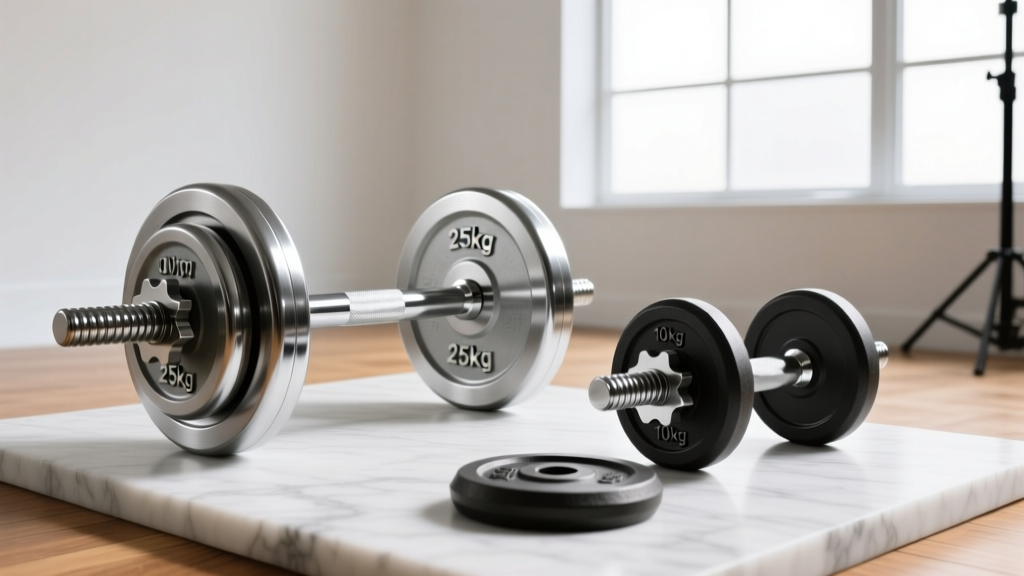
Olympic vs Standard Plates for a Dumbbell Chest Press Without Bench
Compare Olympic vs standard weight plates for loadable dumbbells. Discover the best setup for a safe, effective dumbbell chest press without bench.

The Biomechanics of the Floor Press: Why Plate Choice Matters
As minimalist and garage home gyms continue to dominate fitness trends in 2026, the dumbbell chest press without bench (commonly known as the floor press) has become a staple movement. It isolates the triceps, limits shoulder extension to protect the rotator cuff, and builds massive lockout strength. However, when you swap fixed rubber dumbbells for loadable dumbbell handles, a critical debate emerges: weight plate types Olympic vs standard.
Unlike a traditional bench press where the barbell or dumbbells travel through an unrestricted range of motion (ROM), the floor acts as a hard mechanical stop. Your triceps hit the ground at roughly 4 to 6 inches of elevation. If the physical diameter of your weight plates is too large, the plates will strike the floor before your arms do. This abrupt stop transfers sheer kinetic force directly into your wrist joints and can cause the dumbbell handle to violently torque. Choosing between 1-inch standard plates and 2-inch Olympic plates fundamentally alters the safety, balance, and effectiveness of this exercise.
Standard Weight Plates (1-Inch): The Budget-Friendly Contender
Standard weight plates feature a 1-inch center hole and are typically paired with threaded spinlock dumbbell handles. For the floor press, standard cast iron plates offer a distinct geometric advantage regarding floor clearance.
Product Spotlight: Yes4All 1-Inch Spinlock Handles & CAP Barbell Cast Iron
A standard 10-pound cast iron plate measures approximately 9.1 inches in diameter. When you lower the dumbbells during a dumbbell chest press without bench, your triceps will comfortably touch the floor well before a 9.1-inch plate makes contact. This preserves the natural biomechanical stopping point of the floor press.
- Cost Efficiency: Standard cast iron plates average $1.20 to $1.50 per pound in 2026, making a 40-pound set highly affordable.
- Handle Length: Standard spinlock handles usually offer 5.5 to 7 inches of loadable sleeve space, capping your maximum weight per hand at around 40-50 pounds.
- The Drawback (Wrist Torque): Standard handles lack rotating sleeves. As you press the weight up and naturally pronate/supinate your wrists, the fixed plates create rotational friction, forcing your wrists to absorb the torque.
Olympic Weight Plates (2-Inch): The Heavy-Duty Powerhouse
Olympic plates feature a 2-inch center hole and are designed for heavy loading. When paired with high-quality loadable Olympic dumbbell handles, they offer superior ergonomics but introduce spatial challenges for floor-based exercises.
Product Spotlight: Rogue Fitness Loadable Dumbbell Handles & Hi-Temp Bumpers
Olympic loadable handles, such as the Rogue Fitness Loadable Dumbbell Handles, feature bronze bushings that allow the sleeve to spin freely. This rotation perfectly accommodates the natural arc of the pecs and wrists during the concentric phase of the chest press, drastically reducing joint strain.
⚠️ The Bumper Plate Floor Press Hazard: If you use 10lb or 15lb Olympic bumper plates for your floor press, you will encounter a major issue. Standard Olympic bumper plates maintain a uniform 17.7-inch diameter regardless of weight. A 17.7-inch plate will smash into the floor long before your triceps do, artificially shortening your ROM and risking wrist hyperextension. To safely perform a dumbbell chest press without bench using Olympic gear, you must use cast iron Olympic plates (where a 25lb plate is roughly 14.5 inches in diameter) or specialized 10lb technique plates.Head-to-Head Comparison Matrix
Below is a direct comparison of how standard and Olympic plate setups perform specifically for floor-based pressing movements.
| Feature | Standard (1-Inch) Setup | Olympic (2-Inch) Setup |
|---|---|---|
| Center Hole Diameter | 1 Inch | 2 Inches |
| Sleeve Rotation (Bushings) | Rare (Fixed Sleeve) | Standard (Bronze/Needle) |
| 10lb Plate Diameter | ~9.1 Inches (Safe for Floor) | 17.7 Inches (Bumper) / ~6.5 Inches (Iron) |
| Max Load Per Handle | 40 - 60 lbs | 100 - 150+ lbs |
| Average Cost (Per lb) | $1.20 - $1.50 | $1.80 - $3.00+ |
Real-World Edge Cases: Knurling, Spin, and Forearm Clash
According to biomechanical analyses of the floor press detailed by BarBend's exercise guides, the angle of the elbow at the bottom of the movement dictates tricep activation. When using an Olympic setup with heavy 45-pound cast iron plates (approx. 17.7 inches in diameter), the sheer width of the plates can cause "forearm clash." As you tuck your elbows to a 45-degree angle to protect your shoulders, the inner edges of the massive Olympic plates may scrape against your forearms or chest before your triceps touch the floor.
Conversely, standard plates are narrower and smaller in diameter at higher weights, eliminating forearm clash. However, the lack of sleeve rotation on cheap standard handles means that as you fatigue during a high-rep dumbbell chest press without bench, the fixed momentum of the plates can lead to lateral epicondylitis (tennis elbow) due to unabsorbed rotational forces.
"When programming the floor press with loadable dumbbells, the rotational quality of the handle is just as important as the weight itself. A spinning Olympic sleeve allows the lifter to maintain a neutral or slightly pronated grip without fighting the inertia of the iron." — Home Gym Engineering Principles, 2025
Final Verdict: Which Plate Type Wins for Home Gyms?
If your primary goal is heavy overload and joint longevity, the Olympic setup is the undisputed champion, provided you avoid standard-diameter bumper plates and stick to calibrated steel or cast iron Olympic plates to maintain proper floor clearance. The investment in a rotating Olympic loadable handle (typically $80-$120 per pair) pays dividends in wrist health.
However, if you are on a strict budget, recovering from a shoulder injury, or exclusively doing high-rep, low-weight floor presses, a Standard 1-inch setup with cast iron plates offers excellent floor clearance and geometric safety, so long as you actively manage your wrist alignment to compensate for the fixed sleeves.
Frequently Asked Questions
Can I use Olympic bumper plates for a dumbbell chest press without bench?
It is highly discouraged. Standard Olympic bumper plates are 17.7 inches in diameter regardless of weight. They will hit the floor before your triceps, severely limiting your range of motion and potentially causing the handle to jerk out of your grip. Stick to Olympic cast iron plates for floor presses.
How much weight can I realistically load on a standard spinlock dumbbell?
Most 14-inch standard spinlock handles have a loadable sleeve length of about 6 inches. Using standard 1-inch cast iron plates, you can comfortably fit up to 45 or 50 pounds per hand. Beyond that, the plates become too wide, and the collars struggle to secure the load safely.
Are loadable dumbbells better than adjustable dumbbells for floor presses?
For heavy floor presses, loadable Olympic dumbbells (like those from Rogue or Titan Fitness) are vastly superior to dial-adjustable dumbbells (like Bowflex or Nuobell). Adjustable dumbbells have bulky plastic housings that frequently clash with the floor and your forearms, whereas loadable dumbbells offer a compact, rugged profile ideal for the tight clearances of a floor press.
More gear to consider
All reviews
Fixing Dumbbell Nan Kilo Errors: Adjustable Weight Troubleshooting
Olympic vs Standard Plates & B Stance RDL with Dumbbells

EZ vs Straight Bar Care: Beyond Exercises With Two Dumbbells
Best Neoprene Dumbbells for Dumbbell Bench Pullovers 2026

EZ Curl Bar vs Straight Bar: Space for an Abs Workout with Dumbbells
