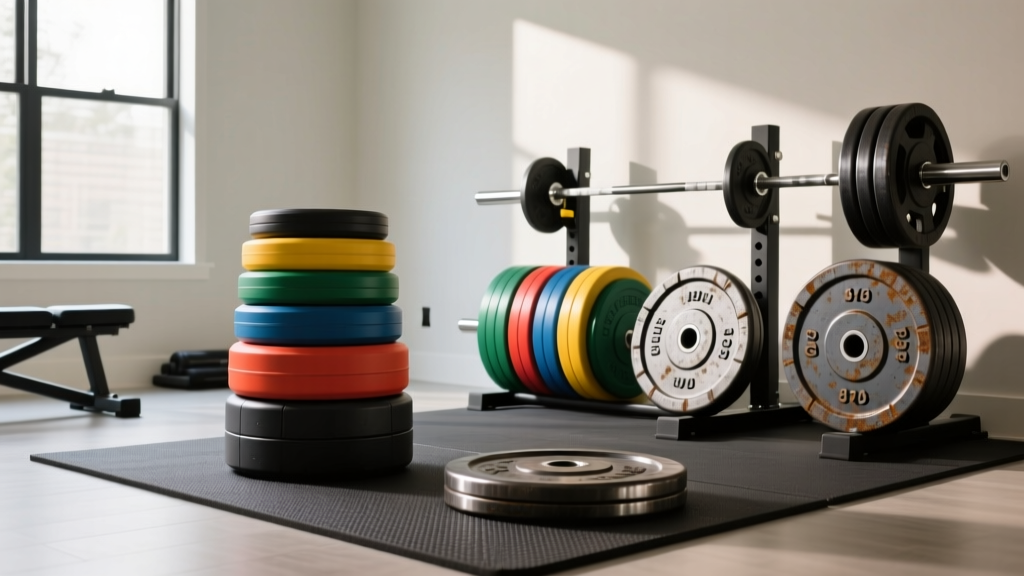
Beyond The Dumbbell Cartoon: Bumper vs Iron Plate Layouts
Stop sketching your gym like a dumbbell cartoon. Compare bumper vs iron plate dimensions, storage footprints, and layout strategies for tight spaces.

When planning a home gym, most beginners start with what I call the 'dumbbell cartoon' phase. You grab a napkin and sketch out generic, two-dimensional circles representing weights, a stick-figure barbell, and a square for a rack. It is a simplistic, top-down view that completely ignores the three-dimensional reality of volumetric footprint, plate thickness, and spatial clearance. In 2026, with garage real estate at a premium and home fitness equipment more specialized than ever, treating your layout like a dumbbell cartoon is a fast track to buying gear that physically will not fit your space.
Nowhere is this spatial disconnect more obvious than in the great debate of bumper plates versus cast iron plates. While most online guides focus purely on the auditory difference (noise) or the ability to drop the barbell, the true deciding factor for compact home gyms is space optimization and layout design. The physical dimensions of your plates will dictate your rack width, your storage tree footprint, your barbell sleeve clearance, and your mandatory drop-zone floor allocation.
The Volumetric Footprint: Bumper vs. Iron Plate Dimensions
To move beyond the dumbbell cartoon sketch, we must look at exact measurements. Standard Olympic bumper plates are manufactured to the International Weightlifting Federation (IWF) standard of 450mm (17.7 inches) in diameter, regardless of whether the plate weighs 10 pounds or 45 pounds. Cast iron plates, however, scale in both diameter and thickness based on their mass. This fundamental difference creates two entirely distinct spatial profiles.
| Plate Weight | Bumper Diameter | Bumper Thickness | Iron Diameter | Iron Thickness |
|---|---|---|---|---|
| 45 lbs | 17.7' | 3.35' | 14.5' | 1.3' |
| 25 lbs | 17.7' | 2.15' | 10.5' | 1.1' |
| 10 lbs | 17.7' | 1.05' | 6.5' | 0.8' |
Data based on standard Rogue Echo Bumper Plates and Rogue Machined Iron Plates. As noted by Garage Gym Reviews, the uniform diameter of bumpers is excellent for barbell stability during deadlifts, but it creates a massive volumetric penalty in storage.
Storage Layouts: Trees, Walls, and Clearance Zones
Let us apply some real-world math to a standard 500-pound plate collection (ten 45-lb plates, two 25-lb plates, two 10-lb plates).
- Bumper Plate Storage: Ten 45-lb bumpers require 33.5 inches of continuous horizontal storage space. A standard vertical plate tree will easily hold this, but the 17.7-inch diameter means the tree requires a minimum 20x20-inch floor footprint just to prevent the plates from scraping the wall or adjacent equipment. Furthermore, the high center of gravity on a fully loaded A-frame tree creates a severe tipping hazard if not bolted down or placed on a wide, weighted base.
- Iron Plate Storage: Ten 45-lb iron plates require only 13 inches of horizontal space. You can easily store a 500-pound iron collection on a compact, wall-mounted horizontal plate rack, freeing up valuable floor space in a tight 10x10 garage gym.
If you are using a squat rack with integrated storage horns (like the Rogue SML-2 Monster Lite), storing 45-lb bumpers on the back uprights adds 3.35 inches of protrusion per plate. If your rack is positioned 18 inches from a wall, loading thick bumpers onto the rear horns will result in the plates grinding against your drywall. Iron plates, being significantly thinner and smaller in diameter, rarely cause this spatial conflict.
The Drop Zone: Floor Space Allocation
Space optimization is not just about where the weights live when they are idle; it is about the active footprint required to use them safely. According to facility design guidelines outlined by the National Strength and Conditioning Association (NSCA), dedicated dropping zones require specific shock-absorption parameters to protect both the flooring substrate and the equipment.
Bumper Plates Require a Dedicated Drop Zone
Bumper plates are designed to be dropped from overhead or chest height. To do this safely in a home environment, you must allocate a minimum 4x8-foot 'drop zone' constructed from 3/4-inch thick vulcanized rubber horse stall mats. This adds a permanent 32-square-foot spatial commitment to your gym layout. You cannot drop bumpers on standard EVA foam puzzle mats or bare concrete without risking catastrophic failure of the plates or the floor.
Iron Plates and the 'Controlled Descent' Layout
Cast iron plates must never be dropped. This means your layout must prioritize barbell j-hooks, safety spotter arms, and pulling blocks. Because you are lowering the weight under control (or resting it on pins), you do not need a massive 4x8 rubber drop zone. A simple 4x6-foot high-density rubber mat footprint is sufficient to protect the floor from rolling iron and provide traction. For ultra-compact spaces (like an 8x8 spare bedroom gym), iron plates allow you to shrink the active floor footprint by up to 25%.
'The biggest mistake I see in compact garage gym layouts is the failure to account for the barbell sleeve length required to load thick bumper plates. If you buy a cheap 7-foot barbell with short 10-inch sleeves, you physically cannot fit 300+ pounds of bumper plates on the bar, rendering your expensive spatial layout useless.' — FitGearPulse Equipment Testing Team
2026 Decision Framework: Which Plate Fits Your Floorplan?
To finalize your layout, use this practical decision matrix based on your available square footage and training style.
Choose Bumper Plates If:
- Space: You have a minimum 12x12-foot space allowing for a 4x8 drop zone and a 24x24-inch vertical storage tree.
- Training: You perform Olympic lifts (cleans, snatches) or high-rep CrossFit-style workouts where dropping the bar is mandatory.
- Subfloor: You have a concrete garage slab that requires thick rubber matting for acoustic and structural dampening.
- Budget: You are prepared to spend roughly $3.00 to $3.50 per pound (e.g., ~$1,000+ for a basic 300-lb set of quality urethane or virgin rubber bumpers).
Choose Cast Iron Plates If:
- Space: You are optimizing a tight 10x10 or smaller footprint and need to utilize wall-mounted horizontal storage to keep the floor clear.
- Training: You are a powerlifter or bodybuilder focused on squats, bench presses, and controlled deadlifts where the bar is never dropped.
- Subfloor: You are building over a wooden subfloor (like a basement or spare bedroom) where the extreme impact force of dropped bumpers could damage floor joists over time.
- Budget: You want to maximize weight-per-dollar, as machined iron plates typically cost between $1.50 and $2.00 per pound.
Frequently Asked Questions
Can I mix bumper plates and iron plates in a small home gym?
Yes, but it requires strategic layout planning. A highly optimized setup for a tight space is to keep a wall-mounted rack of iron plates for heavy squat and bench work, while maintaining just a pair of 45-lb and 25-lb bumpers for occasional deadlift or clean-and-jerk days. This hybrid approach saves floor space and reduces overall equipment costs.
Do I need a wider squat rack for bumper plates?
Not necessarily a wider rack, but you do need to pay attention to the depth of the uprights and the placement of safety straps or spotter arms. Because bumpers are 17.7 inches in diameter, they will engage the safety spotter arms differently than 14.5-inch iron plates. Ensure your spotter arms are set at a height that accounts for the larger radius of the bumper plate to avoid the barbell bouncing off the safeties during a failed squat.
What is the best storage solution for a 500lb bumper plate collection?
For a 500lb collection of bumpers, avoid standard A-frame trees due to the tipping risk caused by the wide 17.7-inch diameter. Instead, opt for a 3-tier horizontal wall-mounted plate rack or a heavy-duty 6-post power rack with integrated rear storage horns. This keeps the weight anchored to the wall or the rack's main frame, optimizing floor space and ensuring structural safety.
More gear to consider
All reviews
Trade Old Dumbbells: Cast Iron vs Competition Kettlebell Value

Barbell Collar Comparison & What Does Incline Dumbbell Press Work?

Elevated Dumbbell Squat Setup: Olympic vs Standard Plates

Setup Guide: Adjustable Dumbbells for an Arm Workout With Dumbbells
2026 Trends: Rubber Hex vs Urethane Dumbbell Chop Exercise
