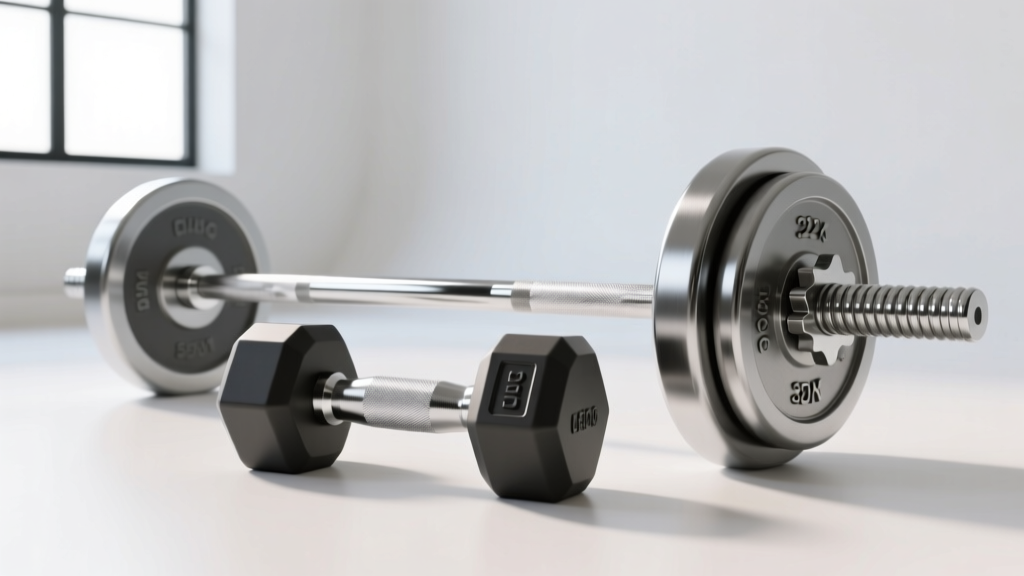
Dumbbell Bench Press vs Barbell Bench Press: The Ultimate Plate Guide
Deciding between dumbbell bench press vs barbell bench press? Learn how Olympic vs standard weight plates impact your home gym setup, budget, and safety.

The Foundation of Your Press: Why Plates Matter More Than You Think
When beginners set up their first home gym, they inevitably stumble into the classic debate: dumbbell bench press vs barbell bench press. Which is better for hypertrophy? Which builds more raw strength? While exercise selection is crucial, most novices make a critical, expensive mistake before they even pick up a weight. They buy the wrong weight plates.
The type of plates you purchase—Standard (1-inch hole) versus Olympic (2-inch hole)—dictates the barbells and dumbbells you can use, the maximum weight you can safely lift, and the longevity of your equipment. If you choose the wrong ecosystem, you will bottleneck your progression and waste hundreds of dollars. This step-by-step guide will walk you through the exact differences between Olympic and Standard plates, and how your choice directly impacts your bench press journey.
Beginner Trap Warning: Big-box sporting goods stores often sell 300-pound "Standard" cast-iron kits for under $150. While the upfront cost is tempting, the 1-inch bars included in these kits are prone to permanent bending (plastic deformation) once you surpass 200 pounds, creating a severe safety hazard during the barbell bench press.Step 1: Understand the Anatomy (1-Inch vs. 2-Inch)
Before comparing exercises, you must understand the hardware. The fitness industry divides free weight plates into two distinct categories based on the diameter of the center hole.
Standard Plates (1-Inch / 25mm)
- Dimensions: Feature a 1-inch center hole designed to fit inexpensive, lightweight barbells and fixed-weight dumbbells.
- Material: Usually cast iron or cement-filled vinyl.
- Limitations: Standard bars lack rotating sleeves. According to biomechanics data from ExRx on the Barbell Bench Press, stabilizing a heavy load requires a rigid, predictable bar. Standard bars often "whip" or bend under heavy loads, and the lack of sleeve rotation transfers dangerous torque directly to your wrists and elbows during the pressing motion.
Olympic Plates (2-Inch / 50mm)
- Dimensions: Feature a 2-inch center hole, originally designed for Olympic weightlifting to accommodate heavy, high-tensile steel barbells.
- Material: Cast iron, calibrated steel, rubber-coated, or urethane bumper plates.
- Advantages: Compatible with Olympic barbells (which feature rotating sleeves and high tensile strength) and heavy-duty power racks. They are the undisputed global standard for commercial gyms and serious home setups.
Step 2: How Plate Types Dictate Your Bench Press Strategy
How does the dumbbell bench press vs barbell bench press debate tie into plate selection? It comes down to equipment versatility and loadability.
The Barbell Bench Press Route
If your primary goal is moving maximum weight and tracking progressive overload, the barbell bench press is king. However, to safely perform this movement, you must use an Olympic barbell and Olympic plates. A standard 1-inch barbell simply cannot handle the 225+ pound loads that an intermediate lifter will quickly achieve. Furthermore, standard bars do not fit into the J-cups of standard power racks or squat stands, meaning you cannot safely bench press alone without a spotter.
The Dumbbell Bench Press Route
When analyzing Dumbbell Bench Press mechanics, the independent movement of the arms requires greater stabilization and offers a deeper stretch at the bottom of the movement. But how do you load them?
If you buy Standard plates, you are forced to buy bulky, awkward 1-inch loadable dumbbell handles, or you must purchase an entire rack of fixed-weight standard dumbbells, which takes up massive amounts of space. Conversely, if you invest in the Olympic ecosystem, you can purchase a pair of Rogue Loadable Dumbbell Handles (or similar Olympic-compatible handles). This allows you to use your existing Olympic barbell plates to perform both the dumbbell bench press and the barbell bench press, saving immense amounts of money and floor space.
Step 3: The Financial Breakdown (Real-World Pricing)
Let us look at the actual cost of building a 300-pound plate inventory in today's market. While Standard plates win on initial price, Olympic plates dominate in long-term value.
| Feature | Standard Plates (1-inch) | Olympic Plates (2-inch) |
|---|---|---|
| Entry-Level 300lb Kit Cost | $120 - $180 (e.g., CAP Barbell Vinyl/Iron) | $350 - $450 (e.g., Titan Fitness Cast Iron) |
| Premium Bumper Plate Cost | Not Available | $3.50 - $5.00 per lb (e.g., Rogue Echo Bumpers) |
| Barbell Compatibility | Low-grade steel bars (Max ~250 lbs) | High-tensile steel (190k+ PSI, Max 1000+ lbs) |
| Resale Value | Very Poor (Often given away for free) | Excellent (Retains 70% - 90% of retail value) |
"Think of Olympic plates as a financial asset. When you outgrow your 300-pound cast iron kit and need to upgrade to calibrated competition plates, you can sell your used Olympic plates on local marketplaces almost instantly. Standard plates, however, are virtually impossible to resell once you leave the beginner phase."
Step 4: Future-Proofing Your Home Gym
When deciding between the dumbbell bench press vs barbell bench press for your weekly routine, you will eventually want to incorporate a power rack or squat stand for safety. This is where the Standard plate ecosystem completely falls apart.
- Rack Compatibility: 99% of high-quality power racks and squat stands on the market are designed exclusively for Olympic barbells (7-foot length, 2-inch sleeves). Standard bars are typically 5 to 6 feet long and will not reach the J-cups on standard racks.
- Plate Storage: Olympic weight trees and rack-attached plate storage pegs are universally sized for 2-inch holes. Standard plates will not fit on commercial-grade storage solutions, leaving them scattered on your floor.
- Accessory Ecosystem: If you eventually want to add landmine attachments, T-bar rows, or plate-loaded cable machines to your gym, they all require Olympic plates. Standard plates are a dead-end ecosystem.
Your Step-by-Step Decision Framework
Use this quick framework to finalize your purchasing decision based on your specific goals and budget.
Scenario A: The "Strict Budget / Temporary Setup" Lifter
Choose Standard Plates IF: You have less than $200 to spend, you are living in a temporary apartment, and your maximum pressing goal is strictly under 150 pounds. Buy a used standard cast-iron kit on local classifieds, pair it with fixed-weight dumbbells for your dumbbell bench press, and plan to donate the standard plates to a local thrift store when you eventually upgrade.
Scenario B: The "Long-Term Progressive" Lifter (Recommended)
Choose Olympic Plates IF: You are serious about tracking your strength, you want to safely perform the barbell bench press inside a power rack, and you want the option to use loadable dumbbell handles for the dumbbell bench press. Action Plan: 1. Purchase a 7-foot, 20kg Olympic barbell (approx. $200-$250). 2. Buy a 300lb Olympic cast-iron plate kit (approx. $350). 3. Invest in a pair of loadable Olympic dumbbell handles (approx. $100-$130). This setup allows you to seamlessly switch between dumbbell and barbell bench pressing using the exact same weight inventory.
Frequently Asked Questions
Can I use an adapter to put Olympic plates on a Standard bar?
No. While you can buy adapters to put 1-inch Standard plates on a 2-inch Olympic bar, you cannot safely reduce a 2-inch Olympic plate to fit a 1-inch Standard bar. Furthermore, the physical weight of heavy Olympic plates will snap a thin 1-inch standard barbell.
Are Bumper Plates necessary for the Bench Press?
No. Bumper plates (like the Rogue Echo Bumpers) are designed to be dropped from overhead during Olympic lifts like the clean and jerk. For the bench press, standard cast-iron Olympic plates are perfectly fine, more cost-effective, and take up less space on the barbell sleeve, allowing you to load more weight.
Which is better for chest growth: Dumbbell or Barbell?
Both have distinct advantages. The barbell bench press allows for greater absolute mechanical tension and easier micro-loading (adding just 2.5 lbs per side). The dumbbell bench press allows for a greater range of motion and converging adduction at the top of the movement, which is highly effective for pectoral hypertrophy. By choosing the Olympic plate ecosystem, you keep the door open to utilize both modalities effectively as your training evolves.
More gear to consider
All reviews
Power Rack vs Squat Rack vs Stand: Setup & SpongeBob Dumbbells

Cast Iron vs Competition Kettlebells for Traps Dumbbell Workouts

Cast Iron vs Competition Kettlebells: Upgrading Dumbbell Renegade Rows

Top Neoprene Dumbbells for Home Use & Dumbbell Hex Press (2026)
PowerBlock Dumbbell to Olympic Barbell: Weight & Knurling Guide