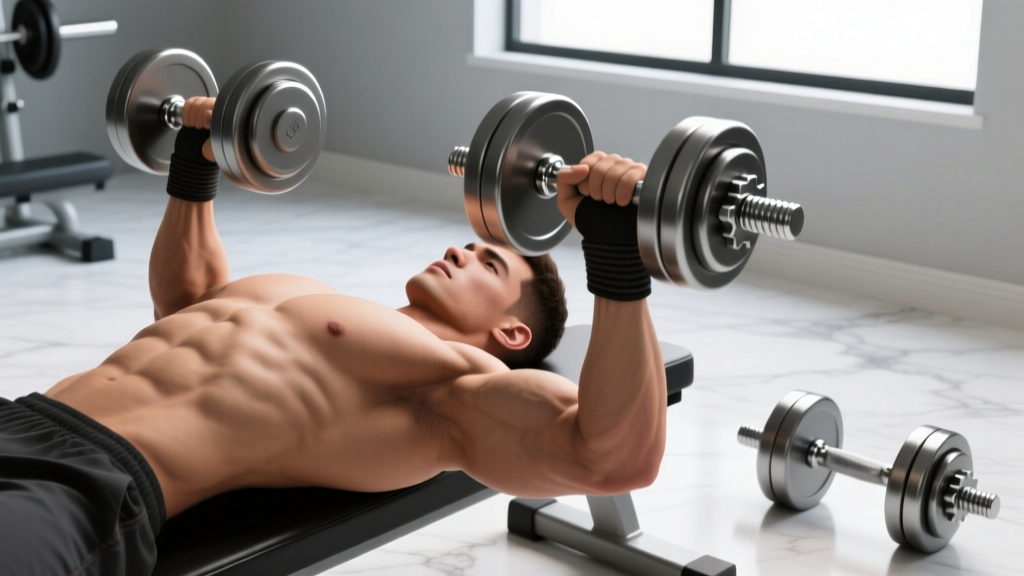
Close Grip Dumbbell Bench Mistakes & Adjustable Weight Fixes
Master the close grip dumbbell bench press. We troubleshoot common form mistakes and compare adjustable dumbbell models for optimal triceps activation.

The Biomechanical Trap: Why Adjustable Dumbbells Complicate the Close Grip
The close grip dumbbell bench press is a foundational movement for targeting the triceps brachii (specifically the lateral and medial heads) and the inner sternal fibers of the pectoralis major. According to biomechanical analyses by ExRx.net, bringing the hands closer together shifts the mechanical advantage away from the chest and directly onto the elbow extensors. However, when you transition from fixed hex dumbbells to adjustable dumbbells, a hidden biomechanical trap emerges: the physical footprint of the equipment.
Unlike standard fixed dumbbells, which have compact heads, adjustable dumbbells require internal mechanisms—dials, selector pins, or sliding cages—that drastically increase their overall length. This structural reality fundamentally alters the mechanics of the close grip dumbbell bench press, often forcing lifters into compromised positions that lead to wrist pain, elbow flare, and suboptimal muscle recruitment. In this 2026 troubleshooting guide, we break down the most common mistakes lifters make with adjustable weights and provide a data-driven comparison to help you choose the right equipment for the job.
⚠️ Equipment Warning: If you are using dial-adjusted dumbbells with a total length exceeding 15 inches, achieving a true 'close grip' (hands spaced 4 to 6 inches apart) is physically impossible without the weight housings colliding. This collision destabilizes the load at the most vulnerable point of the movement—the lockout.3 Fatal Mistakes on the Close Grip Dumbbell Bench Press
Mistake 1: The 'Kissing Dumbbell' Collision
Many lifters attempt to mimic the barbell close-grip bench press by smashing the dumbbells together at the top of the concentric phase. With adjustable dumbbells, this is a critical error. The bulky plastic housings of models like the Bowflex SelectTech 552 or Nuobell 80 will collide before your hands reach the midline of your chest. This collision creates a lateral rebound effect, forcing your wrists into sudden ulnar deviation and robbing your triceps of peak contraction tension. The Fix: Stop the dumbbells 2 to 3 inches apart at the top of the movement. Maintain continuous isometric tension on the triceps rather than relying on the clanking of the weights to signal the end of the rep.
Mistake 2: Ulnar Deviation and Wrist Strain
Because adjustable dumbbells are long, lifters often subconsciously bend their wrists outward (ulnar deviation) to prevent the ends of the dumbbells from hitting each other at the bottom of the eccentric phase. The American Council on Exercise (ACE) consistently warns against breaking the neutral wrist alignment under heavy loads, as it places immense shear force on the carpal tunnel and the triangular fibrocartilage complex (TFCC). The Fix: Stack your joints. Your knuckles should point directly at the ceiling, and your forearm bones should form a perfectly straight vertical line with the dumbbell handle. If you cannot maintain this stack without the weights colliding, your dumbbells are too long for this specific exercise.
Mistake 3: Severe Elbow Flare
When the dumbbells collide at the bottom of the press, the body's natural compensation mechanism is to flare the elbows outward to 75 or 80 degrees to create clearance. This instantly shifts the load back to the anterior deltoids and places the rotator cuff in a vulnerable, internally rotated position. The National Strength and Conditioning Association (NSCA) recommends an elbow tuck of roughly 30 degrees relative to the torso for optimal triceps engagement and shoulder safety. The Fix: Actively brush your triceps against your latissimus dorsi during the eccentric descent. If your adjustable dumbbells are too wide to allow this 30-degree tuck, you must switch to a more compact adjustable model.
Adjustable Dumbbell Comparison Matrix: Which Model Fits a Close Grip?
Not all adjustable dumbbells are created equal. The 'footprint'—specifically the total length of the dumbbell at its maximum weight setting—dictates whether the equipment is viable for close-grip pressing. Below is a 2026 comparison of the top adjustable models on the market, graded specifically on their viability for the close grip dumbbell bench press.
| Model | Max Length | Housing Shape | Close-Grip Viability | Est. Price (Pair) |
|---|---|---|---|---|
| PowerBlock Elite USA | 12.0 inches | Rectangular Cage | Excellent | $369 |
| Ironmaster Quick-Lock V2 | 14.5 inches | Square / Cylinder | Moderate | $399 |
| Bowflex SelectTech 552 | 15.7 inches | Wide Cylinder | Poor | $349 |
| Nuobell 80lb | 16.9 inches | Long Cylinder | Poor | $399 |
The Verdict: The PowerBlock Elite series remains the undisputed champion for close-grip and neutral-grip pressing. Its unique rectangular cage design houses the weight plates around the hand rather than extending outward along a single axis. This allows the lifter to bring their hands within 4 inches of each other without any housing collision, perfectly preserving the biomechanics of the close grip dumbbell bench press. Conversely, while the Nuobell and Bowflex offer incredibly fast weight changes and traditional knurled handles, their 15+ inch lengths make them fundamentally unsuited for dedicated close-grip triceps work.
Step-by-Step Troubleshooting Guide for Adjustable Weights
If you are already committed to a specific set of adjustable dumbbells and cannot upgrade, use this troubleshooting protocol to salvage your close grip dumbbell bench press and protect your joints.
- Alter the Grip Orientation (Neutral vs. Pronated): If your dumbbells are too long to press with a standard pronated (palms facing away) grip without colliding, switch to a neutral grip (palms facing each other). The neutral grip naturally aligns the long axis of the dumbbell with your forearm, allowing the weights to pass each other safely beside your torso rather than crashing together over your sternum.
- Implement a 1.5 Rep Style: To maximize triceps tension without requiring a full lockout (where collision occurs), use 1.5 reps. Lower the weight fully, press it halfway up, lower it again, and then press to full lockout. This keeps the tension on the medial triceps head and minimizes the distance the bulky ends of the dumbbells must travel.
- Check the Selector Dial Clearance: A common mechanical failure with dial-adjustable dumbbells occurs when the user rests the dumbbell on their knee to kick it back into the starting position. The pressure on the knee can accidentally turn the dial, dropping a 40lb plate onto the user's foot. Always verify the dial is locked and facing outward before initiating the kickback.
- Use a Slight Decline: If you are experiencing shoulder impingement at the bottom of the close grip press, adjust your bench to a 10-to-15-degree decline. This alters the angle of the humerus relative to the clavicle, providing more clearance in the subacromial space while heavily biasing the lower sternal pecs and triceps.
FAQ: Close Grip Pressing with Adjustable Weights
Can I use a thumbless (suicide) grip to squeeze the dumbbells closer?
Absolutely not. Wrapping your thumb around the handle is non-negotiable for pressing movements. Using a thumbless grip to shave a half-inch off your grip width drastically increases the risk of the dumbbell slipping inward and crushing your sternum or face. Joint stacking and proper equipment selection are the only safe ways to achieve a close grip.
Why do my wrists hurt specifically when using adjustable dumbbells for this exercise?
Adjustable dumbbells have a different center of gravity compared to fixed hex dumbbells. The weight is distributed further out along the horizontal axis. When you bring your hands close together, the leverage against your wrist joint increases exponentially. If your wrist flexors and extensors are not conditioned for this specific torque, you will feel strain. Strengthen your forearms with heavy farmer's carries and wrist curls to build the necessary stabilizer endurance.
What is the ideal rep range for the close grip dumbbell bench press?
Because the triceps are composed of a high percentage of fast-twitch muscle fibers, and because adjustable dumbbells can be cumbersome to stabilize for high-rep sets, stick to the 6 to 10 rep range. Focus on a slow, 3-second eccentric descent, a 1-second pause at the bottom (without letting the weights rest on your chest), and an explosive concentric lockout.
More gear to consider
All reviews
Adjustable Dumbbells & Full Body Dumbbell Workout Chart PDF Free Download

Dumbbell Sumo Squat Muscles Worked & Best Loadable Handles 2026

Neoprene Dumbbells: Incline Dumbbell Fly Muscles Worked & Guide

Olympic vs Standard Plates & Love Handles Workout With Dumbbells

Spotting Dumbbell Bench Press: Best Adjustable Dumbbells Compared
