Dumbbell vs Barbell vs Kettlebell Thrusters: Cast Iron Space Guide
Optimize your gym layout with our cast iron vs competition kettlebell buying guide. Compare spatial footprints, thruster clearances, and storage racks.

The Spatial Reality: Designing a Functional Free Weight Zone
When designing a home or commercial gym, the debate between cast iron and competition kettlebells is rarely just about aesthetics or grip feel—it is fundamentally a question of space optimization and layout design. Every square foot of your training area dictates how you move, store, and progress. As a senior equipment reviewer for FitGearPulse, I have mapped out hundreds of garage and studio gyms. The choice between traditional cast iron bells and standardized competition models will completely alter your storage footprint, racking solutions, and movement clearance.
In this comprehensive buying guide, we will break down the exact dimensional differences, analyze the spatial requirements of complex movements, and provide a concrete framework for choosing the right kettlebell type for your specific layout constraints in 2026.
Quick Dimensional Data Highlight
Competition Kettlebells: Uniform 280mm height × 210mm width across all weights (8kg to 48kg). Handle diameter is strictly 33mm.
Cast Iron Kettlebells: Scale proportionally. A 16kg bell is roughly 223mm × 171mm, while a 32kg bell expands to 285mm × 215mm. Handle thickness varies from 30mm to 35mm.
Movement Clearance: Dumbbell Thrusters vs Barbell Thrusters and Kettlebell Thrusters
When mapping out your gym's functional training zone, analyzing the spatial demands of dumbbell thrusters vs barbell thrusters and kettlebell thrusters is critical for maximizing your usable square footage. Thrusters are a high-velocity, full-body movement that requires significant overhead clearance and lateral buffer space to ensure safety and proper biomechanics.
| Movement Variation | Lateral Clearance Needed | Vertical Clearance | Equipment Storage Footprint |
|---|---|---|---|
| Barbell Thrusters | 84" - 96" (7ft bar + buffer) | 84"+ (Standard ceiling) | Large (Requires Squat Rack) |
| Dumbbell Thrusters | 48" - 60" | 84"+ | Medium (Requires DB Rack) |
| Kettlebell Thrusters | 36" - 48" | 84"+ | Small (Compact KB Rack) |
As the data illustrates, optimizing your home gym layout heavily favors kettlebell thrusters when lateral space is constrained by walls, doors, or adjacent equipment. While a barbell requires a dedicated 8-foot wide lane to prevent wall damage during the clean or overhead press phase of the thruster, kettlebells allow you to train in a compact 4x4 foot rubber-matted zone. This makes kettlebells the undisputed champion of high-density apartment gyms and narrow garage setups.
The Buying Guide: Cast Iron vs. Competition for Compact Layouts
Choosing between cast iron and competition kettlebells requires looking past the price tag and evaluating how the physical geometry of the bell interacts with your storage racks and floor space.
1. Competition Kettlebells: The Uniform Stackers
Competition kettlebells, such as the Kettlebell Kings Competition Line, are manufactured to exact International Union of Kettlebell Lifting (IUKL) specifications. Every bell, whether it is a lightweight 8kg or a massive 48kg, shares the exact same physical dimensions: 280mm tall and 210mm wide.
- Space Advantage: Because the dimensions never change, competition bells stack perfectly on flat, horizontal shelving units. You can build a dense, multi-tiered wall rack without worrying about varying bell heights causing instability.
- Layout Drawback: The 210mm width is non-negotiable. A row of ten competition bells will consume exactly 2.1 meters (roughly 82 inches) of horizontal shelf space, regardless of the weight increments you choose.
- Pricing (2026 Market): Expect to pay a premium for the hollow steel construction and precision calibration, typically ranging from $3.80 to $5.50 per pound.
2. Cast Iron Kettlebells: The Space-Adaptive Option
Traditional cast iron bells, like the Rogue Cast Iron Kettlebells, are poured into molds that scale with the weight. A 12kg bell is significantly smaller and narrower than a 32kg bell.
- Space Advantage: For lighter weight ranges (8kg to 20kg), cast iron bells have a much smaller physical footprint than competition bells. They are ideal for sliding under benches, tucking into corners, or storing on narrow, vertical A-frame racks where the handle rests on the rail rather than the bell body.
- Layout Drawback: You cannot stack them uniformly on flat shelves. As the weights increase, the bell diameter expands, meaning your storage rack must have adjustable height tiers or deep, wide shelves to accommodate the larger 24kg, 32kg, and 40kg behemoths without them rolling off or clashing.
- Pricing (2026 Market): Highly economical, generally hovering between $1.50 and $2.20 per pound, making it easier to buy a full set without breaking the budget.
⚠️ Layout Warning: The Horn Width Factor
When designing your vertical racking system, pay attention to the "horns" (the sides of the handle). Competition bells feature wider, more squared-off horns to accommodate two-handed cleans and snatches. If you are using a vertical peg rack or a slotted A-frame, ensure the slot width is at least 8 inches to prevent the competition horns from catching and scratching your rack's powder coat. Cast iron horns are generally narrower and more forgiving on compact storage pegs.
Strategic Layout & Storage Configurations
To maximize your training area, your storage solution must match your kettlebell type. Here is a step-by-step framework for configuring your free weight zone based on your purchase.
- Assess Your Wall Space: If you have a long, uninterrupted wall (6+ feet), invest in a 3-tier horizontal flat-shelf rack and purchase competition kettlebells. Their flat bottoms and uniform heights will create a clean, stable, and visually organized display.
- Assess Your Corner/Floor Space: If you are limited to a 2x3 foot corner footprint, purchase a heavy-duty vertical A-frame rack and opt for cast iron kettlebells. The varying sizes allow the smaller bells to sit on the top pegs and the larger bells on the bottom, keeping the center of gravity low and the footprint minimal.
- The Hybrid Approach: Many elite garage gyms in 2026 utilize a hybrid layout. They keep a set of cast iron bells (16kg, 20kg, 24kg) for high-rep metabolic conditioning and swings, stored under a utility bench. They reserve a single pair of competition bells (24kg or 32kg) strictly for technical skill work like snatches and jerks, stored on a dedicated single-tier wall mount.
Frequently Asked Questions
Can I mix cast iron and competition kettlebells on the same rack?
Yes, but it requires strategic placement. Use a horizontal rack with adjustable shelf heights. Place the uniform competition bells on the middle tiers where height consistency matters most, and use the top and bottom tiers for the varying heights of your cast iron collection.
Which type is better for tight apartment gyms?
Cast iron is superior for ultra-compact spaces. Because the lighter weights (which are used most frequently in small spaces) are physically smaller than their competition counterparts, they can be easily tucked under furniture or stored in tight closet shelving units.
Do competition kettlebells chip or rust?
Competition bells are typically made of hollow steel and painted with high-grade powder coat or automotive paint. They will not rust like unprotected cast iron, but they can chip if dropped on concrete. Always use 3/4-inch rubber horse stall mats in your designated drop zones to protect both your floor and your expensive competition steel.
Expert Verdict: Optimizing Your Free Weight Zone
Ultimately, the choice between cast iron and competition kettlebells should be driven by your available square footage and your racking infrastructure. If your layout demands uniform stacking on flat shelves and you prioritize technical sport-specific training, the premium investment in competition bells is justified. However, if you are maximizing a tight garage gym, utilizing vertical A-frames, and frequently incorporating high-clearance movements like kettlebell thrusters to save lateral space, traditional cast iron remains the most versatile and space-adaptive option on the market.
More gear to consider
All reviews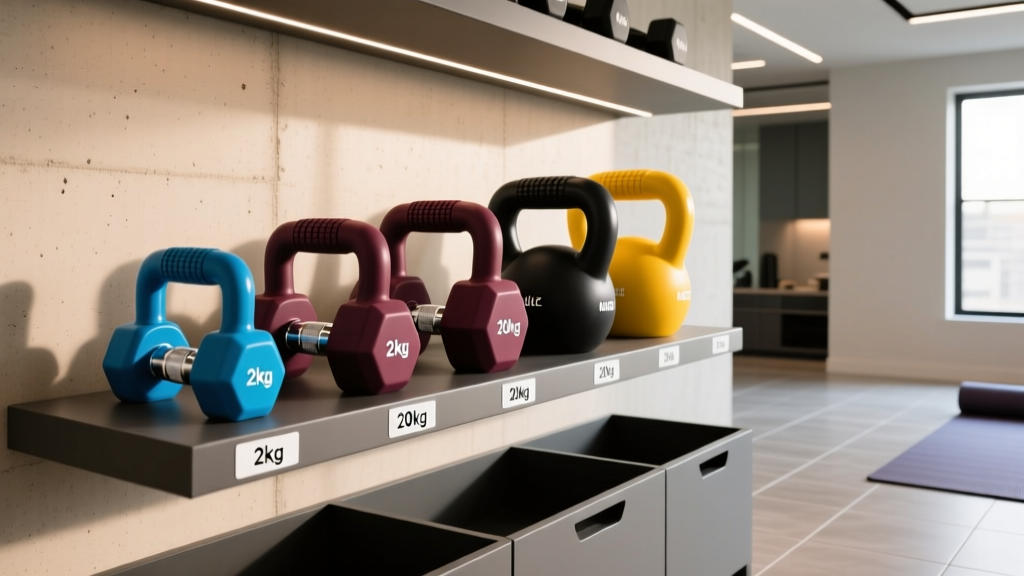
2026 Storage Trends: What Weight Dumbbells Should I Use Male KG?

2026 Loadable Dumbbell Trends: Adapting Dumbbell Squat Form

Rep Fitness Urethane Dumbbells vs. Olympic vs. Standard Plates

Bumper vs Iron Plates & Best Glute Exercise with Dumbbells

Loadable Dumbbells for Your 10 Minute Upper Body Dumbbell Workout