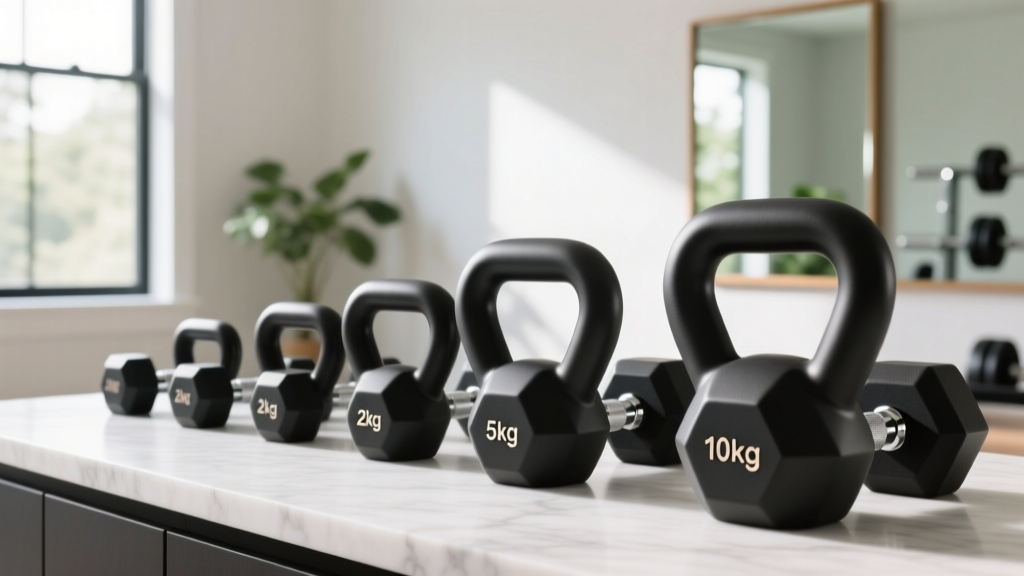
Cast Iron vs Competition Kettlebells: Space & Different Dumbbells
Optimize your home gym layout. We compare cast iron vs competition kettlebell dimensions, storage footprints, and space-saving racks for different dumbbells.

The Spatial Reality: Cast Iron vs. Competition Kettlebells
When designing a space-optimized home gym in 2026, the physical geometry of your free weights dictates your entire floor plan. Nowhere is this more apparent than in the debate between cast iron and competition kettlebells. While both serve the same fundamental biomechanical purposes, their external dimensions create vastly different storage and layout challenges.
According to the standards set by international federations and detailed in the Kettlebell Kings comprehensive buying guide, competition kettlebells are manufactured to a uniform size regardless of weight. A 12kg (26 lb) competition bell and a 32kg (70 lb) competition bell both measure exactly 280mm in height, 210mm in width, and feature a standardized 35mm handle diameter. This uniformity is a dream for spatial planning. You can purchase a single-tier or two-tier rack with identically spaced slots, knowing every bell will fit perfectly without wasting vertical or horizontal clearance.
Cast iron kettlebells, conversely, grow in all three dimensions as the weight increases. A 48kg 'Beast' cast iron kettlebell is massively wider and taller than a 16kg bell. If you attempt to store a full set of cast iron bells on a standard uniform rack, you will either waste massive amounts of empty space around the smaller bells, or the larger bells will physically overlap and clash, scratching the powder coat and destabilizing the rack.
⚠️ Layout Warning: Never place heavy cast iron kettlebells (32kg+) on the top tier of a narrow, freestanding storage rack. The shifting center of gravity on larger, wider cast iron bells can tip standard 3-inch steel tube racks if they lack a widened base plate or wall-anchoring brackets.Calculating Your Kettlebell Storage Footprint
To optimize your layout, you must calculate the exact square footage your kettlebell collection will consume. The pricing and spatial footprint vary wildly between the two types. As of early 2026, competition kettlebells average $2.50 to $3.50 per pound, while cast iron bells hover around $1.50 to $2.20 per pound. However, the racking infrastructure required for cast iron often negates the initial cost savings in a tight space.
| Metric | Competition Set (12kg - 32kg) | Cast Iron Set (12kg - 32kg) |
|---|---|---|
| Dimensional Variance | Zero (Uniform 280x210mm) | High (Width grows up to 280mm+) |
| Rack Type Required | Standard 3-Tier Vertical Rack | Heavy-Duty A-Frame or Custom Wide-Tier |
| Approx. Floor Footprint | 48" W x 24" D (10 sq ft) | 72" W x 30" D (18 sq ft) |
| Average 2026 Cost (Set) | $450 - $600 | $250 - $350 |
Integrating Different Dumbbells into the Layout
A well-designed free-weight zone rarely relies on kettlebells alone. When pairing your kettlebell tree with different dumbbells, the spatial dynamics shift dramatically. The way you store and utilize dumbbells will dictate whether your gym feels like a cluttered garage or a high-performance training facility.
Adjustable Dumbbells: The Ultimate Space Hack
If your primary goal is space optimization, adjustable dumbbells are non-negotiable. Models like the PowerBlock Elite (rectangular profile) or the Nuobell 80 (traditional rounded profile) replace up to 15 pairs of fixed dumbbells.
- PowerBlock Elite: Measures just 12" x 6" x 6" per block. They can be stored on a tiny wall-mounted shelf or tucked under a bench, consuming less than 1 square foot of floor space.
- Nuobell 80lb: Requires their specific cradle, which takes up roughly 24" x 10" of floor space. While larger than PowerBlocks, they offer a superior center of gravity for pressing movements.
Fixed Hex Rubber Dumbbells: The Space Eaters
Opting for a full 5-50 lb set of rubber hex dumbbells requires a massive 3-tier A-frame rack. These racks typically demand a 5-foot wide by 3-foot deep footprint (15 square feet) just for the equipment, not including the clearance needed to walk around them and load/unload weights. In a space-constrained layout, mixing a wide cast-iron kettlebell A-frame with a massive dumbbell A-frame will instantly consume 30+ square feet of prime real estate.
"Biomechanical efficiency isn't just about how you lift; it's about how you move through your space. If you have to navigate a maze of A-frame racks between sets, your heart rate drops and your session density plummets. Consolidate your footprint to maintain training intensity." — NSCA Certified Strength and Conditioning Specialist Guidelines on Facility Layout
Flooring and Clearance: The Hidden Space Eaters
When planning your layout, the physical rack is only half the equation. Ballistic movements like kettlebell swings, snatches, and dumbbell renegade rows require dedicated 'drop zones' to protect your subfloor and the equipment.
💡 The 36-Inch Clearance Rule:For every active lifting station, map out a 36-inch radius from the center of the lifter. If you are performing kettlebell snatches with a 24kg competition bell, the bell can easily travel 3 feet away from your body at the apex of a failed rep. Ensure your storage racks are pushed at least 4 feet back from the primary lifting platform. As noted in ExRx's biomechanical breakdowns of kettlebell exercises, the deceleration phase of a swing requires unhindered spatial awareness to safely dump the weight if grip fails.
Furthermore, competition kettlebells feature a flat, machined base designed for renegade rows and push-ups. Cast iron bells often have uneven casting seams or rounded bases that wobble on hard rubber flooring. If you plan to use your kettlebells for floor-based pressing, competition bells allow you to eliminate the need for specialized parallettes or dumbbell hex-pairs, saving even more storage space.
Step-by-Step Layout Plan for a 10x10 Spare Room
Let's apply this data to a real-world scenario. You have a 10x10 foot spare bedroom (100 sq ft) and want to incorporate both kettlebells and different dumbbells without the room feeling claustrophobic.
- Step 1: Establish the Ballistic Perimeter (Center/Window Wall)
Lay down a 4x6 foot, 3/4-inch thick horse stall mat in the center of the room, pushed slightly toward the exterior wall. This is your dedicated drop zone. Keep 36 inches of clearance on all sides. - Step 2: Mount the Competition Kettlebell Rack (Corner)
Because competition bells are uniform, purchase a wall-mounted, 2-tier steel bracket system. Mount it in the corner adjacent to your lifting mat. This removes the need for a freestanding A-frame, instantly reclaiming 8 square feet of floor space. - Step 3: Integrate Adjustable Dumbbells (Under-Bench Storage)
Place an adjustable FID (Flat/Incline/Decline) bench at the edge of the mat. Slide a pair of Nuobell or PowerBlock adjustable dumbbells directly underneath the bench when not in use. This completely eliminates the need for a dumbbell rack. - Step 4: Vertical Storage for Accessories
Use the back of the door or a slim, wall-mounted pegboard for resistance bands, lifting belts, and chalk. Keep the floor entirely clear of trip hazards.
Expert Verdict: Which Setup Maximizes Your Square Footage?
If your primary constraint is spatial optimization, competition kettlebells paired with adjustable dumbbells is the undisputed champion of layout efficiency. The uniform 280x210mm geometry of competition bells allows for tight, predictable, wall-mounted storage solutions that cast iron simply cannot accommodate without wasting valuable square footage on wide-set A-frames.
While cast iron kettlebells offer a more aggressive, textured handle that some lifters prefer for heavy grinds (and come at a lower initial cost per pound), their unpredictable dimensional growth makes them a nightmare for tight, optimized layouts. By investing in competition-grade steel and pairing them with space-saving adjustable dumbbells, you can build a world-class free-weight facility in less than 40 square feet of dedicated floor space.
More gear to consider
All reviews
Bumper vs Iron Plates: Gym Layouts and Dumbbell Chest Presses
Back Dumbbell Raise Mistakes & Best Adjustable Dumbbells Reviewed

Mastering the Single Arm Dumbbell Bench Press: Neoprene Dumbbell Mistakes & Fixes

Bumper vs Iron Plate Care & Incline Dumbbell Skull Crusher Longevity

EZ Bar vs Straight Bar: Value for a Whole Body Workout with Dumbbells