Cast Iron vs Competition Kettlebells: Dumbbell Overhead Triceps Zones
Optimize home gym space by comparing cast iron vs competition kettlebells. Learn layout strategies for overhead zones and dumbbell triceps extensions.

Designing a high-performance home gym in 2026 requires more than just purchasing foldable racks and modular flooring; it demands a rigorous understanding of volumetric footprints and spatial geometry. When outfitting a garage or basement facility, the debate between cast iron and competition kettlebells heavily influences your storage layout, rack depth, and overhead movement zones. While most buying guides focus solely on grip texture or price per pound, space optimization dictates that the physical dimensions of your free weights must align with your room's architectural constraints.
This guide breaks down the spatial realities of cast iron versus competition kettlebells, providing a concrete framework for designing your overhead clearance zones—specifically accounting for the demanding spatial requirements of exercises like the dumbbell overhead triceps extension, which serves as the ultimate stress test for your gym's vertical and lateral clearance.
The Spatial Dilemma: Variable vs. Uniform Geometry
The fundamental difference between cast iron and competition kettlebells from a layout perspective is dimensional consistency. Understanding this is critical before you commit to a specific storage rack or lifting platform placement.
Cast Iron Kettlebells: The Expanding Footprint
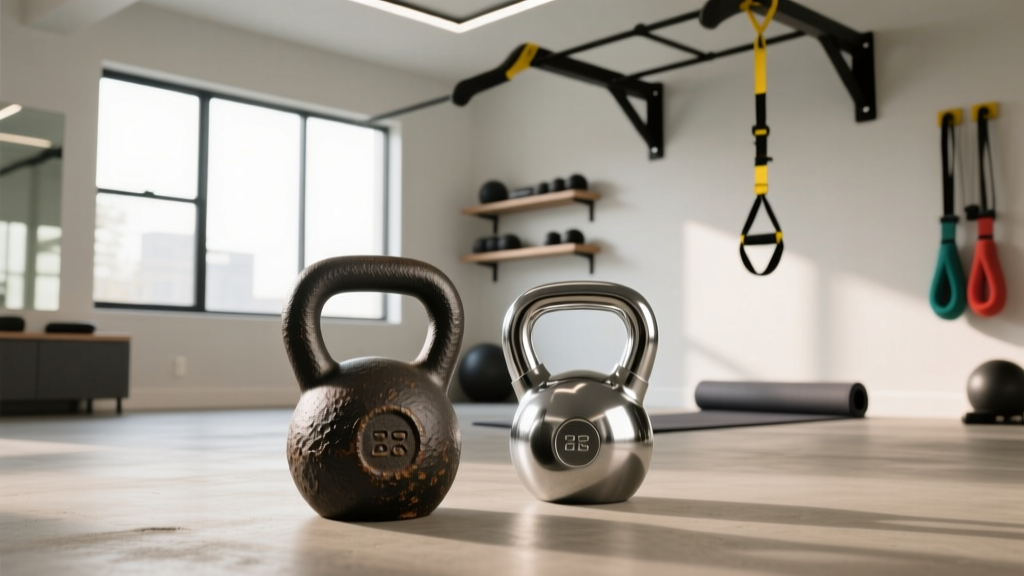
Cast iron bells are manufactured by pouring molten iron into molds. As the weight increases, the physical volume of the bell must also increase. An 8kg cast iron bell might have a base diameter of 150mm, while a 32kg bell can expand to 280mm or more. Furthermore, the handle thickness (horn diameter) scales with weight, typically ranging from 33mm on lighter bells to over 40mm on heavy ones. This variable geometry means your storage solution must accommodate the widest, deepest bell in your arsenal, often resulting in wasted space when storing lighter weights.
Competition Kettlebells: The Spatial Constant
According to international standards, competition kettlebells maintain identical external dimensions regardless of weight. Every bell from 8kg to 32kg (and beyond) measures exactly 280mm in height and 210mm in width, with a uniform 35mm handle diameter and a 140x100mm window. The weight difference is achieved internally by using denser materials (like steel or lead cores) or incorporating air voids in lighter bells. For space optimization, this uniformity is a game-changer, allowing for perfectly flush, tiered storage systems.
Dimensional & Spatial Footprint Comparison
The table below illustrates the spatial variance you must account for when designing your free weight zones. Note how cast iron dimensions force deeper shelving, while competition bells allow for standardized 12-inch deep racks.
| Weight | Cast Iron Base Width (Approx) | Cast Iron Handle Dia. | Competition Width (Exact) | Competition Handle Dia. | Min. Rack Depth Required |
|---|---|---|---|---|---|
| 12 kg | 175 mm | 33 mm | 210 mm | 35 mm | 10" (Cast) / 9" (Comp) |
| 16 kg | 205 mm | 35 mm | 210 mm | 35 mm | 11" (Cast) / 9" (Comp) |
| 24 kg | 240 mm | 38 mm | 210 mm | 35 mm | 13" (Cast) / 9" (Comp) |
| 32 kg | 285 mm | 40+ mm | 210 mm | 35 mm | 15" (Cast) / 9" (Comp) |
Mapping the Overhead Clearance Zone
When mapping out your gym's 'Overhead Clearance Zone,' you must design for the exercise with the maximum vertical and lateral apex. While kettlebell presses and snatches are relatively compact, setting up a dedicated zone for the dumbbell overhead triceps extension dictates your absolute minimum ceiling height and lateral elbow spacing. This, in turn, affects how close you can safely place your kettlebell storage racks to the lifting platform.
The Overhead Clearance Formula
To calculate your minimum safe ceiling height for full-extension overhead movements, use this formula:
User Height + Arm Length + Implement Height + 6" Safety Buffer = Minimum Ceiling Height
Example: A 6'2" (74") user with a 32" arm reach holding an 11" dumbbell or kettlebell requires 123" of vertical space. Standard 8-foot (96") or even 10-foot (120") garage ceilings will result in catastrophic drywall impacts during deep triceps extensions or kettlebell snatches. If your ceiling is under 108", you must restrict overhead work to seated variations or partial-ROM movements.
Furthermore, the lateral space required for the elbows to flare during a heavy triceps extension or a double kettlebell jerk is roughly 60 inches. If you place a cast iron kettlebell rack with a 15-inch depth too close to your lifting zone, you risk striking the rack's steel uprights during the eccentric lowering phase of the movement. Competition bells, stored on flush, wall-mounted 9-inch shelving, keep the walkway entirely clear, maximizing your usable floor plan.
Storage Footprints & Rack Selection Strategies
Your choice of kettlebell directly informs the capital expenditure and square footage dedicated to storage. In 2026, modular gym layouts prioritize verticality and wall-mounted solutions over sprawling floor racks.
Tiered Shelving for Uniform Bells
If you opt for competition kettlebells, you can utilize heavy-duty, wall-mounted steel shelving. Because the bells are uniformly 210mm wide, a standard 48-inch wide shelf can hold exactly five bells per tier with enough spacing for easy grip access. A 3-tier system requires only 36 inches of vertical wall space and protrudes a mere 9 to 12 inches from the wall. This leaves the floor entirely open for deadlifts, lateral lunges, and dynamic movements.
Sloped Racks for Variable Cast Iron
Cast iron bells require specialized, sloped storage racks with wide cradles to accommodate the expanding base diameters. A standard 6-bell cast iron floor rack typically measures 48 inches long, 24 inches wide, and 20 inches high. This consumes 8 square feet of prime floor real estate. Moreover, the sloped design means the rack cannot be pushed flush against a wall, creating a 'dead zone' behind it that collects dust and limits equipment placement options.
Cost vs. Space: The 2026 Buyer's Matrix
Space optimization is intrinsically linked to budget. Competition kettlebells command a premium due to the precision manufacturing and internal weighting required to maintain uniform dimensions. Here is a practical decision framework to help you choose based on your specific spatial and financial constraints:
- The Micro-Gym (Under 150 Sq Ft): Choose Competition Kettlebells. The premium cost ($3.50 - $5.00 per pound) is justified by the ability to use 9-inch deep wall mounts, preserving every inch of floor space for your lifting platform and overhead triceps clearance zones.
- The Standard Garage (200 - 400 Sq Ft): Choose Cast Iron Kettlebells. With ample floor space, the spatial inefficiency of a floor rack is negligible. You benefit from the lower cost ($1.50 - $2.50 per pound), allowing you to purchase a wider variety of weights and dumbbells to complete your overhead isolation arsenal.
- The Hybrid Approach: Purchase competition bells for your primary working weights (16kg, 24kg) to save rack space, and supplement with cast iron for lighter warm-up bells or heavier absolute-strength bells where spatial efficiency is less critical.
Floor Protection and Drop Zone Considerations
Space optimization also involves protecting your investment. Cast iron kettlebells have smaller, harder bases that concentrate impact force, requiring thicker, high-density rubber flooring (minimum 3/4" or 43mm) to prevent concrete spalling. Competition bells feature slightly larger, flatter bases often coated in a thin layer of rubber or plastic, distributing force more evenly. When designing your layout, ensure your 'drop zone'—the area where you safely bail on a failed snatch or clean—is positioned away from the kettlebell storage racks to prevent secondary impact damage to your carefully organized uniform bells.
Final Layout Verdict
Ultimately, the choice between cast iron and competition kettlebells is an exercise in spatial geometry. If your home gym demands maximum floor clearance for complex overhead movements, and you need to integrate seamless storage without compromising the safety zone required for exercises like the dumbbell overhead triceps extension, competition kettlebells offer an unmatched architectural advantage. However, if your square footage allows for dedicated floor racks and budget is the primary constraint, cast iron remains a highly effective, albeit spatially demanding, alternative. Measure your ceilings, map your lateral clearance, and buy the bell that fits your room, not just your grip.
More gear to consider
All reviews
Bumper vs Iron Plates: 2026 Trends & Devils Press Dumbbell Boom

Bumper vs Iron Plates: Layouts & Lawn Mower Exercise Dumbbell Space

Bumper vs Iron Plates: Beyond Single Dumbbell Shoulder Workouts

Best Adjustable Dumbbells for Perfect Dumbbell Flyes Form

Kettlebell Value Guide: Upgrading the Dumbbell Farmer's Carry
