Calf Dumbbell Workouts: Troubleshooting Neoprene Weight Limits
Troubleshoot common mistakes in calf dumbbell workouts using neoprene weights. Learn biomechanics fixes, tempo hacks, and upgrade thresholds for home gyms.

The Neoprene Paradox: Why Your Calves Aren't Growing
Neoprene-coated dumbbells are a staple in home gyms. They protect hardwood floors, resist rust, and offer a comfortable, sweat-resistant grip for high-rep metabolic conditioning. However, when athletes attempt to design effective calf dumbbell workouts using these tools, they frequently hit a frustrating plateau. The calves are notoriously stubborn muscles, and the primary culprit for stagnation is a fundamental mismatch between the load capacity of standard neoprene weights and the biomechanical strength of the lower leg.
If you are performing standing calf raises with a pair of 15lb CAP Barbell neoprene dumbbells and wondering why you lack lower leg development, you are experiencing the neoprene paradox. This comprehensive troubleshooting guide will dissect the common mistakes home gym owners make when training calves with light, fixed-weight dumbbells, and provide advanced biomechanical workarounds to force adaptation without immediately buying heavier gear.
Quick Diagnostic Checklist: Calf Stagnation
- Are you training straight-legged exclusively? You are neglecting the soleus muscle.
- Is your heel touching the floor? You are losing 40% of the active range of motion (ROM).
- Are you bouncing at the bottom? You are relying on the Achilles tendon's stretch reflex, not muscle tension.
- Is your grip failing before your calf burns? Neoprene becomes slippery with sweat, limiting your time under tension.
Mistake 1: Ignoring the Load-to-Strength Ratio
The gastrocnemius and soleus muscles are designed to propel your entire body weight forward and upward with every step you take. According to the ExRx Kinesiology database, the gastrocnemius is a powerful plantar flexor that handles massive eccentric loads during running and jumping. When you step onto a scale, you are already holding a 'dumbbell' equivalent to your body weight on your calves.
Adding two 10lb or 15lb neoprene dumbbells to a 180lb individual only increases the total load by roughly 11% to 16%. This is vastly insufficient to trigger mechanical tension-based hypertrophy in fast-twitch muscle fibers if performed with standard, rapid repetitions.
| Training Variable | Standard Neoprene Limitation | Calf Hypertrophy Requirement |
|---|---|---|
| Absolute Load | Max 20-30 lbs per hand (Yes4All/CAP) | Bodyweight + 50-100% overload |
| Fiber Targeting | Fails to overload fast-twitch (Type II) | Heavy loads for Type II, high tension for Type I |
| Grip Integrity | Smooth neoprene slips with sweat |
Mistake 2: Targeting the Wrong Calf Muscle
The calf is primarily composed of two distinct muscles: the gastrocnemius (the visible, diamond-shaped upper muscle) and the soleus (the wider, flatter muscle underneath). A massive error in home calf dumbbell workouts is treating them as a single entity. Because the gastrocnemius crosses the knee joint, its ability to generate force is drastically reduced when the knee is bent. Conversely, the soleus only crosses the ankle joint, meaning it is isolated when the knee is flexed.
The Soleus Solution (Where Neoprene Shines)
Research indicates that the soleus is highly oxidative, meaning it is predominantly composed of slow-twitch (Type I) muscle fibers. These fibers respond exceptionally well to metabolic stress, time under tension, and higher repetition ranges. This is the exact scenario where your 15lb neoprene dumbbells become highly effective.
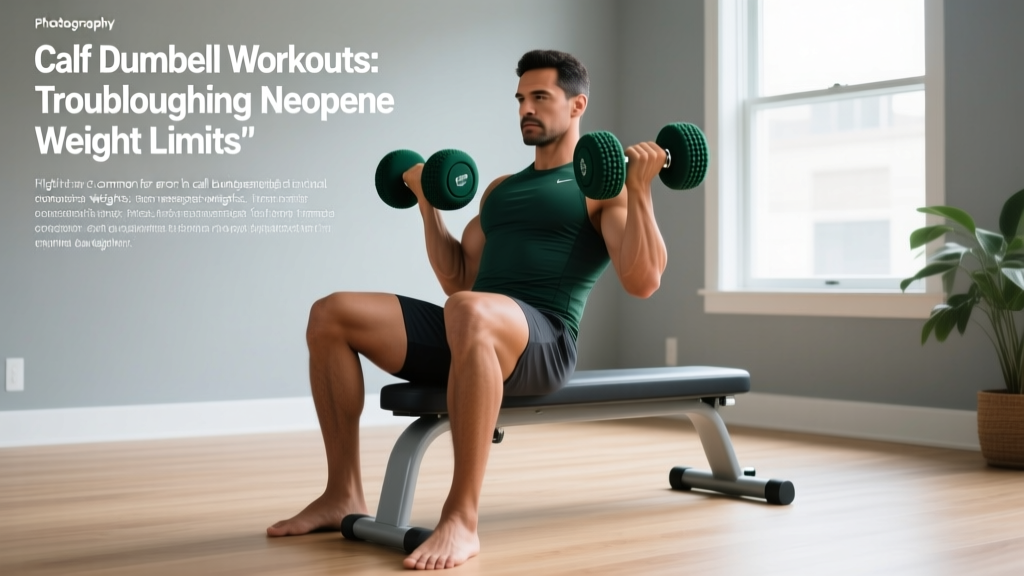
The Fix: Perform seated calf raises. Sit on a bench or sturdy chair, place a 2x4 wooden plank under your toes for elevation, and rest the neoprene dumbbells vertically on your thighs, just above the knees. Perform sets of 20-30 repetitions with a slow tempo. The light weight will induce massive metabolic pooling (the 'burn') necessary for soleus hypertrophy.
The Gastrocnemius Problem
The gastrocnemius is biased toward fast-twitch (Type II) fibers, requiring heavy mechanical loads. Standing straight-leg calf raises with light neoprene weights will simply not provide enough stimulus. If you only have neoprene weights, you must manipulate leverage and tempo to artificially increase the load (detailed in the Advanced Troubleshooting section below).
Mistake 3: Range of Motion and Footwear Errors
The ACE Fitness Exercise Library emphasizes that full dorsiflexion (the stretched position at the bottom of the movement) is critical for muscle damage and subsequent growth. Most home gym owners perform calf raises on flat hardwood or rubber mat flooring. This limits the heel's descent, effectively turning the exercise into a partial-rep ankle bounce.
Recent biomechanical analyses show that training muscles at long muscle lengths (the stretched position) yields significantly greater hypertrophic adaptations than training at shortened lengths. If your heel touches the floor, you are eliminating the most anabolic portion of the calf raise.
The Troubleshooting Fix: You do not need an expensive wooden calf block. Take a standard 10lb rubber bumper plate or a thick piece of 2x4 lumber, and place it on your floor. Stand with the balls of your feet on the edge of the plate/wood, allowing your heels to drop 2 to 3 inches below the toe line. This single adjustment will make your 20lb neoprene dumbbells feel twice as heavy due to the increased stretch-mediated tension.
Mistake 4: Neoprene Grip Failure and Pelvic Tilt
When performing single-leg standing calf raises to double the load on one calf, grip and balance become the limiting factors. Neoprene coating, while comfortable, lacks the aggressive knurling of bare steel or the textured rubber of hex dumbbells. As you sweat, the dumbbell slips, causing you to terminate the set before the calf reaches true muscular failure.
Furthermore, holding a heavy dumbbell in the contralateral (opposite) hand during a single-leg raise often causes the lifter to hike their hip and lean laterally, shifting the load away from the ankle joint and into the lateral hip stabilizers (gluteus medius).
- Fix 1 (Grip): Apply liquid chalk to your hands and the neoprene handles before the set. Alternatively, use figure-8 lifting straps to bind the dumbbell to your wrist, entirely removing grip from the equation.
- Fix 2 (Balance & Alignment): Hold the dumbbell in the ipsilateral (same side) hand as the working leg. Use your free hand to lightly touch a wall or power rack purely for balance, not for weight support. This keeps the pelvis level and forces the ankle to stabilize the load.
Advanced Troubleshooting: Making 15lbs Feel Like 50lbs
If you are locked into using neoprene coated dumbbells for home use due to budget or space constraints, you must abandon standard 'up-and-down' repetitions. To trigger hypertrophy in the gastrocnemius with sub-optimal loads, implement the 3-2-1-2 Tempo Protocol:
- 3-Second Eccentric: Lower your heel below the block at a strict, controlled count of three seconds. Do not rush the stretch.
- 2-Second Deep Pause: Hold the bottom position (maximum dorsiflexion) for two full seconds. This eliminates the elastic energy stored in the Achilles tendon, forcing the muscle belly to initiate the concentric phase.
- 1-Second Concentric: Drive up onto the big toe explosively.
- 2-Second Peak Contraction: Hold the top position, squeezing the calf hard. Shift your weight slightly forward over the big toe to prevent rolling onto the outside of the foot.
By utilizing this tempo, a set of 12 repetitions takes 48 seconds of continuous, agonizing tension. Even with light neoprene weights, this level of metabolic and mechanical stress will force the calves to adapt.
When to Ditch Neoprene: Upgrade Thresholds
While tempo and leverage hacks are excellent stopgaps, there is a hard ceiling to what neoprene dumbbells can achieve for straight-leg calf training. As of 2026, if you can comfortably perform 20 strict, paused repetitions with the heaviest neoprene dumbbells you own (typically 15-20 lbs per hand), it is time to reinvest in your home gym.
| Equipment Upgrade | Estimated 2026 Cost | Why It Fixes Calf Training |
|---|---|---|
| Adjustable Dumbbells (e.g., Bowflex 552 or Nuobell) | $350 - $450 / pair | Allows micro-loading up to 50-80lbs per hand for heavy gastrocnemius overload. |
| Hex Rubber Dumbbells (e.g., Rogue or Rep Fitness) | $2.00 - $2.50 / lb | Knurled chrome handles prevent grip failure; flat heads allow for floor-based seated presses. |
| Dedicated Calf Raise Block / Slant Board | $40 - $80 | Provides optimal, stable ankle angles and deeper dorsiflexion than improvised wooden blocks. |
Frequently Asked Questions
Can I build big calves using only 10lb neoprene dumbbells?
You can build the soleus muscle using 10lb dumbbells by performing high-rep, seated bent-knee calf raises with strict tempos. However, building the upper calf (gastrocnemius) requires heavy mechanical loading that 10lb weights simply cannot provide, even with advanced tempo manipulation.
Why do my ankles roll outward during dumbbell calf raises?
This is a common biomechanical fault caused by weak peroneal muscles or improper foot placement. Ensure you are driving the pressure through the base of your big toe and first metatarsal, rather than the outer edge of your foot. If using neoprene dumbbells, hold them at your sides rather than racked at your shoulders to lower your center of gravity and improve ankle stabilization.
How often should I train calves at home?
The calves recover incredibly quickly due to their high daily work capacity and dense capillary network. You can safely perform targeted calf dumbbell workouts 3 to 5 times per week, provided you alternate between heavy, straight-leg gastrocnemius days and lighter, high-rep bent-knee soleus days.
For more detailed biomechanical breakdowns of lower leg musculature, refer to the ExRx Kinesiology Soleus Guide to ensure your home programming aligns with human anatomy.
More gear to consider
All reviews
EZ vs Straight Bar: Gym Layouts & Dumbbell Thrusters GIF Guide
Dumbbell Workout at Home for Men vs Olympic Barbells

Top Adjustable Dumbbells for an Arm Workout With Dumbbells Only (2026)
Dumbbell Lat Pullover Safety: Collar & Clamp Types Compared

Long Dumbbells & Barbell Collars: Clamp Mistakes & Fixes