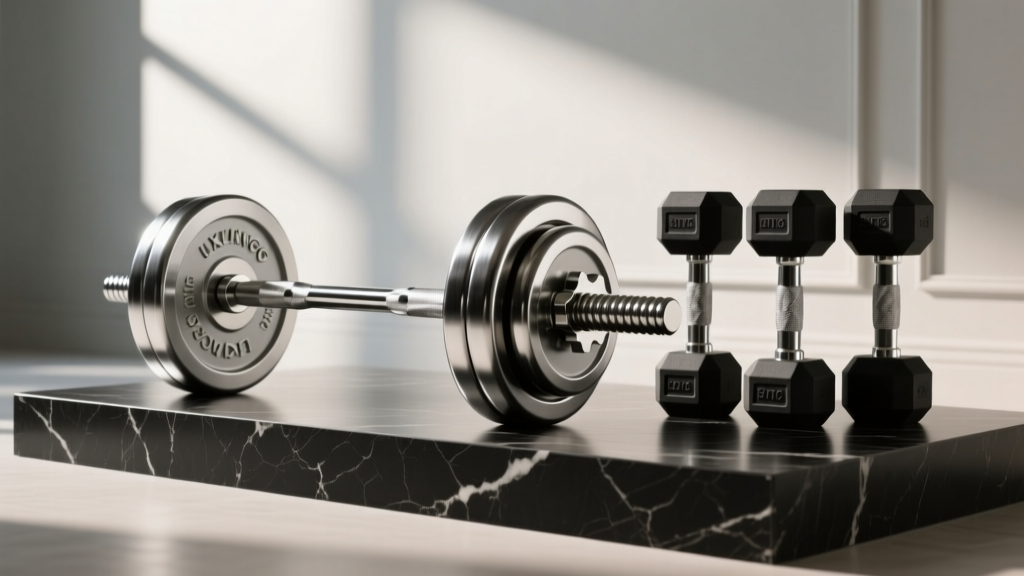
Bumper vs Iron Plates: Beyond Single Dumbbell Shoulder Workouts
Compare bumper vs iron plates for your home gym. Expert hands-on review covering drop ratings, durometer, and pairing with single dumbbell shoulder workouts.

The Home Gym Evolution: You have mastered your unilateral accessories, but as your overhead press and Olympic lifts scale up, the metal-on-metal clanking and floor vibrations demand a solution. The great debate in garage gym architecture is no longer just about the barbell—it is about what you load onto it.
As we navigate the fitness equipment landscape in 2026, the choice between bumper plates and traditional cast iron plates remains one of the most consequential decisions for home and commercial gym owners. While many lifters obsess over barbell whip or knurling depth, the plates dictate your floor longevity, noise pollution, and barbell sleeve capacity. In this hands-on expert review, we break down the material science, real-world failure modes, and programming integrations of both plate types to help you build a resilient, high-performance free weight ecosystem.
Material Science: Virgin Rubber vs. Cast Iron
To understand the performance gap, we must look at the manufacturing standards. According to the International Weightlifting Federation (IWF) Technical Rules, competition bumper plates must be exactly 450mm in diameter, ensuring that the barbell is always elevated to the correct starting height regardless of the weight loaded. Bumper plates are constructed from virgin or crumb rubber, measured on the Shore A durometer scale.
Standard training bumpers typically register between 88 and 90 on the Shore A scale, providing a balance of durability and dead-bounce absorption. Competition bumpers are softer (around 70-75 Shore A) to protect competition platforms during massive overhead drops. Cast iron plates, conversely, rely on sheer mass and structural rigidity. High-quality machined iron plates offer a tactile, dense feel that rubber simply cannot replicate, but they transfer 100% of the kinetic energy from a dropped barbell directly into your subfloor.
⚠️ Expert Warning: Barbell Sleeve Capacity
Before buying a full set of bumpers, measure your barbell sleeves. A standard Olympic sleeve is 16.3 inches long. Because a 45lb bumper plate is roughly 3.2 inches thick (compared to 1.3 inches for a 45lb iron plate), you can only fit about five 45lb bumpers per side (455 lbs total). If you are a powerlifter squatting 500+ lbs, you will run out of sleeve space with bumpers and must opt for calibrated steel or cast iron.
Tale of the Tape: 2026 Market Comparison
Freight stabilization over the last two years has shifted the pricing dynamics of free weights. Here is how the two categories stack up in the current market:
| Feature | Premium Bumper Plates | Machined Cast Iron |
|---|---|---|
| Average Cost (per lb) | $3.20 - $4.50 | $1.60 - $2.50 |
| Weight Tolerance | +/- 1% (Standard) | +/- 2% (Machined) |
| Thickness (45lb Plate) | ~3.2 inches | ~1.3 inches |
| Noise Reduction | Excellent (Absorbs impact) | Poor (High decibel clank) |
| Drop Rating | 10,000+ drops (from 6ft) | Not rated for dropping |
Hands-On Review: Rogue HG 2.0 vs. Rogue Echo Iron
To ground this data in reality, we tested two industry benchmarks: the Rogue HG 2.0 Bumper Plates and the Rogue Echo Cast Iron Plates.
The Bumper Experience: Rogue HG 2.0
The HG 2.0 series utilizes a proprietary 'dead-blow' inner steel ring. In our drop tests from a 5-foot overhead position onto a standard 3/4-inch horse stall mat, the barbell exhibited almost zero secondary bounce. This is a critical safety feature; cheaper bumpers with smooth steel inserts often act like pogo sticks, launching the barbell back toward the shins. The virgin rubber formulation also resists the 'white stress marks' that plague recycled crumb rubber bumpers after a year of heavy use. However, the 10lb and 15lb HG bumpers are notoriously thin and prone to 'taco-ing' (folding inward) if dropped alone on the barbell. You must always pair them with a 45lb plate to maintain structural integrity.
The Iron Experience: Rogue Echo Cast Iron
Handling the Echo iron plates is a nostalgic, tactile experience. The deep, raised numerals and e-coat finish provide a rust-resistant, grippy surface that makes manual plate changes rapid and secure. Because they are cast with tight tolerances, they sit flush against the barbell collar, eliminating the rattling vibration common in big-box store iron plates. The primary drawback is the noise and floor impact. Dropping a loaded Echo iron barbell, even onto a thick lifting platform, generates a low-frequency seismic thud that will rattle drywall and agitate neighbors in shared-wall spaces.
Real-World Failure Modes
- Bumper Insert Blowouts: The most common catastrophic failure in bumpers is the steel insert tearing through the rubber hub. This occurs when plates are dropped on uneven surfaces or when the barbell bends excessively under 500+ lb loads, putting lateral torque on the insert.
- Iron Chipping and Oxidation: Cast iron is brittle. If dropped on concrete without a platform, the outer lip will chip, creating sharp, rust-prone edges that can tear calluses and ruin gym flooring.
Programming Integration: Bridging Barbell and Dumbbell Work
How does your plate choice affect your daily programming flow? Consider the architecture of a comprehensive push day. Many advanced lifters structure their sessions by starting with heavy, CNS-taxing barbell overhead presses, then pivoting to single dumbbell shoulder workouts to isolate the medial deltoid and address unilateral imbalances without compressing the spine.
When transitioning between these modalities, the physical footprint and handling of your weight plates matter immensely. Iron plates are significantly easier to grip, carry, and swap quickly during drop-sets or when clearing the barbell to make room for your adjustable dumbbells on the floor. Bumper plates, while excellent for the initial heavy barbell work, are bulky and cumbersome to move out of the way when you transition to your single dumbbell shoulder workouts. If your home gym space is tight and requires constant equipment shuffling, a hybrid approach—using iron for the bulk of your weight and keeping a pair of 45lb bumpers for occasional Olympic lifts or noisy deadlift drops—is the most pragmatic setup.
The 2026 Buyer's Decision Matrix
Do not default to bumpers simply because they are trendy. Use this step-by-step framework to finalize your purchase:
- Evaluate Your Subfloor: If you are lifting in a basement with a concrete slab and no dedicated platform, buy bumper plates. The kinetic energy transfer from iron plates will eventually crack your foundation or destroy your flooring.
- Assess Your Lift Style: If your programming includes Olympic weightlifting (cleans, snatches, jerks) or high-rep touch-and-go deadlifts where the bar is dropped, bumpers are non-negotiable. If you strictly powerlift and control the eccentric phase of every rep, machined iron is superior and more cost-effective.
- Calculate Sleeve Real Estate: If your working sets exceed 450 lbs, you must purchase calibrated steel or cast iron plates to ensure you have enough barbell sleeve space to load the weight safely and secure the collars.
- Factor in Noise Ordinances: For garage gyms in dense suburban neighborhoods or apartment-adjacent spaces, the acoustic dampening of high-durometer rubber bumpers is worth the 40% price premium over iron.
Ultimately, the best free weight racks and bars are only as effective as the plates loaded onto them. By matching the material properties of your plates to your specific training environment and programming needs, you ensure a safer, quieter, and more efficient training space for years to come.
More gear to consider
All reviews
Best Neoprene Dumbbells for Standing Dumbbell Rotations

Setting Up Your Space for Effective Dumbbell Workouts for Women

Perfecting the Dead Bug with Dumbbells: Top Neoprene Picks 2026

Beyond How to Build Chest Muscle Using Dumbbells: Barbell Setup Guide

Collar Types Compared: Safe Dumbbell Skull Crushers Workout