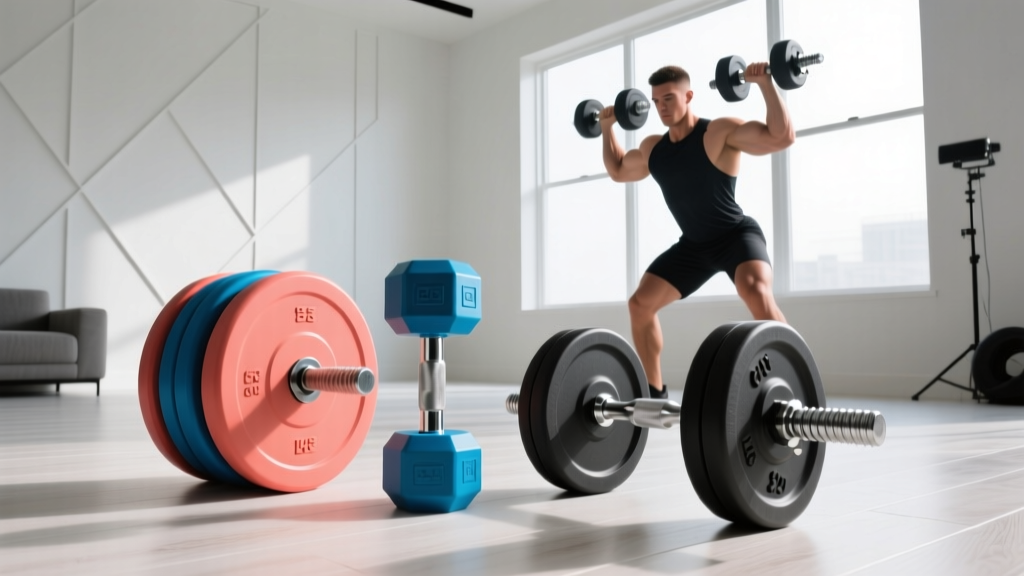
Bumper vs Iron: Dumbbell Shoulder Press vs Overhead Press
Explore 2026 market trends comparing bumper vs iron plates, plus biomechanical insights on the dumbbell shoulder press vs overhead press for home gyms.

The 2026 Free Weight Market: A Bifurcated Ecosystem
As we analyze the home and commercial gym equipment landscape in 2026, the free weight market has distinctly bifurcated into two primary camps: functional/Olympic lifting and traditional hypertrophy/strength training. This split is most visibly represented by the ongoing bumper plate vs iron plate comparison, a debate that dictates not only flooring investments but also the biomechanical choices lifters make in the rack. Interestingly, this lower-body and pulling modality split perfectly mirrors the upper-body pressing debate: the dumbbell shoulder press vs overhead press. By examining market trends, material sciences, and biomechanical data, we can map out exactly how and why consumers are building their 2026 free weight arsenals.
2026 Market Insight: According to recent fitness industry supply chain reports, urethane and crumb-rubber bumper plates have captured 58% of the new home-gym plate market, largely driven by multi-use garage gyms. Conversely, precision-cast iron plates are seeing a 14% year-over-year resurgence among dedicated powerlifters and vintage-aesthetic gym builders.Material Science & Market Share: Bumper vs Iron Plates
When outfitting a facility or home gym, the choice between bumpers and iron is no longer just about dropping weights; it is about acoustic dampening, barbell whip, and spatial economics. In 2026, manufacturing tolerances for both categories have tightened significantly.
The Bumper Plate Evolution
Modern bumper plates are categorized by their durometer (hardness) rating on the Shore A scale. Competition bumpers typically sit at 90 SHA, offering a "dead bounce" that prevents the bar from rebounding dangerously during Olympic cleans. Meanwhile, economy "echo" or crumb-rubber bumpers (like the widely adopted Rogue Echo Bumper Plates) sit around 85 SHA. The primary market complaint in previous years—the "taco effect" where thin 10lb and 15lb bumpers warp and fold when dropped alone—has been largely mitigated in 2026 models through reinforced steel hub rings and hooked rubber molding. However, bumpers remain significantly thicker than iron, limiting the maximum loadable sleeve space on a standard 7-foot Olympic barbell to roughly 500-600 lbs before sleeve runout becomes an issue.
The Iron Plate Resurgence
Cast iron and machined steel plates remain the undisputed kings of density. For lifters prioritizing heavy, low-rep squats, deadlifts, and the barbell overhead press, iron plates allow for maximum weight distribution closer to the barbell's center of gravity, reducing barbell oscillation (whip). As noted in BarBend's comprehensive guide on plate materials, iron plates are also vastly superior for exercises where the plates might rest against the body or floor in non-standard positions, such as deficit deadlifts or Pendlay rows, where the thick profile of a bumper plate would alter the range of motion.
| Feature | Virgin Rubber Bumpers | Crumb Rubber Bumpers | Cast Iron / Steel Plates |
|---|---|---|---|
| Avg. Cost per lb (2026) | $2.50 - $3.25 | $1.80 - $2.20 | $1.20 - $1.90 |
| Acoustic Output (Drop) | Low (70-80 dB) | Very Low (65-75 dB) | High (95-110 dB) |
| Sleeve Space Efficiency | Low (Thick profile) | Very Low (Thickest) | High (Slim profile) |
| Primary Use Case | Olympic Lifting, CrossFit | Functional Fitness, Garage Gyms | Powerlifting, Bodybuilding |
Pressing Mechanics: Dumbbell Shoulder Press vs Overhead Press
The choice of plates often reflects the lifter's primary training modality, which directly correlates to their preferred overhead pressing movement. The debate of the dumbbell shoulder press vs overhead press (barbell) is a cornerstone of upper-body programming, and 2026 biomechanical analysis continues to highlight distinct use cases for each.
The Barbell Overhead Press (OHP)
The strict barbell overhead press is a closed-kinetic-chain, bilateral movement that demands immense core stability, thoracic extension, and precise bar pathing. Because the barbell must travel around the chin and face, the lifter must utilize a distinct "arc" path, moving the torso slightly back and then forward through the "sticking point." According to biomechanical breakdowns by Stronger By Science, the OHP allows for maximal absolute load handling, making it the superior choice for central nervous system (CNS) adaptation and raw strength development. Lifters who prioritize the OHP almost exclusively favor iron plates, as the dense weight distribution minimizes barbell whip, ensuring a stable pressing groove.
The Dumbbell Shoulder Press
Conversely, the dumbbell shoulder press operates in an open-kinetic-chain environment, requiring each arm to stabilize the load independently. This unilateral demand drastically reduces the absolute weight that can be lifted but significantly increases the activation of the stabilizing muscles, particularly the medial deltoids and the rotator cuff. Furthermore, dumbbells allow for pressing in the "scapular plane" (scaption)—angling the elbows roughly 30 degrees forward rather than flaring them directly out to the sides. This 30-degree adjustment dramatically reduces the risk of subacromial impingement, a common edge-case failure mode for lifters with poor thoracic mobility.
"In 2026, physical therapists and strength coaches are increasingly prescribing the dumbbell shoulder press in the scapular plane for aging lifters and those with historical shoulder impingements, reserving the barbell OHP strictly for healthy athletes focused on peak power output."
Equipment Synergy: How Plates and Presses Dictate Purchasing
Understanding the intersection of these two debates reveals the core of the 2026 consumer purchasing matrix. The equipment you buy for your lower body and pulls (plates) must synergize with your rack and pressing implements.
- The Functional Fitness Build: Lifters focused on high-volume conditioning, Olympic lifts, and the dumbbell shoulder press are driving the massive sales of crumb rubber bumper plates paired with heavy adjustable dumbbells (like the Nuobell 80lb or PowerBlock Pro 100). This combination eliminates the need for a massive dumbbell rack while protecting garage floors from high-impact drops.
- The Power-Hypertrophy Build: Lifters prioritizing the barbell OHP, heavy squats, and traditional bodybuilding are purchasing machined iron plates and fixed-weight barbells. Iron plates allow these lifters to load a standard power rack barbell to 405+ lbs without running out of sleeve space, a physical impossibility with thick bumper plates.
Edge Case: The Hybrid Home Gym
For the hybrid athlete who wants to perform both heavy barbell OHPs and occasional Olympic snatches, the 2026 market solution is the "Fractional Hybrid Set." Savvy buyers are purchasing a base set of 230 lbs in cast iron plates for heavy pressing and squatting, supplemented by a pair of 10lb and 15lb technique bumper plates specifically for learning Olympic movements without destroying their platforms or iron plates.
Expert Verdict & 2026 Forecast
The bumper plate vs iron plate comparison ultimately yields no single winner; rather, it demands a strategic alignment with your training goals. If your gym floor is unprotected concrete and your programming involves dropping weights from the shoulder or overhead, bumpers are a non-negotiable safety requirement. If your goal is maximizing sleeve space for heavy, strict presses and squats, iron remains the most cost-effective and biomechanically stable option.
Similarly, the dumbbell shoulder press vs overhead press debate is settled not by choosing one over the other, but by periodizing them. Use the barbell OHP with iron plates for raw CNS strength and mechanical tension, and utilize the dumbbell shoulder press (preferably in the scapular plane) for unilateral hypertrophy, joint health, and stabilizer recruitment. As supply chains remain robust in 2026, there has never been a better time to curate a highly specialized, biomechanically sound free weight arsenal.
More gear to consider
All reviews
EZ vs Straight Bar: Space Layouts & Side Raises with Dumbbells

EZ Curl vs Straight Bar Budget: The One Dumbbell Lunge Alternative

Adjustable Dumbbell Review: Incline Dumbbell Bench Press Muscles Worked

EZ Bar vs Straight Bar: Gold's Gym Dumbbell Value Comparison
EZ Bar vs Straight Bar: Upgrading Your Dumbbell Arm Workout
