
Bumper vs Iron Plates vs Dumbbell Rear Delt Fly Machine Budgets
We break down the 2026 costs and ROI of upgrading to bumper vs iron plates compared to investing in a dumbbell rear delt fly machine for your home gym.

The 2026 Home Gym Budget Dilemma: Foundation vs. Isolation
When outfitting or upgrading a home gym in 2026, lifters with a strict $800 to $1,500 budget inevitably face a critical crossroads: do you invest heavily in foundational free weights, or do you allocate capital toward specialized isolation equipment? This debate frequently manifests when comparing the cost of a premium bumper plate vs iron plate set against the purchase of a dedicated isolation unit, such as a rear deltoid machine. Making the right choice requires a deep understanding of material science, biomechanics, and long-term equipment ROI.
In this comprehensive budget breakdown, we will dissect the exact costs, failure modes, and training value of upgrading your weight plates versus investing in specialized hypertrophy machines. Whether you are a powerlifter needing calibrated steel or a bodybuilder chasing 3D delts, this value analysis will dictate where your money is best spent.
Bumper Plates vs. Cast Iron Plates: Material & Cost Breakdown
The foundation of any free-weight setup lies in the plates. However, not all weight is created equal. The choice between bumper plates and traditional cast iron plates drastically alters your training environment, floor longevity, and wallet.
Cast Iron and Calibrated Steel Plates
Cast iron plates are the undisputed kings of density and affordability. In 2026, standard economy cast iron plates average between $1.50 and $2.00 per pound. For a 260-pound set, you are looking at an investment of roughly $390 to $520. The primary advantage of iron is its thin profile; you can easily fit 500+ pounds on a standard barbell sleeve, which is essential for heavy deadlifts and squats.
However, if you require competition-level accuracy, calibrated steel plates (machined to a strict ±10-gram tolerance) will cost between $3.50 and $5.00 per pound. The downside to iron? Noise and impact. Dropping iron plates transfers kinetic energy directly into your subfloor, risking structural damage over time without heavy-duty horse stall mats.
Bumper Plates: Durometer and Dead-Blow Mechanics
Bumper plates are constructed from virgin rubber or recycled crumb rubber, designed to be dropped from overhead heights. When shopping for bumpers, you must pay attention to the Shore A Durometer scale, which measures rubber hardness.
- Economy Crumb Rubber (80-85 Shore A): Highly bouncy, loud, and prone to degrading. Costs around $1.75 to $2.25 per pound.
- Virgin Rubber (88-90 Shore A): The sweet spot for home gyms. Offers a 'dead-blow' effect, absorbing impact without excessive bounce. Costs $2.50 to $3.50 per pound.
- Competition Urethane (92+ Shore A): Extremely dense, minimal bounce, and highly durable. Costs $4.50 to $6.00+ per pound.
Cost & Specs Comparison Matrix
| Equipment Type | 2026 Avg Cost (per lb) | Diameter / Profile | Drop Tolerance | Best For |
|---|---|---|---|---|
| Economy Cast Iron | $1.50 - $2.00 | Varies / Very Thin | Low (Chips floors) | General strength, tight budgets |
| Calibrated Steel | $3.50 - $5.00 | 450mm / Ultra-Thin | Low (High impact) | Powerlifting, precision tracking |
| Virgin Rubber Bumper | $2.50 - $3.50 | 450mm / Thick | High (Dead-blow) | Olympic lifting, CrossFit |
| Competition Urethane | $4.50 - $6.00+ | 450mm / Medium | Very High | Commercial gyms, elite athletes |
The Dumbbell Rear Delt Fly Machine: Is the Isolation Worth the Price Tag?
When building a specialized physique, many lifters find themselves searching for a 'dumbbell rear delt fly machine.' Technically, this is a paradoxical term—you either use free-weight dumbbells or a machine. However, in the fitness equipment industry, this search intent points directly to independent-arm, plate-loaded rear deltoid isolation machines (such as those engineered by Hammer Strength, Prime Fitness, or Titan Fitness). These machines mimic the converging arc of a dumbbell reverse fly while providing the thoracic stability of a chest pad.
Biomechanics and the Rear Delt Bottleneck
The posterior deltoid is responsible for horizontal abduction and external rotation of the humerus. As documented in the biomechanics databases at ExRx, performing this movement with free-weight dumbbells (like the bent-over rear delt fly) introduces a massive stability bottleneck. Your lower back and hamstrings must work isometrically to hold the hinge position, often failing before the rear deltoids reach true muscular failure.
An independent-arm plate-loaded machine removes this bottleneck. By supporting the chest, you isolate the target muscle, allowing for progressive overload without systemic fatigue.
Pricing the Isolation Upgrade
In 2026, the pricing for rear delt isolation machines varies wildly based on the pivot-point engineering:
- Budget Plate-Loaded (e.g., Titan Fitness Rear Delt): $599 - $799. Uses basic linear bearings and standard steel pivot pins. Excellent for home gyms.
- Mid-Tier Commercial (e.g., Hammer Strength MTS): $1,800 - $2,500. Features converging arcs of motion that match natural scapular retraction.
- Elite Selectorized (e.g., Prime Fitness or Arsenal Strength): $3,500 - $5,000+. Includes adjustable resistance profiles (cams) and premium upholstery.
ROI Scenarios: Where Should Your Money Go?
To determine the highest ROI for your $1,000 budget, you must align your equipment purchases with your primary training modality.
Scenario A: The Strength Athlete (Powerlifting / Olympic Lifting)
Recommendation: Allocate 90% of your budget to foundational plates. If you are pulling heavy deadlifts or performing Olympic cleans, a specialized rear delt machine is a luxury you cannot afford. Invest $800 into a 260lb set of Virgin Rubber Bumper Plates (for drops) or Calibrated Steel Plates (for sleeve space). Use the remaining $200 for heavy-duty flooring and a basic set of adjustable dumbbells to perform bent-over rear delt flies. The ACE Fitness Exercise Library confirms that with proper scapular retraction cues, free-weight dumbbell flies are highly effective for posterior chain development without requiring a $2,000 machine.
Scenario B: The Hypertrophy & Aesthetics Athlete (Bodybuilding)
Recommendation: Split the budget 50/50. If your goal is a 3D shoulder look and a thick upper back, joint health and muscle isolation are paramount. Purchase a basic 150lb set of cast iron plates ($300) to handle your compound presses and rows. Then, allocate the remaining $700 toward a high-quality, plate-loaded independent-arm rear delt machine. The ability to safely train the rear delts to absolute failure multiple times a week, without lower-back fatigue, will yield vastly superior hypertrophy outcomes over a decade of training.
Real-World Failure Modes & Maintenance Costs
When analyzing long-term value, you must factor in how equipment degrades over time.
Plate Degradation
- Iron Oxidation: Cast iron plates are highly susceptible to rust in unclimate-controlled garages. If you live in a humid environment, factor in the cost of wire-brushing and applying a rust-inhibitor like WD-40 Specialist Corrosion Inhibitor every 18 months.
- Bumper 'White Ring' Tearing: Economy bumper plates frequently suffer from hub separation, where the rubber tears away from the steel center ring after repeated drops. This is a catastrophic failure mode that renders the plate unsafe for overhead drops.
Machine Pivot Seizure
Plate-loaded isolation machines rely on steel pivot pins and bronze or nylon bushings. If not cleaned and lubricated with PTFE-based lubricants annually, dust and chalk buildup will cause the pivot points to seize, resulting in a 'stuttering' motion path that ruins the mind-muscle connection and places uneven shear force on the shoulder joint.
Final Verdict: The 2026 Buying Framework
The decision between upgrading your bumper vs iron plates and investing in a dedicated dumbbell rear delt fly machine ultimately comes down to your training age and specific goals. If you are still building your baseline strength and lack a comprehensive set of weight plates, always prioritize the plates. Free weights offer infinite exercise variations that a single-purpose machine cannot replicate.
However, if your home gym is already stocked with adequate iron, and you find your rear deltoid development lagging due to lower-back fatigue during free-weight flies, an independent-arm plate-loaded machine is one of the highest-ROI hypertrophy investments you can make in 2026. Evaluate your weaknesses, respect the biomechanics, and allocate your budget accordingly.
More gear to consider
All reviews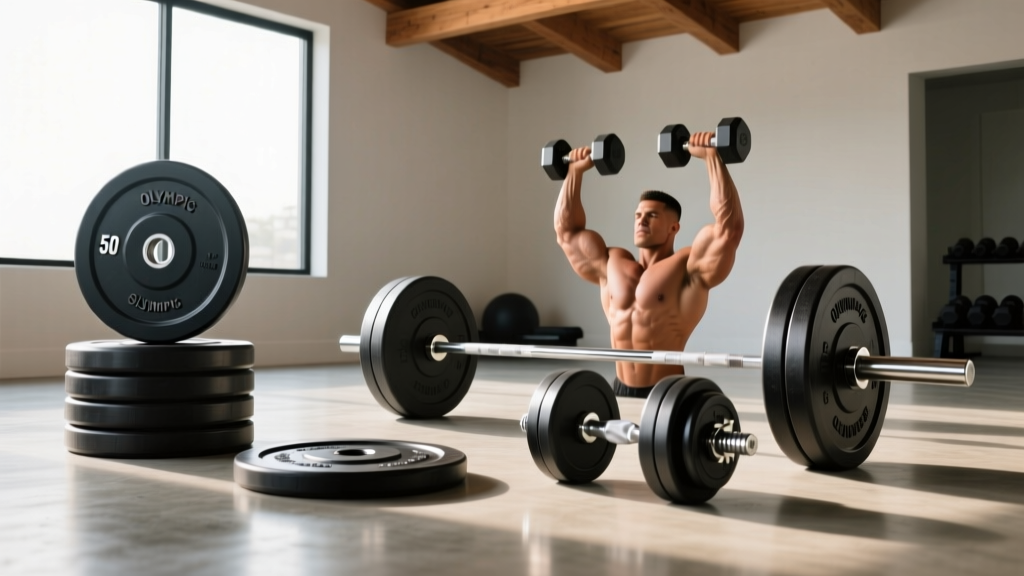
Olympic vs Standard Plates: Troubleshooting Gear & Dumbbell Skull Crusher Muscles Worked

Space Layouts for Different Exercises with Dumbbells: Hex vs Urethane

Barbell Setup vs Deadlifts with Dumbbells Form: Knurl & Weight Guide
2026 Trends: Rubber Hex vs Urethane Dumbbell Chop Exercise

EZ vs Straight Bar: 2026 Trends & The Dumbbell Deadlift Exercise
