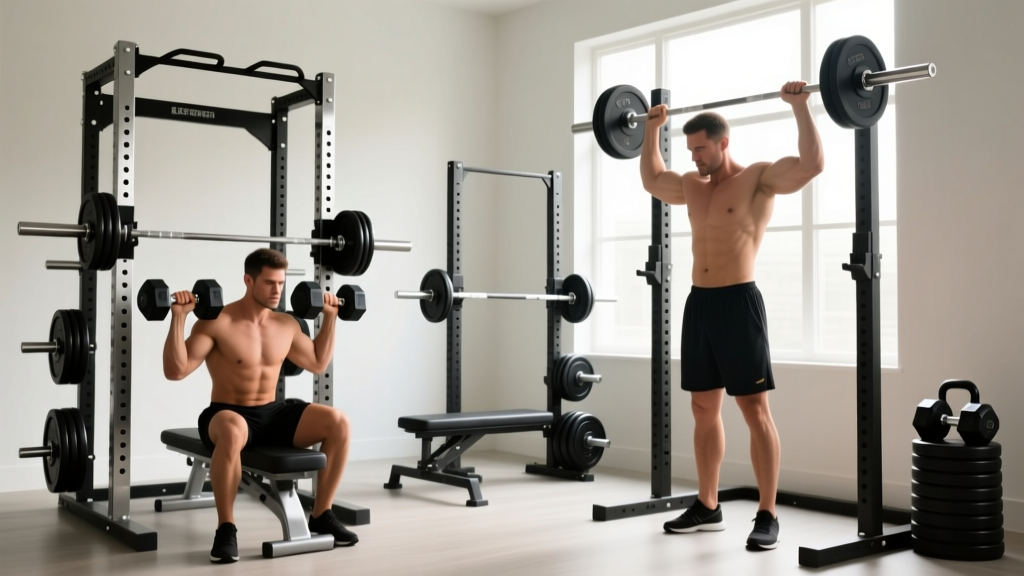
Bumper vs Iron Plates: Layouts & Lawn Mower Exercise Dumbbell Space
Optimize your home gym layout. Compare bumper vs iron plates for spatial efficiency, drop zones, and lawn mower exercise dumbbell row clearance.

The Spatial Geometry of Free Weight Storage
When designing a high-performance home gym in 2026, the debate between bumper plates and cast iron plates usually centers on noise reduction or Olympic lifting drop-ability. However, from a strict space optimization and layout design perspective, the decision is fundamentally about volumetric geometry and functional clearance. Every square foot in a multi-use garage or basement gym carries a premium, and the physical dimensions of your weight plates dictate your rack placement, storage footprint, and movement aisles.
Choosing the wrong plate profile can bottleneck your floor plan, forcing you to compromise on essential movement zones. This is especially true when programming unilateral, high-clearance movements like the classic lawn mower exercise dumbbell row, which demands precise spatial awareness and unobstructed floor paths. Below, we break down the exact dimensional differences, storage economics, and layout blueprints required to optimize your gym space based on your plate selection.
Dimensional Matrix: Bumper vs. Iron Plate Footprints
To understand the spatial impact, we must look at the raw data. Bumper plates are manufactured to the International Weightlifting Federation (IWF) standard diameter of 450mm (17.7 inches), regardless of their weight. Iron plates, conversely, scale in diameter and thickness based on their mass. This fundamental design difference creates a massive divergence in storage volume.
| Specification | Standard Crumb Rubber Bumper (45lb) | Urethane Competition Bumper (45lb) | Machined Cast Iron (45lb) |
|---|---|---|---|
| Diameter | 17.7 inches (450mm) | 17.7 inches (450mm) | 14.5 - 15.0 inches |
| Thickness (Single Plate) | 2.15 inches | 1.45 inches | 1.25 - 1.30 inches |
| Thickness (Pair on Sleeve) | 4.30 inches | 2.90 inches | 2.50 - 2.60 inches |
| 10-Pair Storage Tree Width | ~24.0 inches | ~18.0 inches | ~14.0 inches |
| Floor Stand Footprint | 24" x 24" minimum | 24" x 24" minimum | Wall-mountable (8" projection) |
As the data illustrates, a standard 10-peg vertical storage tree holding five pairs of 45lb crumb rubber bumpers requires nearly double the linear peg space of machined iron plates. More critically, bumper plates almost universally require floor-standing A-frames or heavy-duty horizontal wall shelves due to their sheer volume and weight distribution, whereas iron plates can be stored on compact, wall-mounted vertical trees that project barely 8 inches from the wall.
Designing the Functional Aisle: The Lawn Mower Protocol
Space optimization isn't just about where equipment lives at rest; it's about the dynamic envelope required during movement. Consider the biomechanics of the lawn mower exercise dumbbell row. This unilateral back movement requires the user to brace one knee and hand on a flat bench, hinge at the hips, and pull a heavy dumbbell from a dead stop on the floor up to the hip pocket.
Collision Zones and Rack Placement
Executing the lawn mower exercise dumbbell row safely requires a minimum lateral clearance of 36 inches from the edge of the bench to allow for the natural swing path of the weight and the user's torso rotation. If you utilize floor-standing bumper plate trees, their 24-inch base and 17.7-inch plate overhang frequently encroach into this 36-inch functional aisle.
⚠️ Layout Warning: Placing a loaded bumper plate A-frame within 4 feet of a bench station creates a severe knuckle-collision hazard during heavy dumbbell rows and single-arm snatches. The thick profile of rubber bumpers extends past the steel frame, turning your storage unit into an active obstacle.Conversely, iron plates stored on a wall-mounted vertical rack completely eliminate this floor-level collision zone. By pushing storage flush against the drywall, you open up the entire floor plane, allowing you to position your bench anywhere in the room without calculating the overhang radius of a bumper plate tree.
Vertical vs. Horizontal Storage Economics
When mapping out your layout, you must weigh the cost per square foot of your gym space against the cost of the plates themselves. In 2026, high-quality crumb rubber bumper plates average $2.50 to $3.50 per pound, while machined cast iron plates sit at $2.00 to $2.50 per pound. However, the hidden cost is spatial real estate.
- The Bumper Layout: Requires a dedicated 4x4 foot drop zone lined with 3/4-inch horse stall mats, plus a 2x2 foot footprint for the storage tree. Total dedicated spatial footprint for a 400lb bumper setup: ~20 square feet.
- The Iron Layout: Requires no dedicated drop zone (as dropping iron destroys concrete and equipment), allowing the storage tree to be mounted on the wall directly above a multi-use lifting platform. Total dedicated floor footprint for a 400lb iron setup: 0 square feet (wall-mounted).
For garage gyms under 200 square feet, the spatial efficiency of wall-mounted iron plates is mathematically superior. You reclaim up to 20 square feet of floor space, which can be repurposed for a dedicated functional fitness turf strip or an additional cardio station.
Floor Protection and Drop Zone Allocation
The primary argument for bumper plates is their shock-absorbing capability. If your layout includes high-volume Olympic lifting (cleans, snatches, overhead squats) or high-rep deadlift drops, bumper plates are non-negotiable. However, this dictates your layout design: you must allocate a centralized, reinforced drop zone.
According to equipment specialists at Rogue Fitness, repeated dropping of iron plates, even on thick rubber mats, will eventually cause micro-fractures in standard residential garage concrete—a phenomenon known as spalling. Therefore, if you choose iron plates to save space and utilize the wall-mount strategy, your layout must strictly prohibit dropping the barbell. You will need to install safety spotter arms on your power rack at knee height to allow for controlled, quiet lowering of the bar during heavy rack pulls or deadlifts, completely negating the need for a sprawling floor drop zone.
Hybrid Layout Solutions
For the advanced home gym designer, a hybrid approach often yields the best spatial and functional results. Consider purchasing a minimal set of bumper plates (e.g., a pair of 45s and a pair of 25s) strictly for Olympic movements, stored on a low-profile horizontal wall shelf. Supplement this with a full set of machined iron plates for heavy squats, bench presses, and deadlifts, stored on a vertical wall tree. This hybrid model keeps the floor clear for the lawn mower exercise dumbbell row and other sprawling unilateral movements while preserving the equipment's integrity.
Final Verdict: Which Plate Fits Your Floor Plan?
Your choice between bumper and iron plates should be dictated by your available square footage and your movement inventory. If your gym exceeds 250 square feet and your programming heavily features Olympic lifts, the spatial penalty of bumper plate A-frames is a worthy trade-off for floor protection. However, if you are optimizing a tight, multi-use space under 200 square feet, and your programming relies on heavy powerlifting, unilateral dumbbell work, and functional aisle clearance, machined iron plates on a vertical wall-mount system are the undisputed champions of spatial efficiency. By reclaiming the floor space traditionally surrendered to bulky rubber storage, you unlock the freedom to design a truly unobstructed, high-performance training environment.
More gear to consider
All reviews
2026 Market Trends: Loadable Dumbbells for Dumbbell Glute Workouts

Bowflex 552 Dumbbell Review: 2026 Adjustable Weight Guide

Bumper vs Iron Plate Trends & Dumbbell Exercises for Seniors PDF

Beyond the Plank with Dumbbell: Olympic Barbell Weight & Knurling Guide

Power Rack vs Squat Rack vs Stand Setup: Leg Extensions at Home With Dumbbells