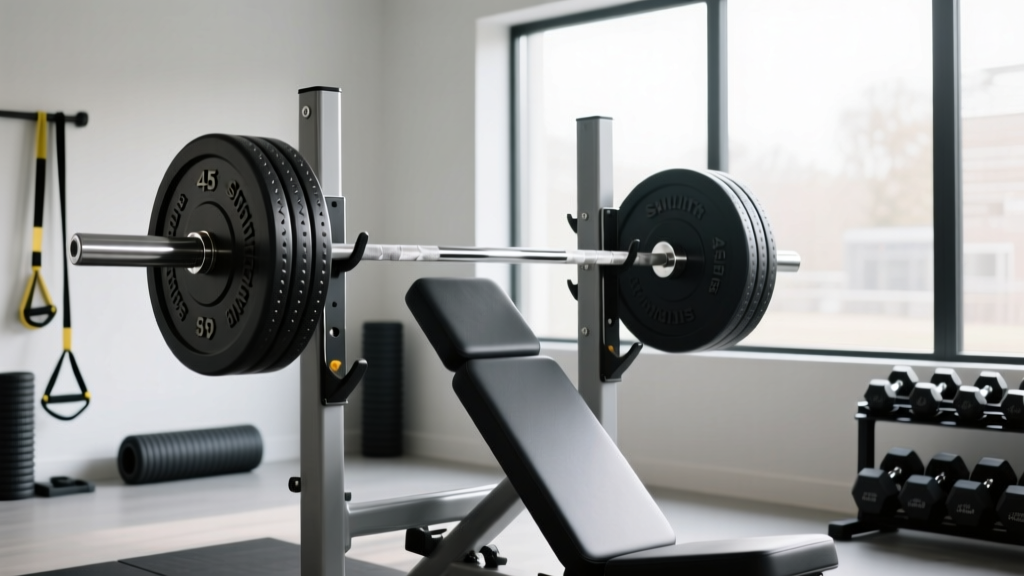
Barbell Weight & Knurling Guide: Smith Machine Leg Press Attachment
Master Olympic barbell weight, tensile strength, and knurling patterns. Learn how shaft tolerances impact your smith machine leg press attachment.

Selecting an Olympic barbell requires looking far beyond the 20kg stamp on the end of the sleeve. As manufacturing processes have evolved through 2026, the nuances of barbell weight calibration, knurling geometry, and steel tensile strength dictate not only your lifting performance but also the longevity of your gym equipment. Furthermore, understanding these dimensional tolerances is critical when integrating your barbell with modular rack accessories, particularly when loading a shaft into a plate-loaded sled or a specialized smith machine leg press attachment.
Dimensional Tolerances and Weight Calibration
The International Weightlifting Federation (IWF) mandates strict tolerances for competition barbells. According to the IWF technical rules, a 20kg barbell must weigh between 19.98kg and 20.02kg. However, commercial and home gym barbells often operate on wider manufacturing tolerances, typically ranging from +/- 1% to +/- 2%. While a 200-gram variance is imperceptible during a heavy deadlift, it matters for precise programming and competition preparation.
Beyond total weight, the shaft diameter dictates the bar's 'whip' (elastic deformation) and grip feel. Olympic weightlifting bars feature a 28mm shaft to maximize whip and accommodate the hook grip, whereas powerlifting bars utilize a 29mm shaft for rigidity during squats and bench presses. Multi-purpose bars usually split the difference at 28.5mm.
Expert Warning: Never assume a barbell labeled 'Olympic' features true 50mm sleeves. Budget import bars often feature 48mm or 49mm sleeves, which will cause severe binding and scratching when used with calibrated steel plates or specialized rack attachments.Knurling Geometry: Hill, Mountain, and Volcano
Knurling is the cross-hatched pattern machined into the steel shaft to increase friction. The geometry of the knurl—specifically the peak shape and valley depth—determines how aggressively the bar bites into your skin. There are three primary knurl profiles in the 2026 market:
- Hill Knurling: The peaks of the knurl are rounded off during the machining process. This creates a smooth, almost dull grip. It is ideal for high-repetition conditioning or beginners, but it fails to provide adequate traction for heavy 1RM deadlifts or low-bar squats. The York Legacy series is a classic example of this milder profile.
- Mountain Knurling: The peaks are left sharp and flat, resembling jagged mountain tops. This provides an incredibly aggressive grip that acts like sandpaper. While excellent for heavy powerlifting, it will easily tear the calluses off your hands during high-volume Olympic lifts. The classic Texas Power Bar utilizes this severe geometry.
- Volcano Knurling: Widely considered the gold standard for modern multi-purpose bars, volcano knurling features sharp rims with a small crater or 'valley' in the center of each peak. This design increases the total surface area of the grip, providing exceptional traction without the sharp, tearing edges of a mountain knurl. The Rogue Ohio Bar popularized this specific volcano profile, featuring a peak-to-valley depth of approximately 1.2mm.
Equipment Interoperability: The Smith Machine Leg Press Attachment
When outfitting a home gym with modular power rack accessories, many lifters invest in a plate-loaded sled or a specialized smith machine leg press attachment to simulate hack squats and sled movements. However, a massive and frequently overlooked failure mode occurs when the barbell's knurling and sleeve dimensions interact with the attachment's carriage.
The Knurl Width and UHMW Liner Problem
Many aftermarket smith machine leg press attachment models rely on a standard 7-foot Olympic barbell resting inside a pivoting UHMW (Ultra-High Molecular Weight) plastic-lined sled track. If you purchase a budget barbell where the knurling extends too far laterally into the sleeve, the sharp steel knurl will act like a file against the UHMW plastic liners every time you press the weight. Within a few months, the plastic will degrade, leading to metal-on-metal grinding, catastrophic sled binding, and voided equipment warranties.
Always measure the un-knurled section of the sleeve. A high-quality barbell will leave at least 4 to 5 inches of smooth steel between the end of the knurl and the sleeve collar to ensure safe clearance inside plate-loaded attachment carriages.
Shaft Diameter Binding
If your leg press attachment features a fixed pivot collar designed for a standard 28.5mm multi-purpose bar, attempting to use a 29mm stiff power bar can cause micro-binding at the pivot point. This alters the force vector of the press, placing uneven shear stress on the barbell sleeves and potentially bending the pivot pins of the attachment.
2026 Barbell Comparison Matrix
Below is a comparative breakdown of top-tier Olympic barbells, highlighting how their specific dimensions and knurl patterns suit different training modalities and equipment integrations.
| Barbell Model | Shaft (mm) | Knurl Type | Tensile (PSI) | Est. Price (2026) |
|---|---|---|---|---|
| Rogue Ohio Bar | 28.5mm | Volcano | 190,000 | $295.00 |
| Kabuki NG Power Bar | 29.0mm | Mountain | 215,000+ | $399.00 |
| Eleiko Olympic WL | 28.0mm | Aggressive Hill | 215,000 | $1,150.00+ |
| American Barbell SS | 28.5mm | Mild Volcano | 190,000 | $265.00 |
Tensile Strength vs. Yield Strength
Marketing materials heavily emphasize tensile strength (measured in PSI), but yield strength is actually the more critical metric for barbell longevity. Tensile strength represents the absolute maximum stress the steel can withstand before snapping. Yield strength represents the point at which the steel permanently deforms (bends) and fails to return to its original straight line.
A high-quality Olympic barbell should feature a tensile strength of at least 190,000 PSI. Budget bars often drop to 160,000 PSI or lower, making them highly susceptible to permanent bending if dropped on a rack with heavy loads. However, the heat treatment process determines the yield strength. Brands like Kabuki Strength utilize specialized heat-treating protocols to ensure their 29mm power bars resist permanent deformation even when subjected to extreme eccentric squat loads exceeding 800 lbs.
Maintenance Protocols and Edge Cases
Even the most expensive cerakote or stainless steel barbell requires maintenance to preserve its knurling and internal rotation mechanics. The primary enemy of barbell knurling is not friction from your hands, but the accumulation of dead skin, chalk, and ambient humidity, which leads to oxidative rust deep within the knurl valleys.
'Once rust takes hold in the valley of a volcano knurl, the structural integrity of the peak is compromised. The steel will eventually flake, transforming a premium grip into a dull, slippery hazard.' — Master Equipment Technician
Step-by-Step Knurl Maintenance
- Dry Brushing: After every session, use a stiff nylon brush (never brass or steel on bare shafts) to dislodge chalk and skin from the knurl valleys.
- Solvent Application: Once a month, apply a few drops of 3-in-1 oil or a specialized barbell cleaner to the shaft.
- Deep Agitation: Scrub the shaft with the nylon brush to lift embedded debris.
- Wipe Down: Use a microfiber cloth to remove excess oil, leaving only a microscopic protective film inside the knurl valleys.
Furthermore, pay attention to the internal bushings or bearings. If your barbell is frequently used in dynamic rack attachments or leg press sleds where lateral sleeve pressure is high, composite or bronze bushings are preferred over needle bearings. Bushings handle slow, heavy, lateral loads significantly better than bearings, which are designed for the high-RPM rotation of Olympic cleans and snatches. Matching your barbell's internal mechanics to your accessory equipment ensures a seamless, friction-free training experience for years to come.
More gear to consider
All reviews
Setup Guide: Bent Over Dumbbell Raise & Olympic Barbell Knurling

Olympic vs Standard Plates & the Dumbbell Pullover Without a Bench

Cast Iron vs Competition Kettlebells: The Red Dumbbell Trend

EZ Curl Bar vs Straight Bar & Dumbbell Core Exercises

Olympic vs Standard Plates: Setup for the Best Dumbbell Back Workout
