Barbell Guide: Weight, Knurling & Chest Exercises With One Dumbbell
Master your Olympic barbell buying guide for weight and knurling. Plus, discover top chest exercises with one dumbbell to fix muscle imbalances.

The Centerpiece of the Rack: 2026 Olympic Barbell Standards
Building a elite-tier home or commercial gym in 2026 requires a foundational understanding of your most critical piece of equipment: the Olympic barbell. While the market is flooded with budget options, a true lifetime barbell is defined by precise weight tolerances, metallurgical strength, and tactile knurling. However, relying exclusively on heavy bilateral barbell pressing can lead to severe left-to-right strength asymmetries. That is why a complete training arsenal must pair a premium barbell with targeted chest exercises with one dumbbell to correct imbalances and build unilateral stability.
In this comprehensive guide, we break down the exact specifications you need to look for when purchasing an Olympic barbell, decode the confusing world of knurl patterns, and provide a targeted unilateral dumbbell protocol to keep your pressing mechanics bulletproof.
The Anatomy of an Olympic Barbell: Weight and Dimensions
The International Weightlifting Federation (IWF) and International Powerlifting Federation (IPF) dictate strict standards for competition bars, which trickle down to high-quality commercial and home gym equipment.
- Weight: A standard men's Olympic bar weighs exactly 20kg (44.09 lbs), while a women's bar weighs 15kg (33.07 lbs). Budget bars often skimp on material, coming in at 45 lbs but lacking the proper shaft diameter and sleeve length.
- Shaft Diameter: This dictates the 'whip' and grip feel. Weightlifting bars feature a 28mm shaft for maximum whip and grip ease. Multi-purpose bars sit at 28.5mm. Powerlifting bars maximize stiffness with a 29mm shaft.
- Tensile Strength: Measured in PSI (pounds per square inch), this indicates the bar's resistance to permanent bending. Anything below 165,000 PSI is prone to warping under heavy loads. For a lifetime investment in 2026, demand a minimum of 190,000 PSI, with elite bars pushing past 215,000 PSI.
Decoding Knurling: The Tactile Interface
Knurling is the cross-hatched machining pattern on the shaft that provides grip. The depth and geometry of the knurl dictate how aggressive the bar feels against your calluses. According to equipment experts at BarBend, understanding knurl geometry is the most crucial factor in matching a bar to your specific training style.
| Knurl Profile | Geometry & Depth | Best Application | Example Model |
|---|---|---|---|
| Volcano | Peaks with a small crater in the center (approx. 1.2mm - 1.5mm deep). Grippy without tearing skin. | Multi-purpose, Powerbuilding, Olympic Lifting | Rogue Ohio Bar |
| Mountain | Sharp, unmachined peaks. Highly aggressive and abrasive. | Heavy Powerlifting (Deadlifts, Low Bar Squats) | Texas Power Bar |
| Hill | Rounded, shallow peaks. Mild and comfortable for high-rep work. | High-Rep CrossFit, Beginners, Budget Bars | Standard Commercial Bars |
2026 Olympic Barbell Comparison Matrix
Supply chain stabilizations in 2026 have brought premium stainless steel and hard chrome finishes back to accessible price points. Here is how the top contenders stack up regarding weight tolerance, knurl, and pricing.
| Barbell Model | Tensile Strength | Finish & Knurl | Price Range (2026) |
|---|---|---|---|
| Rogue Ohio Bar (Stainless) | 190,000 PSI | Stainless Shaft / Volcano Knurl | $375 - $395 |
| Eleiko Sport Training Bar | 215,000 PSI | Hard Chrome / Mild Mountain | $1,100 - $1,250 |
| Kabuki Strength Transformer | 200,000 PSI | Black Oxide / Aggressive Volcano | $330 - $350 |
| Rep Fitness AB-4100 | 190,000 PSI | Hard Chrome / Deep Volcano | $299 - $329 |
Fixing Barbell Imbalances: Chest Exercises With One Dumbbell
While a premium 20kg Olympic barbell is unmatched for absolute strength development, bilateral pressing (using both arms simultaneously on a barbell) can mask and even exacerbate left-to-right strength asymmetries. This phenomenon, known as the bilateral deficit, occurs when the combined force of both limbs working simultaneously is less than the limbs working individually. Heavy barbell benching often allows your dominant side to subtly shift the bar path, overworking the dominant triceps and pec while the weaker side lags.
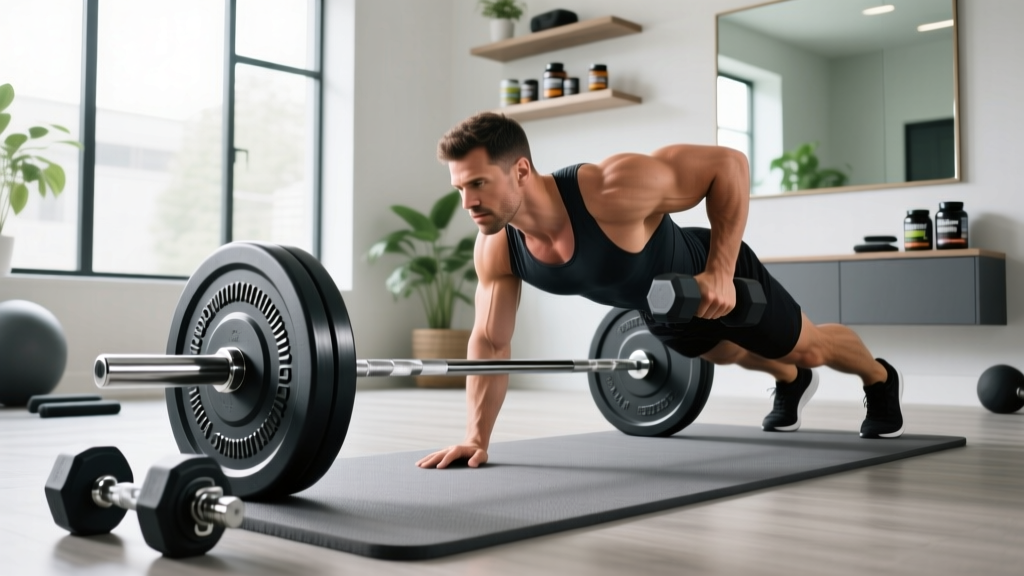
To combat this, integrating chest exercises with one dumbbell into your accessory blocks is non-negotiable. Unilateral pressing forces the core to resist rotation (anti-rotation) and demands equal force production from each pectoral muscle.
1. The Contralateral Single-Arm Dumbbell Press
By holding a heavy dumbbell in one hand and leaving the other hand empty (or resting on your stomach to feel your ribcage expand), you force your obliques and transverse abdominis to work in overdrive to keep your spine pinned to the bench.
- Execution: Plant your feet firmly. Press the dumbbell up and slightly inward toward the midline of your chest to maximize pec adduction.
- Prescription: 3 sets of 8-10 reps per arm. Start with the weaker arm first, and match the reps with your dominant arm, even if you have reps left in the tank.
2. Single-Arm Dumbbell Floor Press
The floor press eliminates the stretch reflex at the bottom of the movement, placing the entirety of the load on the triceps and the sternal head of the pectoralis major during the lockout phase.
- Execution: Lie on the floor with your knees bent. Lower the single dumbbell until your tricep gently touches the floor. Pause for a full one-second dead stop, then explode upward.
- Prescription: 4 sets of 6-8 reps per arm. This is an excellent bridge exercise for lifters dealing with mild anterior shoulder impingement from heavy barbell benching.
3. Unilateral Cross-Body Dumbbell Fly
While traditional flyes can place excessive sheer force on the shoulder capsule, the single-arm cross-body variation allows for a more natural, joint-friendly arc that aligns with the pectoral muscle fibers.
- Execution: Using a lighter dumbbell, lower the weight out to the side with a slight bend in the elbow. As you contract the pec, bring the dumbbell across your body toward the opposite shoulder, squeezing the muscle hard at the top.
- Prescription: 3 sets of 12-15 reps. Focus entirely on the mind-muscle connection and the stretch at the bottom.
Expert Insight: According to the ExRx Exercise Directory, unilateral chest movements not only correct muscular imbalances but also improve neural drive to the stabilizing muscles of the rotator cuff, which translates directly to a safer, more stable barbell bench press.
Bushings vs. Bearings: Choosing Your Sleeve Spin
When selecting your barbell, the internal mechanism of the sleeves dictates how smoothly the plates spin during dynamic movements.
Quick Decision Framework: Bushings or Bearings?
Choose Bronze Bushings if: Your training focuses on Powerlifting (Squat, Bench, Deadlift) or general strength. Bushings provide a slow, controlled spin that feels stable under heavy, slow-moving loads. They are also significantly more durable and require less maintenance.
Choose Needle Bearings if: You are an Olympic Weightlifter performing Snatches and Clean & Jerks. Bearings allow the sleeves to spin rapidly, reducing the rotational torque on your wrists during the explosive turnover phase of the lifts.
Maintenance Protocol: Protecting Your Investment
Even the most expensive 215,000 PSI stainless steel bar will degrade if neglected. Sweat, dead skin, and chalk accumulate deep inside the knurl valleys, creating a paste that traps moisture and accelerates oxidation (rust).
The 5-Minute Weekly Barbell Spa
- Brush: Use a stiff brass wire brush (never steel, which will strip the protective finish) to scrub the knurling in all directions. This dislodges chalk and skin.
- Wipe: Use a microfiber cloth lightly dampened with a non-toxic disinfectant or simple water to wipe away the loosened debris.
- Lubricate: Apply 3-4 drops of 3-in-One oil or a specialized barbell oil onto a clean rag and wipe down the shaft and sleeves. This leaves a microscopic protective barrier against ambient humidity.
Final Verdict: Building a Balanced Arsenal
Investing in a high-quality Olympic barbell with the correct weight tolerance, tensile strength, and knurl profile is the first step toward building a world-class home gym. For most lifters in 2026, a multi-purpose bar with a stainless steel shaft and a volcano knurl pattern (like the Rogue Ohio or Rep AB-4100) offers the highest return on investment.
However, the barbell is only a tool. To ensure longevity in the iron game, you must address the imbalances that heavy bilateral lifting creates. By systematically programming chest exercises with one dumbbell into your weekly split, you will build a resilient, symmetrical, and highly functional physique capable of handling the heaviest loads the barbell can offer.
More gear to consider
All reviews
Nike Dumbbells vs Olympic & Standard Weight Plates: 2026 Guide
Dumbbell Wrist Curls Palms Up: Rubber Hex vs Urethane Value
Dumbbell Press to Bench Press Conversion: Power Rack vs Squat Stand

Olympic vs Standard Plates: Home Exercise Program with Dumbbells

Olympic vs Standard Plates & the Pullover Exercise with Dumbbells