Best Adjustable Dumbbells for Bent-Over Dumbbell Reverse Fly 2026
Discover the best adjustable dumbbells for the bent-over dumbbell reverse fly. We compare handle ergonomics, micro-loading, and bulk for 2026.

Why the Bent-Over Dumbbell Reverse Fly Demands Specific Gear
The posterior deltoid is notoriously stubborn. Because it is a relatively small muscle group responsible for transverse abduction and external rotation of the shoulder, it requires strict isolation, precise loading, and zero momentum. The bent-over dumbbell reverse fly remains the gold standard for rear delt hypertrophy. However, as home gyms evolve in 2026, lifters are increasingly relying on adjustable dumbbells—and this is where a critical biomechanical mismatch often occurs.
Not all adjustable dumbbells are created equal for isolation movements. When you hinge at the hips and let gravity pull the weights toward the floor, two major failure modes emerge with poorly designed adjustable dumbbells: grip fatigue and range-of-motion (ROM) restriction. According to biomechanics data from ExRx.net, maximizing the stretch at the bottom of the reverse fly requires the dumbbells to hang freely without clashing against your torso or each other. Furthermore, because the rear delts fatigue quickly, you need equipment that allows for micro-loading (2.5 lb increments) to sustain progressive overload without compromising form.
Below, we break down the top adjustable dumbbells on the market, evaluating them specifically through the lens of rear deltoid training, handle ergonomics, and physical footprint.
2026 Adjustable Dumbbell Comparison Matrix
| Model | Handle Ergonomics | Increment Size | Max Weight | Approx. Price (2026) | Rear-Delt Suitability |
|---|---|---|---|---|---|
| Nuobell 80lb | Steel Knurled (Traditional) | 5 lbs (Moddable to 2.5) | 80 lbs | $399 / pair | Excellent |
| PowerBlock Elite USA | Urethane Cage (Neutral) | 2.5 lbs (w/ adder kit) | 50-90 lbs | $369 / pair | Good (Cage limits grip) |
| Bowflex SelectTech 552 | Smooth Rubber/Plastic | 2.5 lbs (up to 25 lbs) | 52.5 lbs | $299 / pair | Poor (Bulky ends clash) |
| ATLIAS Fast Adjust | Steel Knurled (Traditional) | 5 lbs | 55 lbs | $349 / pair | Very Good |
Top Adjustable Dumbbell Picks for Rear Delt Isolation
1. Nuobell 80lb: The Biomechanical Ideal
If your primary goal is executing a flawless bent-over dumbbell reverse fly, the Nuobell 80lb set is the undisputed champion in 2026. Why? Because it perfectly mimics a traditional hex dumbbell. The handle features genuine steel knurling, which is non-negotiable for hinged movements. When you are bent over at a 45-degree angle, sweat and gravity conspire to pull smooth-handled dumbbells out of your grip. The Nuobell's aggressive diamond knurling ensures your grip fails long after your posterior delts do.
Additionally, the Nuobell's compact footprint means the ends of the dumbbells will not prematurely strike your ribs or thighs at the bottom of the eccentric phase, allowing for a full, deep stretch of the rear deltoid fibers. The only drawback is the 5 lb jump between increments; however, many advanced lifters use aftermarket 2.5 lb magnetic micro-plates to bridge this gap for isolation work.
2. PowerBlock Elite USA: The Micro-Loading Master
The rear deltoid does not respond well to massive weight jumps. A study on dose-response relationships in muscle hypertrophy published in the National Center for Biotechnology Information (NCBI) highlights that smaller muscle groups require meticulous volume management and incremental loading to avoid joint strain. PowerBlock's Elite series offers 2.5 lb micro-loading capabilities right out of the box (using the internal adder weights), making it incredibly easy to progress from 12.5 lbs to 15 lbs per hand over a multi-week mesocycle.
However, the PowerBlock's signature rectangular cage design forces your hand into a strict neutral or semi-pronated position. While this is excellent for hammer curls, it slightly restricts the natural wrist supination and pronation adjustments lifters subconsciously make during the transverse abduction of a reverse fly. If you can adapt to the cage, the micro-loading makes it a top-tier choice.
3. Bowflex SelectTech 552: The Budget Compromise
The Bowflex 552 remains a massive seller due to its accessible price point and 2.5 lb increments in the lower weight ranges (up to 25 lbs). For reverse flys, where most lifters operate between 10 and 25 lbs per hand, the dial system is highly convenient.
But there is a severe functional flaw: the physical dimensions. The Bowflex 552 measures 15.75 inches in length due to the bulky plastic dial housings on both ends. During the bent-over dumbbell reverse fly, as you lower the weights toward the floor, the oversized plastic ends will frequently clack together or dig into your outer thighs. This artificially shortens your range of motion, robbing you of the loaded stretch that is critical for rear delt hypertrophy. If you already own these, we recommend performing the movement chest-supported on an incline bench with your arms hanging straight down to mitigate the clashing.
Pro-Tip: The Chest-Supported Hack for Bulky Dumbbells
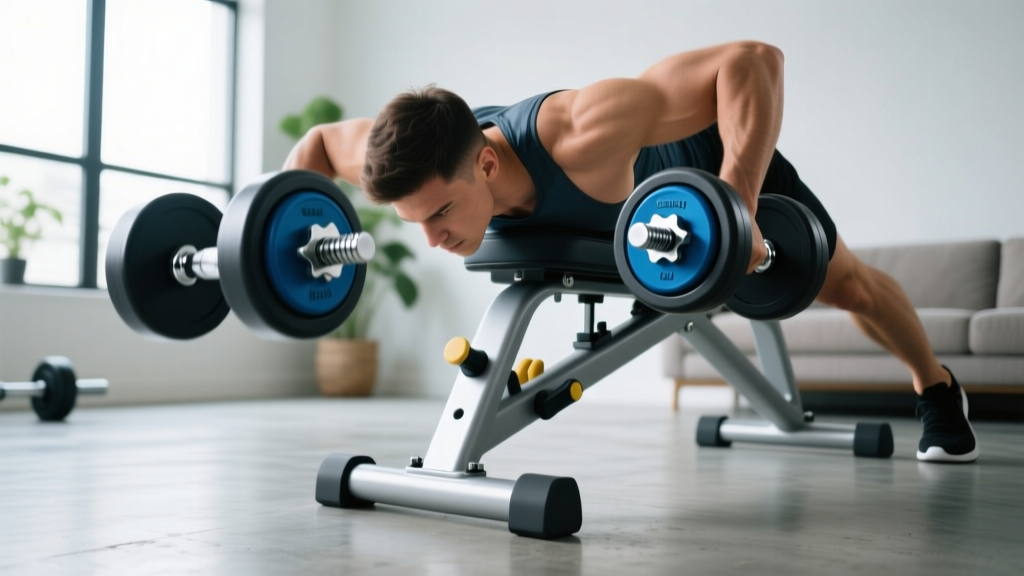
If your adjustable dumbbells are too bulky for a freestanding bent-over reverse fly, set an adjustable bench to a 30-degree incline. Lie face down (chest-supported) and let the dumbbells hang. This not only eliminates lower-back fatigue but naturally widens the path of the dumbbells, preventing the ends from hitting your torso and allowing for a full ROM even with oversized adjustable models.
Execution Guide: Avoiding Momentum Traps
Having the right adjustable dumbbell is only half the battle. The bent-over dumbbell reverse fly is frequently butchered by lifters turning it into a mid-back row. Follow this step-by-step framework to ensure the load stays on the posterior deltoid:
- The Hinge: Push your hips back until your torso is nearly parallel to the floor. Maintain a neutral spine.
- Scapular Protraction: At the bottom of the movement, let your shoulder blades spread apart (protract). Do not pinch them together prematurely.
- The Pull: Initiate the movement by driving your elbows up and out toward the ceiling, imagining you are trying to touch the walls on either side of the room.
- The Squeeze: At the top, your shoulder blades will naturally retract. Hold for one second, ensuring the dumbbells are not swung upward using lumbar extension.
- The Eccentric: Lower the weights slowly over 2-3 seconds, fighting gravity to maximize muscle fiber tearing.
Frequently Asked Questions
Can I use heavy weights for the bent-over dumbbell reverse fly?
Generally, no. The posterior deltoid is a small synergist muscle. Using heavy weights (e.g., 40+ lbs) usually forces the rhomboids, traps, and lats to take over the movement, turning the fly into a wide-grip row. Stick to weights that allow for 12-20 strict reps, utilizing adjustable dumbbells with micro-loading to incrementally increase the challenge.
Should my palms face each other or face backward?
Both grips are valid but target the muscle slightly differently. A neutral grip (palms facing each other) emphasizes the rear delt and the infraspinatus, while a pronated grip (palms facing backward) places slightly more emphasis on the rear delt and the lateral rotators. Adjustable dumbbells like the Nuobell allow you to switch grips seamlessly mid-set, whereas cage-style dumbbells lock you into a neutral grip.
Why do my forearms burn out before my rear delts?
This is a classic grip-strength bottleneck caused by smooth, urethane-coated handles found on many budget adjustable dumbbells. When hinged over, your grip must work overtime to prevent the dumbbell from slipping. Upgrading to a knurled steel handle (like the Nuobell or ATLIAS) or using lifting straps will immediately solve this issue and allow you to train the rear delts to true muscular failure.
More gear to consider
All reviews
Loadable Dumbbells for Flies: 2026 Budget Breakdown

Urethane vs Rubber Hex: Space & the Dumbbell Shoulder Press Exercise
Barbell Collar Types Compared: Mistakes Beyond Dumbbell Arm Circles
Barbell Setup & Knurling: Beyond Chest and Back Dumbbell Exercises
EZ Curl Bar vs Straight Bar Care & Dumbbell Shoulder Press Standards