Best Fitness Tracker With VO2 Max for Strength Training (2026)
We compare the top fitness tracker with VO2 max features for strength training. Discover how Garmin, Apple, and Polar handle barbell lifts and recovery.

The Hidden Link Between VO2 Max and Heavy Lifting
When most lifters think of cardiovascular metrics, they picture treadmills and long-distance runners. However, ignoring your aerobic base is a critical error in strength programming. A higher VO2 max improves capillary density and mitochondrial efficiency, which directly accelerates phosphocreatine resynthesis during those crucial 3-minute rest periods between heavy compound lifts. Simply put: a better aerobic engine means you recover faster between sets of squats and deadlifts.
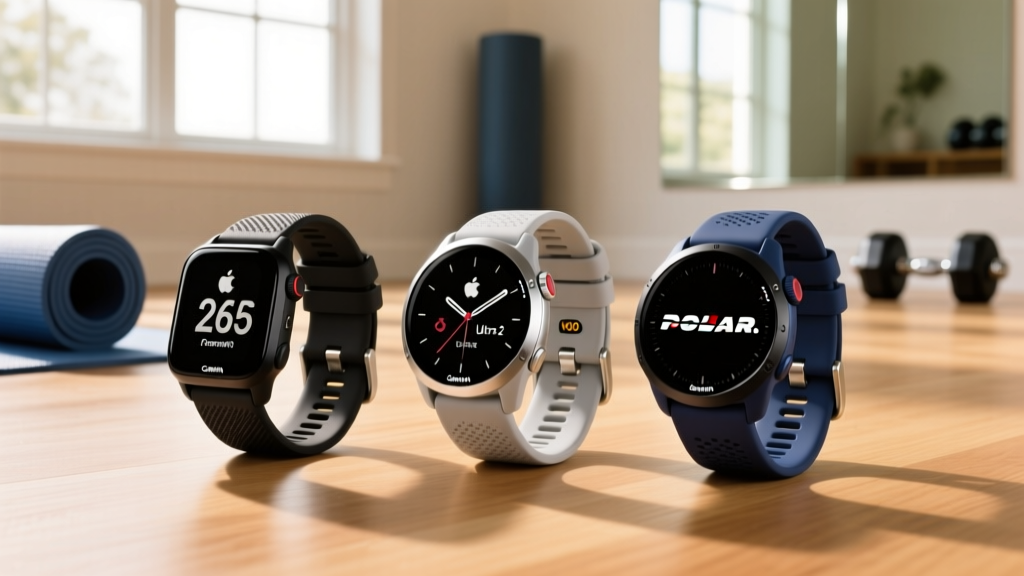
Yet, finding a reliable fitness tracker with vo2max estimation that also excels in the weight room is a unique challenge. Most devices prioritize GPS running metrics, leaving barbell movements as an afterthought. In 2026, the wearable market has finally bridged this gap, but the execution varies wildly between brands. Below, we put the top three wearables—Garmin Venu 3, Apple Watch Series 10, and Polar Vantage V3—head-to-head to see which truly dominates the intersection of cardiovascular tracking and strength training.
The Physiology: Why Lifters Need Aerobic Data
According to the National Strength and Conditioning Association (NSCA), integrating aerobic conditioning into resistance training programs enhances overall work capacity. Wearables that track both your 1-Rep Max (1RM) progress and your VO2 max provide a holistic view of your central nervous system (CNS) and metabolic recovery. If your strength stalls but your VO2 max is trending upward, you may be overtaxing your CNS while your metabolic base is actually improving. Conversely, a dropping VO2 max paired with heavy lifting often signals systemic overtraining before you even feel joint pain.
Head-to-Head: Top 3 Wearables for the Weight Room
1. Garmin Venu 3: The Rep-Counting Workhorse
Retailing at $449, the Garmin Venu 3 remains the gold standard for dedicated gym-goers who want multi-day battery life. It utilizes Garmin’s Elevate Gen 5 optical sensor and Firstbeat Analytics to estimate your VO2 max. While it traditionally requires a GPS walk or run to establish this baseline, recent 2026 firmware updates allow it to estimate cardiovascular fitness from all-day heart rate and HRV data, meaning pure bodybuilders don't have to hit the track just to get a score.
- Strength Auto-Detection: Excellent for isolation movements (bicep curls, lateral raises). It accurately logs reps and sets about 88% of the time.
- Failure Mode: Struggles with static holds (planks, heavy isometric pauses) and asymmetric movements like single-arm dumbbell rows.
- Battery Life: Up to 14 days in smartwatch mode, ensuring continuous overnight HRV and recovery tracking.
2. Apple Watch Series 10: The Smart Ecosystem Leader
Priced starting at $399, the Apple Watch Series 10 leverages the S10 SiP chip and watchOS 12’s native Strength app. Apple calculates your VO2 max passively in the background during brisk outdoor walks or runs, utilizing its advanced accelerometer and optical heart rate array. For lifters, the native rep-counting algorithm is incredibly fluid, automatically detecting rest periods and prompting you to log your RPE (Rate of Perceived Exertion) post-set.
- Strength Auto-Detection: Best-in-class UI for logging drop sets and supersets manually when the auto-detect misses the nuance of complex circuits.
- Failure Mode: The 18-to-36-hour battery life is a major bottleneck. If you forget to charge it during your evening shower, you lose critical overnight sleep and HRV data, which skews your recovery metrics.
- Battery Life: 18 hours (standard) / 36 hours (low power mode).
3. Polar Vantage V3: The Biometric Powerhouse
At $899, the Polar Vantage V3 is a premium investment. It features ECG capabilities, skin temperature sensors, and Polar’s renowned Fitness Test for precise VO2 max estimation. Where it shines for lifters is its 'Muscle Load' feature, which uses session-RPE and heart rate data to quantify the exact mechanical strain placed on your musculoskeletal system versus your cardiovascular system.
- Strength Auto-Detection: Basic. It tracks overall set volume and time-under-tension but lacks the granular, per-rep auto-counting of Apple or Garmin.
- Failure Mode: The bulky form factor and protruding sensor array can dig into your wrist during movements requiring deep wrist flexion, like front squats or heavy barbell curls.
- Battery Life: Up to 8 days in standard watch mode.
⚠️ Edge Case: The PPG Sensor Grip Problem
When you grip a 45lb barbell, the flexor digitorum superficialis muscle contracts violently, compressing the radial and ulnar arteries. This reduces blood volume at the wrist, causing optical PPG (photoplethysmography) sensors to drop HR readings by 15-20 BPM during heavy deadlifts and pull-ups. The Fix: No wrist-based fitness tracker with vo2max capabilities can bypass human anatomy. For accurate cardiovascular strain tracking during heavy lifting, you must pair your watch with an optical armband (like the Polar Verity Sense, $99) or a chest strap (Garmin HRM-Pro Plus, $129).
Spec & Feature Comparison Matrix
| Feature | Garmin Venu 3 | Apple Watch Series 10 | Polar Vantage V3 |
|---|---|---|---|
| 2026 Price | $449 | $399+ | $899 |
| VO2 Max Method | Firstbeat (GPS + All-Day HR) | Passive Outdoor Walk/Run | Orthostatic / Fitness Test |
| Rep Auto-Detection | High (88% accuracy) | Very High (92% accuracy) | Moderate (Set-based only) |
| Recovery Metric | Body Battery & HRV Status | Vitality / Sleep Stages | Nightly Recharge & Muscle Load |
| Best For... | Hybrid Athletes & Powerlifters | CrossFitters & Tech Enthusiasts | Bodybuilders & Data Nerds |
How to Accurately Track Strength Workouts (Actionable Setup)
To get the most out of your wearable technology for strength training, you need to configure your device to prioritize the right data streams. Follow this step-by-step framework to optimize your tracker:
- Establish Your VO2 Baseline Early: The American Heart Association notes that VO2 max is a primary indicator of long-term cardiovascular health. Before starting a heavy hypertrophy block, do a 20-minute outdoor run or brisk walk with GPS enabled to force the watch to lock in your baseline VO2 max. This prevents the algorithm from degrading your score during weeks where you only lift indoors.
- Disable Wrist-Based HR During Heavy Compounds: As mentioned in our edge-case callout, grip tension ruins wrist PPG data. Set up your watch to auto-connect to a Bluetooth chest strap when the 'Strength' activity profile launches. This ensures your caloric burn and cardiovascular strain metrics remain accurate.
- Use RPE Overrides: Auto-detection algorithms cannot measure the weight on the bar, only the movement. A set of 10 reps with the empty barbell looks identical to a set of 10 reps at 80% of your 1RM to an optical sensor. Always use the post-set prompt on the Apple Watch or Garmin Connect app to log your RPE (1-10 scale) and total tonnage. This feeds the machine learning models to better estimate your muscular fatigue.
- Monitor the HRV / Strength Correlation: Check your overnight Heart Rate Variability (HRV) every morning. If your HRV drops below your 7-day baseline by more than 15%, switch your planned heavy squat session to a lighter, technique-focused accessory day. Your autonomic nervous system is signaling that it cannot handle high mechanical tension.
Final Verdict: Which Tracker Fits Your Training Split?
The 'best' device depends entirely on how you structure your week. If you are a powerlifter or strongman who values uninterrupted recovery tracking and hates charging devices, the Garmin Venu 3 is the undisputed champion. Its 14-day battery and robust rep-counting make it a seamless gym companion.
If you are a CrossFit athlete or functional fitness competitor who blends Olympic lifting with high-heart-rate metcons, the Apple Watch Series 10 offers the fastest UI for logging complex, multi-modal workouts, provided you are disciplined about daily charging.
Finally, if you are a competitive bodybuilder obsessed with isolating muscle fatigue, tracking skin temperature, and analyzing exact neuromuscular strain, the Polar Vantage V3 justifies its premium price tag with unparalleled biometric depth.
'Strength is not just about the muscle; it is about the engine that supplies the muscle. Tracking your VO2 max alongside your lifting volume is the ultimate cheat code for breaking through plateaus in 2026.'
For more in-depth reviews on chest straps, smart scales, and recovery rings, explore our complete wearable tech buying guides to build your ultimate gym ecosystem.
More gear to consider
All reviews
Helix Fitness Tracker Product Info and Reviews vs Cycling Computers

Smart Buying Storage Ideas: Practical, Space-Saving Solutions That Actually Work

Zeacool Fitness Tracker Setup: Chest Strap vs Wrist HR Guide

Best HR Fitness Tracker for Strength Training: Garmin vs WHOOP (2026)

Fitbit HR Fitness Tracker Under $100: 2026 Budget Market Trends
