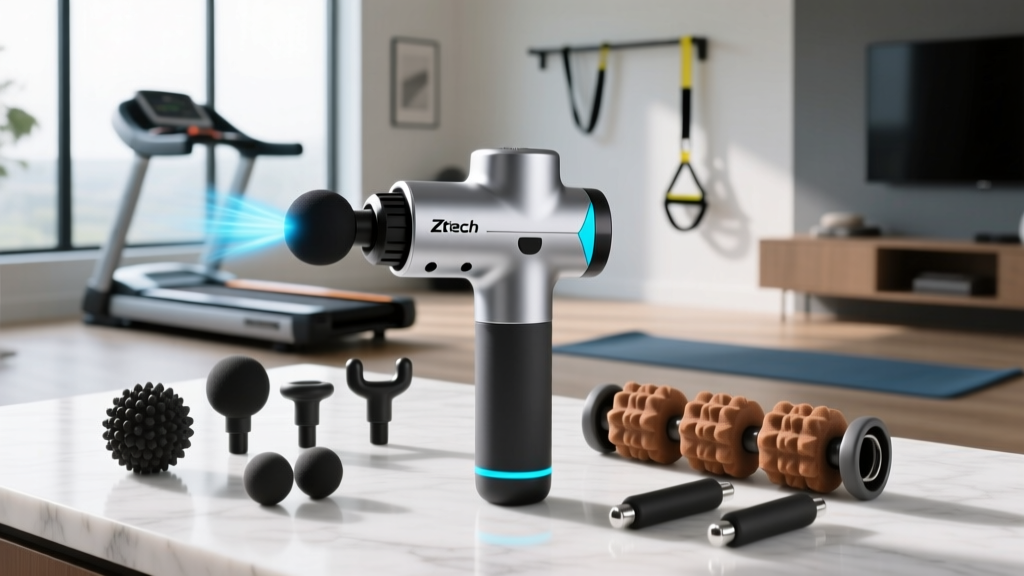
Theragun vs Hyperice & PulseRoll Massage Gun Space Layouts
Optimize your home recovery zone. We compare Theragun vs Hyperice footprint and storage, plus how a PulseRoll massage gun fits compact layouts.

The Spatial Reality of Modern Recovery Gear
As urban living spaces shrink and home gym footprints become more constrained in 2026, the 'dump it in the closet' approach to recovery equipment is no longer viable. Percussive therapy devices are notorious for creating clutter, with their proprietary charging cradles, bulky hard-shell cases, and scattered attachment heads. When designing a dedicated recovery zone, the physical dimensions and storage ergonomics of your tools are just as critical as their stall force or amplitude.
In this guide, we are conducting a comprehensive Theragun vs Hyperice massage gun comparison through the lens of space optimization and layout design. We will also evaluate where a compact pulseroll massage gun fits into micro-layouts, providing you with exact measurements, drawer blueprints, and battery-safe charging station designs.
The Footprint Face-Off: Dimensions & Storage Realities
Before designing your recovery shelf or drawer, you must understand the exact volumetric footprint of the market leaders. The table below breaks down the spatial requirements for the flagship models from Therabody and Hyperice, alongside a space-saving alternative.
| Device Model | Dimensions (L x W x H) | Weight | Minimum Drawer/Shelf Footprint | Case Storage Volume |
|---|---|---|---|---|
| Theragun Pro (Gen 5) | 9.9 x 7.1 x 3.4 in | 4.6 lbs | 12 x 10 in (Flat) | 14 x 11 x 5 in |
| Hyperice Hypervolt 2 Pro | 9.5 x 6.5 x 3.2 in | 2.5 lbs | 10 x 7 in (Flat) | 12 x 9 x 4.5 in |
| PulseRoll Mini / Pro | 6.5 x 5.5 x 2.2 in | 1.5 lbs | 7 x 6 in (Flat) | 8 x 7 x 3 in |
Theragun vs. Hyperice: Ergonomics vs. Storage Efficiency
The core of the Theragun vs Hyperice debate usually centers on amplitude (16mm vs 14mm) and smart-app integration. However, from a layout design perspective, their chassis designs dictate entirely different storage solutions.
The Theragun Triangle: A Storage Nightmare?
Therabody’s patented triangular handle is a marvel for reducing wrist strain during use, allowing for multiple grip positions without awkward wrist flexion. According to research published in the Journal of Sports Science & Medicine, ergonomic grip variations significantly reduce localized muscle fatigue during prolonged percussive therapy sessions.
However, spatially, the triangle is a compromise. Failure Mode: Because of the protruding third handle, a Theragun cannot lay completely flush in a standard 3-inch deep drawer. It requires either a custom deep-drawer (minimum 4.5 inches) or an open-concept shelf. Attempting to force it into a shallow drawer often results in the power button being depressed against the drawer wall, leading to accidental activation, battery drain, and potential motor overheating.
The Hyperice Cylinder: Drawer-Friendly but Top-Heavy
The Hypervolt 2 Pro utilizes a traditional cylindrical, T-bar design. This makes it infinitely more 'drawer-friendly.' It slides easily into standard kitchen or office drawers (which typically offer 10 to 12 inches of depth and 3 to 4 inches of vertical clearance).
Edge Case: The Hypervolt’s battery and motor are heavily weighted toward the base. If stored vertically in a cubby or open bin without a dedicated stand, it is highly prone to tipping over, which can damage the precision glide ring or crack the plastic housing if it falls onto a hard floor.
Layout Pro-Tip: If you choose the Hypervolt for a drawer layout, line the drawer with high-density EVA foam and cut a custom negative-space outline of the device. This prevents the heavy base from shifting when the drawer is opened or closed, protecting the internal lithium-ion cells from kinetic shock.Integrating the PulseRoll Massage Gun in Micro-Layouts
When square footage is at an absolute premium—such as in studio apartments, RVs, or travel setups—the flagship models from Therabody and Hyperice simply demand too much real estate. This is where evaluating a pulseroll massage gun becomes a strategic design choice.
The PulseRoll lineup, particularly their compact and mini iterations, strips away the bulky triangular wings and elongated T-handles. By utilizing a streamlined, concentric cylindrical housing, the pulseroll massage gun can be stored vertically in a standard 4-inch wide mesh bin or tucked into the side pocket of a gym bag without the need for a rigid, space-wasting hard shell case. For recovery zones built inside narrow hallway closets or under-bed storage systems, the reduced volumetric footprint of the PulseRoll allows you to allocate the saved 40% of space to other essential recovery tools, like compression boots or targeted heat wraps.
Charging Station Blueprints & Battery Safety
A critical, often overlooked aspect of recovery space design is the charging station. Percussive guns utilize high-density lithium-ion batteries that degrade rapidly if exposed to heat or left in poorly ventilated enclosures.
The U.S. Consumer Product Safety Commission (CPSC) emphasizes that lithium-ion batteries require adequate ventilation during charging to prevent thermal runaway, and they should never be stored in environments exceeding 85°F (29°C).
The 'Ventilated Cubby' Layout
Do not build a sealed, airtight drawer for your charging station. Instead, design an open-air alcove or a slatted shelf. Here is the optimal step-by-step blueprint for a wall-mounted recovery charging station:
- Locate a Climate-Controlled Wall: Avoid exterior walls that fluctuate in temperature, and never mount charging docks above radiators or HVAC vents.
- Install Slatted Wood Shelving: Use a 12-inch deep shelf with horizontal slats (gaps of at least 0.5 inches) to allow passive airflow beneath the charging bases.
- Cable Management: Route the proprietary power bricks behind the wall or through a ventilated cord-cover. Power bricks generate significant heat; trapping them in a drawer accelerates battery degradation and poses a fire risk.
- Magnetic Attachment Strips: Instead of storing massage heads in their original zippered pouches, mount a silicone-coated magnetic strip under the shelf. Metal-based attachment heads can snap directly to the strip, saving massive amounts of drawer volume.
Organizing Accessories: The Hidden Space Hogs
The device itself is only half the battle. A Theragun Pro comes with 6 attachments and a bulky carrying case; the Hypervolt comes with 5. If left in their original cases, you are dedicating nearly 0.5 cubic feet of dead space to your recovery zone.
'The most common mistake in home gym design is storing tools in their retail packaging. Retail cases are designed for shipping protection and shelf appeal, not for daily spatial efficiency.' — 2026 Home Fitness Design Report
The Modular Drawer Insert Solution:
Ditch the hard cases. Invest in a modular pegboard drawer system (like the Knax or similar customizable grid systems). Map out a 10x10 grid where the massage gun sits in the center, and the attachments are arranged radially around it based on frequency of use. The dampener and standard ball heads should be in the most accessible slots, while the micro-point and cone heads can be placed in the deeper, harder-to-reach corners of the drawer.
Expert Verdict: Choosing by Spatial Constraint
Ultimately, the Theragun vs Hyperice comparison comes down to your specific architectural constraints:
- Choose Theragun if you have open, deep shelving or plan to use a custom 3D-printed wall mount that accommodates the triangle grip. It is the superior tool for heavy-duty, deep-tissue work, provided you have the spatial luxury to store it properly.
- Choose Hyperice if your recovery zone is built into standard-depth drawers or low-profile under-bed storage. Its cylindrical profile and lighter weight make it the undisputed king of traditional concealed storage.
- Choose a PulseRoll massage gun if you are designing a micro-recovery kit for travel, studio living, or multi-purpose rooms where every cubic inch must be fiercely protected.
By prioritizing spatial efficiency and battery-safe charging layouts, you ensure that your recovery tools remain accessible, safe, and ready to optimize your physical performance without turning your living space into a cluttered storage unit.
More gear to consider
All reviews
Percussion vs Vibration: Are Massage Guns at Costco Worth the Space?

Space-Saving Ice Bath Setups & Massage Gun Xiaomi Recovery Zones

Foam Roller Density & Size Guide: Pairing With an Icy Hot Massage Gun

Best Tools Guns: Precision, Power, and Reliability for Professional Equipment Recovery

Normatec vs Hyperice Boots & Massage Gun Heads Uses: Beginner Guide