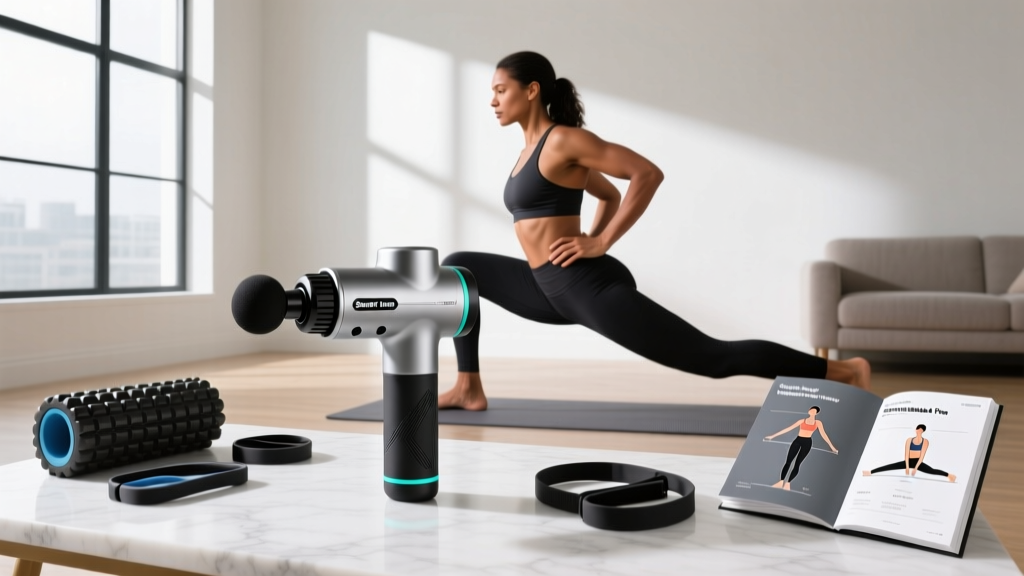
Sharper Image Massage Gun Reviews: Stretching Mistakes & Fixes
Fix flexibility mistakes: Why Sharper Image massage gun reviews fall short for mobility, and the exact stretching tools and protocols you need instead.

The Flexibility Illusion: What Sharper Image Massage Gun Reviews Miss
When browsing Sharper Image massage gun reviews, consumers are often drawn to the appealing price point (typically $49 to $89) and the promise of rapid muscle recovery. However, a pervasive and frustrating issue arises when users attempt to use these entry-level percussive devices as a primary tool for improving flexibility and joint range of motion (ROM). You use the device on your tight hamstrings for ten minutes, yet you still cannot touch your toes. Why? Because you are falling victim to the flexibility illusion.
Percussive therapy is an excellent modality for temporary neurological down-regulation and localized blood flow. It is not, however, a mechanism for structural tissue lengthening. To achieve lasting changes in muscle fascicle length and joint mobility, you must transition from passive vibration to active mechanical loading using dedicated stretching equipment. This troubleshooting guide will dissect the common mistakes users make when relying solely on budget massage guns and provide a concrete, equipment-based framework to actually fix your flexibility deficits.
Troubleshooting Mistake #1: Confusing Neural Down-Regulation with Tissue Lengthening
The most frequent error identified in mobility routines is misunderstanding what a massage gun actually does to the nervous system. According to the American Council on Exercise (ACE), flexibility is governed by the stretch reflex, mediated by muscle spindles. When you apply a Sharper Image massage gun to a tight calf, the rapid percussive strokes (usually around 2,400 to 3,200 RPM) overwhelm the nervous system's proprioceptors. This creates a temporary analgesic effect and reduces neural tone, making the muscle feel looser.
Expert Insight: A reduction in neural tone is not the same as adding sarcomeres to a muscle belly. Once the neurological effect wears off (usually within 15 to 30 minutes), the muscle returns to its baseline resting length. True flexibility requires mechanical tension applied over time to induce structural adaptation.
The Fix: Stop using the massage gun as your entire stretching routine. Instead, use it as a primer. Apply the percussive device for 60 seconds to down-regulate the stretch reflex, then immediately transition to a dedicated stretching tool to capitalize on that temporary window of neurological compliance.
Troubleshooting Mistake #2: Relying on Low-Amplitude Percussive Therapy
Not all recovery tools are engineered equally. When analyzing the hardware behind popular Sharper Image models compared to clinical-grade devices or mechanical stretchers, the limitations in amplitude and stall force become glaringly obvious. Budget models simply cannot penetrate deep fascial adhesions, nor can they provide the sustained, progressive load required for flexibility gains.
| Tool Category | Example Model | Amplitude / Depth | Stall Force / Load | Primary Flexibility Benefit |
|---|---|---|---|---|
| Budget Massage Gun | Sharper Image Pro Series | 8mm - 10mm | 20 - 25 lbs | Superficial neural down-regulation |
| Premium Massage Gun | Theragun PRO (5th Gen) | 16mm | 60 lbs | Deep tissue fluid exchange |
| PNF Stretching Strap | IdealStretch | N/A (User Load) | Up to 300+ lbs | Active fascicle lengthening |
| Biomechanical Stretcher | ProStretch Plus | N/A (Fixed Angle) | Bodyweight + Leverage | Targeted Achilles/Gastroc loading |
As the data illustrates, expecting a 10mm amplitude device with a 20 lb stall force to permanently lengthen a dense, tight posterior chain is a biomechanical mismatch. You must introduce equipment that allows for sustained, high-load stretching.
The Fix: Essential Stretching Equipment for True Mobility
To troubleshoot your stalled flexibility progress, you need to invest in tools that provide mechanical advantage and sustained tension. Here are the top three categories of stretching equipment you should pair with your percussive therapy routine.
1. Inversion Tables for Spinal and Posterior Chain Decompression
If your flexibility issues stem from spinal compression or a universally tight posterior chain, an inversion table is a highly effective, gravity-assisted stretching tool. The Teeter FitSense Inversion Table (retailing around $399) is FDA-registered and allows for precise angle adjustments between 20 and 75 degrees. By inverting, you utilize your own body weight to apply a sustained, passive stretch to the hamstrings, calves, and spinal erectors without the active muscular guarding that often ruins traditional floor stretches. Troubleshooting tip: Limit initial inversion sessions to 2-3 minutes at a 30-degree angle to prevent orthostatic hypotension.
2. PNF Stretching Straps for Hamstrings and Calves
Proprioceptive Neuromuscular Facilitation (PNF) is widely considered the gold standard for increasing ROM. The IdealStretch (approx. $159) is a specialized flexibility tool designed specifically for PNF protocols. Unlike a standard $10 nylon strap, the IdealStretch features a rigid, ergonomic frame that allows you to apply heavy, isolated loads to the hamstring while keeping the knee fully extended. By contracting the muscle against the rigid frame for 5 seconds and then relaxing into a deeper stretch, you bypass the Golgi tendon organ's protective inhibition, resulting in measurable length gains.
3. Biomechanical Calf Stretchers for Achilles and Plantar Fascia
For localized lower-leg stiffness, standard wall stretches are notoriously inconsistent because they rely on variable foot placement and balance. The ProStretch Plus ($39.95) is a dual-slot biomechanical stretcher that locks the foot into an optimal 7-degree to 15-degree dorsiflexion angle. It features an adjustable heel lift, allowing you to isolate the gastrocnemius (straight knee) or the soleus and Achilles tendon (bent knee). This tool ensures the stretch vector is perfectly aligned with the muscle fibers, eliminating the guesswork and ankle rolling associated with free-weight calf stretching.
The "Percussive-Then-Pull" Protocol
Follow this exact sequence to maximize your recovery gear and fix your flexibility routine:
- Prime (60 Seconds): Use your Sharper Image massage gun on the target muscle belly (e.g., medial hamstring) at a medium speed (approx. 2,400 RPM). Do not press hard; let the 10mm amplitude do the work to down-regulate neural tone.
- Load (3 Sets of 30 Seconds): Immediately transition to your stretching equipment (e.g., IdealStretch). Pull into a deep stretch until you feel a 7/10 tension.
- Contract (5 Seconds): Push against the stretching tool, contracting the target muscle at 50% of your maximum effort.
- Relax and Deepen (25 Seconds): Exhale, relax the muscle, and use the tool's leverage to pull the stretch 10% deeper. Hold for the remainder of the 30 seconds.
Note: Research published in sports science journals indicates that combining vibration therapy with static or PNF stretching yields significantly greater acute ROM improvements than either modality alone.
FAQ: Maximizing Your Recovery Gear
Can a budget massage gun replace stretching equipment?
No. While Sharper Image massage gun reviews often highlight the device's ability to soothe sore muscles, percussive therapy cannot structurally lengthen muscle tissue or remodel stiff tendons. The Mayo Clinic emphasizes that sustained mechanical stretching is required to maintain joint health and tissue elasticity. Budget massage guns are priming tools, not structural remodeling tools.
How long should I use a stretching strap after percussive therapy?
The neurological window of opportunity created by percussive therapy lasts roughly 15 to 30 minutes. You should begin your mechanical stretching protocol (using tools like the IdealStretch or ProStretch) immediately after your 60-second massage gun priming session. Aim for a total stretching volume of 3 to 5 minutes per specific muscle group to trigger viscoelastic deformation of the fascia.
Is it safe to use a massage gun directly on a joint capsule before stretching?
Absolutely not. A common and dangerous mistake is applying percussive heads directly to the knee cap, elbow joint, or spinal vertebrae. Massage guns are strictly for muscle bellies and thick tendinous tissue. If you need to improve joint capsule mobility, rely on targeted stretching equipment, banded joint distractions, or consult a physical therapist for manual mobilizations. For more data on how different modalities affect joint mechanics, you can review outcome metrics on Examine.com's Range of Motion database.
Final Thoughts on Troubleshooting Your Mobility
Reading through Sharper Image massage gun reviews might convince you that a $60 gadget is the ultimate cure for tight muscles, but true flexibility requires a more sophisticated, multi-tool approach. By understanding the biomechanical limitations of low-amplitude percussive devices and integrating dedicated stretching equipment like inversion tables, PNF straps, and biomechanical calf stretchers, you can transition from temporary relief to permanent mobility gains. Stop troubleshooting the wrong tool, and start applying the right mechanical tension.
More gear to consider
All reviews
Normatec vs Hyperice Recovery Boots & the Best 16 Head Massage Gun

Theragun vs Hyperice 2026: Therabody Prime Plus Massage Gun Review

Recovery Room Layouts: Cupping Gear & Massage Gun Sex Myths

Cupping Therapy vs No Cry Massage Gun: 2026 Athlete Guide
Space-Saving Recovery: Trigger Point Tools vs Etafor Plus Massage Gun
