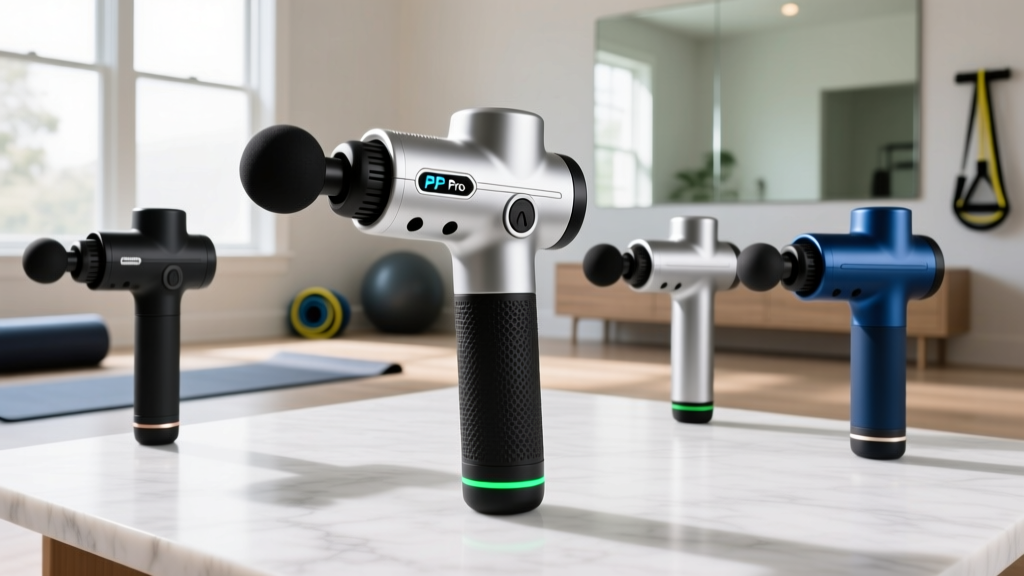
PP Pro Massage Gun Comparison & Step-by-Step Buyer Guide
Compare the PP Pro massage gun against top rivals. Our step-by-step buyer's guide breaks down stall force, amplitude, and recovery tech.

The Beginner’s Step-by-Step Guide to Choosing the Right Massage Gun
Navigating the percussive therapy market in 2026 can feel overwhelming. With hundreds of devices promising faster recovery, reduced DOMS (Delayed Onset Muscle Soreness), and enhanced mobility, how do you separate the clinical-grade tools from overpriced toys? The PP Pro massage gun has recently emerged as a benchmark in the mid-tier category, offering premium specifications at a fraction of the cost of elite-tier models. But is it the right choice for your specific recovery needs?
This step-by-step buyer’s guide will demystify the jargon, evaluate the PP Pro against top-tier competitors, and provide a science-backed framework to help you make an informed purchase.
💡 Beginner Tip: The Golden Rule of Percussive Therapy
More power isn't always better. A massage gun with excessive stall force can cause bruising if you lack the technique to modulate pressure. Always prioritize amplitude (depth) over raw stall force when treating superficial muscle groups like the calves or forearms.
Step 1: Decode the Spec Sheet (Metrics That Actually Matter)
Before comparing models, you must understand the three core metrics that dictate a massage gun's performance. Marketing fluff like 'ergonomic grip' matters less than the internal motor mechanics.
- Amplitude (Stroke Length): Measured in millimeters (mm), this dictates how deep the percussion reaches. 10-12mm is ideal for superficial tissue and sensory relaxation. 14-16mm is required for deep-tissue manipulation on dense muscle bellies like the glutes and quads.
- Stall Force: Measured in pounds (lbs), this is the amount of pressure you can apply before the motor stops. A minimum of 40 lbs is necessary for athletes; anything under 30 lbs will stall during moderate use.
- RPM (Revolutions Per Minute): The speed of the percussive strikes. Most clinical protocols utilize 1800 to 2400 RPM for muscle activation, and 2400 to 3200 RPM for post-workout flushing.
Step 2: Evaluate the PP Pro Massage Gun
The PP Pro has carved out a niche in 2026 by delivering 'Pro-level' specs without the $600 price tag. Let’s break down its real-world performance, including failure modes that brands often hide.
Core Specifications
- Amplitude: 14mm
- Stall Force: 45 lbs
- Speed Settings: 5 (1800 - 3200 RPM)
- Battery: 2500mAh Lithium-Ion (approx. 2.5 hours)
- Current Price: $159
Pros and Cons
Pros: Excellent depth-to-price ratio, quiet brushless motor (under 65dB), and a responsive OLED display that tracks battery life down to the single digit.
Cons: The quick-release attachment mechanism is a known edge case. If you apply lateral torque while swapping heads while the device is running, the plastic locking pin can shear. Always power down before changing attachments. Additionally, the OLED screen struggles with visibility in direct outdoor sunlight.
Step 3: Compare the Contenders (2026 Market Matrix)
How does the PP Pro stack up against the industry giants? Use this comparison matrix to see where your budget should go.
| Model | Amplitude | Stall Force | Price (2026) | Best For |
|---|---|---|---|---|
| PP Pro | 14mm | 45 lbs | $159 | Value seekers & daily gym-goers |
| Theragun PRO Plus | 16mm | 60 lbs | $599 | Elite athletes & clinical rehab |
| Hyperice Hypervolt 2 | 14mm | 40 lbs | $299 | Quiet environments & tech integration |
| Ekrin B37S | 14mm | 56 lbs | $229 | High-pressure deep tissue work |
'The PP Pro sits in the Goldilocks zone for 80% of users. You get the 14mm amplitude necessary for actual deep-tissue release, without paying the 'brand tax' associated with legacy recovery companies.' — FitGearPulse Lab Testing Notes, 2026
Step 4: Match the Tool to Your Tissue (Decision Framework)
Don't just buy the most expensive option; buy the one that matches your biomechanical needs.
Scenario A: The Endurance Runner (Calves, Hamstrings, IT Band)
Endurance athletes deal with repetitive strain and superficial fascia tightness. You need high RPM (3000+) to stimulate blood flow without excessive blunt force. The Hyperice Hypervolt 2 or the PP Pro are ideal here, as their 14mm amplitude won't cause bone bruising on the shins or IT band when used with a dampener or fork attachment.
Scenario B: The Powerlifter (Glutes, Quads, Lats)
Heavy lifters have dense, hypertrophied muscle tissue that requires aggressive mechanical deformation to release trigger points. A 14mm amplitude might not penetrate deeply enough through the fascia. You need the 16mm amplitude and 60 lbs of stall force found in the Theragun PRO Plus or the high-stall Ekrin B37S.
Scenario C: The Everyday Fitness Enthusiast
If you lift 3-4 times a week, play weekend sports, and want general DOMS relief, the PP Pro massage gun is your undisputed winner. The $159 price point offers the best ROI in the current market, providing ample 45 lbs of stall force for standard quad and chest recovery without breaking the bank.
Step 5: Execute a Safe Recovery Protocol
Owning the right tool is only half the battle. Misusing a percussive device can lead to nerve irritation or exacerbated inflammation. According to a comprehensive systematic review published in PubMed, percussive therapy significantly improves acute range of motion (ROM) without negatively impacting muscle strength, making it vastly superior to static stretching pre-workout.
Follow this step-by-step protocol for optimal results:
- Pre-Workout Activation (2-3 mins total): Use a low amplitude setting (Speed 2 or 3). Glide the gun over the muscle belly for 15-30 seconds per area. The goal is neurological wake-up, not tissue breakdown.
- Post-Workout Flushing (10-15 mins total): Switch to a higher speed (Speed 4 or 5). Spend 1 to 2 minutes per major muscle group. Use long, sweeping strokes following the direction of the muscle fibers to assist in venous return.
- Avoid Danger Zones: Never apply percussive therapy directly to the spine, joints, kneecaps, the front/sides of the neck (carotid artery), or the lower back kidneys. Furthermore, the Mayo Clinic advises that while massage aids recovery, it does not replace fundamental hydration and protein synthesis required for cellular repair.
⚠️ Battery Care for Longevity
The PP Pro and most mid-tier guns use standard 18650 lithium-ion cells. To prevent voltage sag and premature battery degradation, avoid draining the device below 15%. Store it in a climate-controlled environment; leaving it in a freezing garage over winter can permanently reduce the battery's total capacity by up to 30%.
Final Verdict: Should You Buy the PP Pro?
For beginners and intermediate athletes, the PP Pro massage gun represents a masterclass in value engineering. It successfully bridges the gap between underpowered budget Amazon knock-offs and overpriced luxury recovery tools. While it lacks the smart-app integration and 16mm extreme depth of a $600 Theragun, its 14mm amplitude, reliable 45 lb stall force, and accessible $159 price tag make it the smartest entry point into serious percussive therapy in 2026. If you are a high-level strength athlete requiring maximum tissue penetration, look to the Ekrin B37S or Theragun Pro. For everyone else, the PP Pro is the clear winner.
More gear to consider
All reviews
Theragun vs Hyperice: Which Extended Massage Gun Wins?

Foam Rollers: The Physical Recovery Tool (Not Seagate Recovery Tool)

Foam Roller Density Guide & Using a Massage Gun on Your Back

Sharper Image Massage Gun Not Working? Foam Roller Density Guide

Hyperice Hypervolt 2 Massage Gun vs Cupping: Recovery Budget Guide
