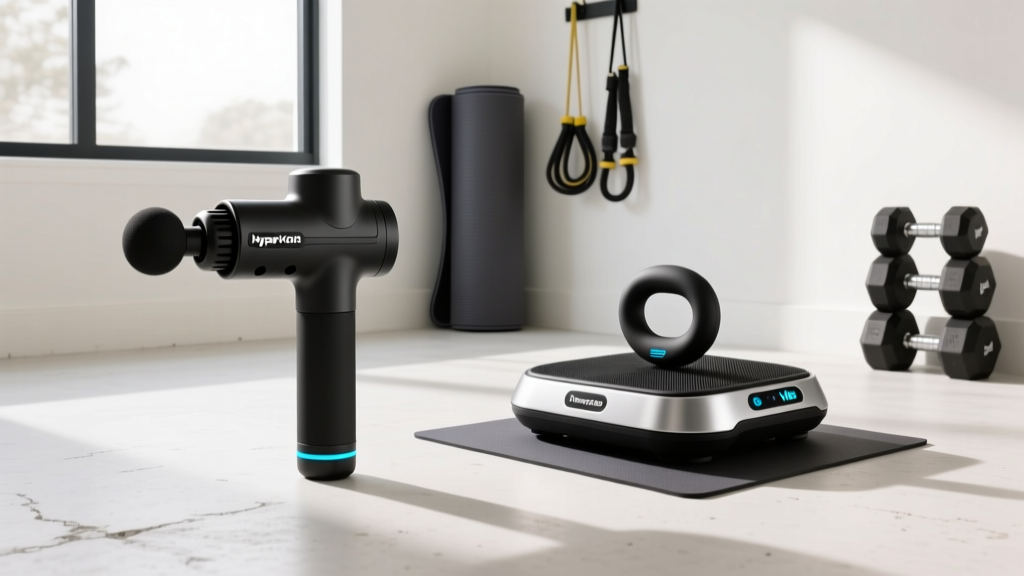
Percussion vs Vibration: Are Massage Guns at Costco Worth the Space?
Compare percussion vs vibration therapy for home gyms. We analyze device footprints, spatial layouts, and if massage guns at Costco fit small spaces.

The Spatial Dilemma: Designing Your Home Recovery Zone
When outfitting a home gym or apartment recovery corner, fitness enthusiasts often focus entirely on physiological benefits while ignoring the physical footprint of their gear. As recovery technology evolves in 2026, the debate between percussion therapy and vibration therapy is no longer just about muscle tissue—it is about spatial efficiency. If you are living in a compact urban apartment or optimizing a tight 4x4-foot home gym nook, the cubic volume of your recovery tools matters just as much as their RPMs.
This brings us to a common purchasing crossroads: evaluating the bulk-buy bundles and warehouse club deals that dominate the market. Specifically, many buyers wonder if the heavily bundled massage guns at Costco justify the significant spatial tax their packaging demands. To answer this, we must break down the biomechanics of percussion versus vibration, and map those mechanics directly to your home's layout and storage capabilities.
Percussion vs. Vibration: A Biomechanical & Spatial Breakdown
Understanding the mechanical differences between these two modalities explains why their physical footprints vary so drastically. According to Therabody's clinical research, percussive therapy relies on amplitude (stroke length) to deliver rapid bursts of pressure deep into muscle fascia. Vibration therapy, conversely, utilizes high-frequency oscillations with minimal amplitude to stimulate surface-level mechanoreceptors and promote localized blood flow.
| Feature | Percussion Therapy | Vibration Therapy | Spatial Footprint Impact |
|---|---|---|---|
| Amplitude | 12mm to 16mm (Deep) | 2mm to 6mm (Surface) | Percussion requires longer internal shafts and bulkier motor housings. |
| Frequency | 2,000 - 3,200 RPM | 30 - 100+ Hz | Vibration motors are compact, allowing for sleek, minimalist device profiles. |
| Average Weight | 2.0 lbs - 2.8 lbs | 0.8 lbs - 1.5 lbs | Heavier percussion tools require reinforced shelving or heavy-duty wall mounts. |
| Typical Case Size | 14" x 10" x 6" | 8" x 6" x 4" | Percussion cases consume roughly 2.5x more drawer or shelf volume. |
The Deep Tissue Footprint (Percussion)
To achieve a 16mm amplitude, a percussion gun needs a physical shaft that travels back and forth inside the device housing. This mechanical reality dictates a minimum physical size. Premium models like the Theragun Pro or the Ekrin B37S are inherently T-shaped or triangular to accommodate the internal cam mechanism and large lithium-ion batteries required to sustain high-torque output. Consequently, they demand wider, deeper storage drawers or dedicated shelf space.
The Surface-Level Sleekness (Vibration)
Vibration tools (and hybrid micro-percussion devices) utilize eccentric rotating mass (ERM) motors or linear resonant actuators (LRA). These components are incredibly small. Devices like the Hyperice Hypervolt Go 2 or compact vibration wands can easily be tossed into a standard gym bag or stored in a shallow 4-inch drawer, making them the undisputed champions of space optimization.
Evaluating Massage Guns at Costco for Small-Space Living
Warehouse clubs operate on a bulk-inventory model, which heavily influences the physical footprint of the products they sell. When you shop for massage guns at Costco, you are rarely buying just the device. You are purchasing a "bundle."
The Warehouse Club Spatial Tax
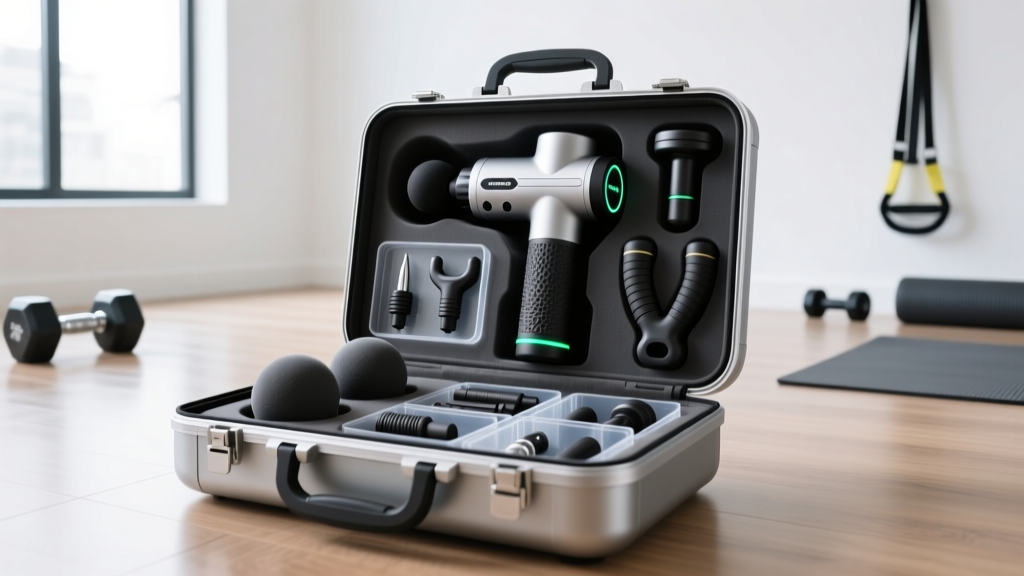
Costco typically stocks recovery tech in massive, hard-shell EVA zipper cases designed to hold the device, 6-8 attachment heads, a wall charger, a lubricant bottle, and extensive printed manuals. While the perceived value is high, the case dimensions often measure 15" L x 12" W x 7" H. In a small apartment, dedicating 1,260 cubic inches of prime cabinet real estate to a single recovery tool is a significant layout compromise.
The Layout Compromise: If you opt for a percussion bundle from Costco, you must design your recovery zone around this rigid, oversized case. Conversely, buying a standalone vibration tool online often results in a soft fabric pouch or a minimalist cardboard box, allowing you to integrate the tool into a mixed-use drawer alongside resistance bands and lacrosse balls.
Layout Blueprint: The 16-Square-Foot Recovery Corner
How do you integrate these tools into a space-optimized home? Whether you choose a bulky percussion bundle or a sleek vibration wand, spatial design requires intentionality. Here is a tested layout for a 4x4-foot recovery nook that maximizes vertical space and minimizes floor clutter.
- The Floating Shelf Anchor (Depth: 10 inches): Install a heavy-duty floating shelf at chest height (approx. 48 inches from the floor). A 10-inch depth is the critical threshold—it is deep enough to hold a Costco-sized percussion case flat, but shallow enough that it won't impede movement in a tight room. Use drywall toggle bolts rated for at least 50 lbs to support the dead weight of the device and case.
- Pegboard Attachment Zone: Mount a 2x4-foot metal pegboard directly below the shelf. Instead of keeping attachment heads inside the bulky Costco case, extract the daily-use heads (dampener, standard ball, thumb) and mount them on the pegboard using 3D-printed custom hooks or standard 1/4-inch peg hooks wrapped in rubber tape. This reduces the need to open and store the massive case daily.
- Under-Bench Drawer Dividers: If your recovery zone includes a weight bench, utilize the space beneath it. Use adjustable tension dividers (like the IKEA STÖDDIG series) to create a dedicated 9-inch wide channel specifically for vibration tools and travel-sized recovery tech, keeping them hidden but accessible.
Storage Hacks for Bulky Recovery Tech
If you have already committed to a large-footprint percussion device, you must mitigate its spatial impact. Here are advanced storage strategies for 2026 home gyms:
- Decant the Bundle: Immediately remove the device from the oversized warehouse club hard-shell case. Store the case in an attic or under-bed bin. Purchase a slim, aftermarket silicone sleeve or a soft neoprene drawstring bag (approx. 8" x 4") for daily use. This reduces the daily storage volume by up to 70%.
- Vertical Wall Docks: Invest in a universal wall-mount charging dock. Many third-party manufacturers now produce minimalist aluminum wall cradles that hold the percussion gun vertically while charging. This turns a bulky liability into a sleek, wall-mounted display piece, freeing up all horizontal shelf space.
- The 'Gym Bag' Rule: For vibration tools, implement a strict 'never unpack' rule. Because their footprint is so small, they should live permanently in the front mesh pocket of your gym bag or your daily work commuter bag, completely eliminating the need for home gym storage allocation.
The Final Decision Framework
Choosing between percussion and vibration—and deciding whether to leverage warehouse club bundles—comes down to a matrix of physiological need versus spatial reality.
Choose Percussion (and accept the spatial tax) if: You are a heavy lifter or endurance athlete requiring deep fascial release (16mm amplitude) to manage delayed onset muscle soreness (DOMS), and you have dedicated, reinforced shelving in your home gym to accommodate the larger motor housing and case.
Choose Vibration (and embrace spatial efficiency) if: You prioritize nervous system down-regulation, surface blood flow, and travel portability. Vibration tools slide effortlessly into shallow drawers or gym bags, making them the superior choice for apartment dwellers and minimalist layout designs.
Ultimately, the best recovery tool is the one you actually use. If a massive hard-shell case from a warehouse club bundle gets shoved to the back of a closet because it is too cumbersome to move, its therapeutic value drops to zero. Evaluate your square footage, measure your drawers, and select the modality that seamlessly integrates into your physical environment.
More gear to consider
All reviews
Foam Roller Density Guide & Aura Wellness Massage Gun Charger: Budget Breakdown
2026 Market Trend: Upgrading Your Massage Gun Case for Trigger Point Therapy Tools

Therabody Theragun Elite Massage Gun vs Cupping: 2026 Trends

Theragun vs Hyperice: Is the Aduro Sport Massage Gun Better?

Cold Plunge Market Trends & Deep Tissue Massage Gun Benefits
