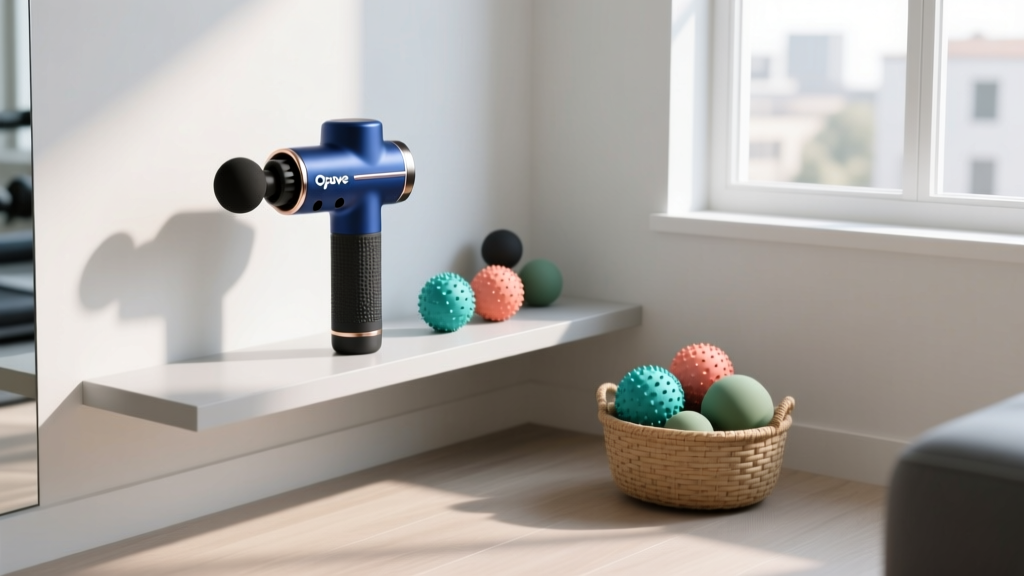
Space-Saving Recovery: Opove Massage Gun & Trigger Point Ball Layouts
Discover how to design a compact recovery zone. We compare the Opove massage gun with trigger point balls for space-saving, effective myofascial release.

The Spatial Economics of Myofascial Release
As urban living spaces shrink and home gym footprints become increasingly constrained, fitness enthusiasts face a spatial paradox: the need for professional-grade recovery tools versus the reality of limited square footage. Designing an effective recovery zone in a small apartment or a compact 4x4 foot home gym nook requires a strategic approach to layout and storage. Myofascial release is non-negotiable for athletic longevity, but bulky massage tables and oversized foam rollers quickly consume valuable real estate.
To optimize your recovery layout, you must balance high-tech percussive devices with ultra-compact manual tools. In this guide, we analyze the spatial footprint, storage requirements, and clinical efficacy of integrating an Opove massage gun alongside a curated arsenal of trigger point therapy balls. By understanding the physical dimensions and storage needs of these tools, you can engineer a highly efficient, zero-clutter recovery sanctuary.
Opove Massage Gun: Percussive Power vs. Storage Footprint
The Opove brand has carved out a significant niche in the percussive therapy market by offering high-amplitude devices at accessible price points. When designing a recovery layout, the physical dimensions of the device and its charging ecosystem dictate how it integrates into your space.
Model Breakdown and Spatial Requirements
- Opove M3 Pro: Priced around $129, this model features a 10mm amplitude and weighs approximately 2.2 lbs. Its hard-shell carrying case measures roughly 10.5 x 8.2 x 3.5 inches (240 cubic inches). This rectangular footprint is ideal for sliding under a bed or onto a standard 12-inch deep floating shelf.
- Opove Apex: Retailing near $159, the Apex delivers a deeper 12mm amplitude for larger muscle groups. The case is slightly more robust, requiring a dedicated 12 x 9 x 4 inch storage zone.
Lithium-ion batteries degrade when stored at 0% or 100% for extended periods. Do not bury your Opove massage gun in a deep drawer where it will be forgotten and over-discharge. Instead, dedicate a small 6x6 inch section of a pegboard or slatwall for a custom 3D-printed charging holster, keeping the device visible, accessible, and optimally charged between 40% and 80%.
Trigger Point Balls: High-Density Relief in a Low-Profile Package
While percussive therapy excels at broad muscle stimulation and neurological down-regulation, targeted trigger point therapy requires localized, sustained compression. According to the Cleveland Clinic, applying direct pressure to myofascial trigger points helps release muscle knots and restore normal tissue glide. Trigger point balls offer the highest density of relief per cubic inch of storage space.
The Compact Trigger Point Arsenal
- Standard Lacrosse Balls (e.g., Kiefer): At just $8 each and measuring exactly 2.5 inches in diameter, these are the ultimate space-saving tools. A mesh bin of three lacrosse balls takes up less than 40 cubic inches.
- RadRound / RadBlock: Priced around $35, these specialized high-density spheres and blocks feature ergonomic curves designed to cradle the spine and target the suboccipital muscles. They require slightly more shelf space but eliminate the need for a full foam roller.
- Thermal/Acuball Variations: The Acuball ($35) features a textured, heatable core. Because it requires microwave access, storing it in a kitchen-adjacent recovery nook or a designated drawer near your hydration station optimizes your workflow.
As noted by the Mayo Clinic, myofascial pain syndrome involves sensitive points in the muscles that can cause deep, aching pain. Having a variety of ball densities (from soft silicone to firm rubber) allows you to modulate pressure without requiring large, multi-piece mechanical devices.
Spatial Comparison Matrix: Opove vs. Trigger Point Arsenal
To visualize how these tools impact your room layout, review the spatial and financial matrix below. This data is critical for planning shelving dimensions and budget allocation for your recovery corner.
| Tool Category | Specific Model | Approx. Cost (2026) | Storage Volume | Ideal Layout Placement |
|---|---|---|---|---|
| Percussive Gun | Opove M3 Pro | $129 | ~240 cu in | Mid-level floating shelf |
| Percussive Gun | Opove Apex | $159 | ~432 cu in | Bottom shelf / floor bin |
| Manual Sphere | Kiefer Lacrosse Ball | $8 | ~8 cu in | Magnetic strip / small jar |
| Ergonomic Block | RadBlock | $45 | ~65 cu in | Pegboard hook / top shelf |
Layout Blueprint: Integrating Both into a 16-Square-Foot Recovery Nook
Transforming a 4x4 foot corner of your bedroom or living space into a dedicated recovery zone requires vertical thinking. Floor space is premium; wall space is abundant. Here is a step-by-step blueprint for integrating your Opove massage gun and trigger point balls into a cohesive, space-optimized layout.
Step 1: Install a 24-Inch Slatwall or Pegboard Panel
Mount a 24x24 inch slatwall panel at eye level (approximately 54 inches from the floor). This serves as the command center for your manual tools. Use specialized peg hooks to hang your RadRound and Acuball by their fabric loops or mesh sleeves. This keeps them off the floor, allows for air circulation (preventing rubber degradation), and turns your tools into functional wall art.
Step 2: The Floating Shelf Ecosystem
Install two 24-inch floating shelves below the pegboard.
Top Shelf (Eye-Level Reach): Place a small, aesthetically pleasing wooden tray or acrylic bin here. This is where your lacrosse balls and massage gun attachments (dampener, fork, bullet) live.
Bottom Shelf (Waist-Level): This is the designated docking station for your Opove M3 Pro case. Ensure the shelf is rated for at least 15 lbs to accommodate the weight of the device and case without sagging over time.
Step 3: The Floor Zone (Active Release Area)
Keep the actual 4x4 floor space entirely clear of storage bins. Lay down a high-density, interlocking EVA foam mat (at least 12mm thick). This mat serves as your active trigger point therapy zone. When using a lacrosse ball for glute or thoracic spine release, the EVA mat provides necessary cushioning so the ball doesn't slip on hardwood floors, maximizing the efficacy of the localized pressure.
Clinical Protocol: Zoning Your Recovery Routine
Space optimization isn't just about storage; it is about workflow. The American Council on Exercise (ACE) emphasizes that the sequence of myofascial release matters. Design your physical space to encourage the correct physiological sequence.
The Sequential Workflow Layout1. Zone A (The Shelf): Grab the Opove massage gun. Spend 2-3 minutes on broad muscle groups (quads, lats, calves) to increase local blood flow and down-regulate the nervous system.
2. Zone B (The Pegboard): Retrieve a firm lacrosse ball or RadRound.
3. Zone C (The Floor Mat): Transition to the floor. Use the ball to apply sustained, ischemic pressure to specific, stubborn trigger points (e.g., piriformis, rhomboids) for 30-60 seconds per knot.
Material Degradation and Confined Storage Maintenance
When optimizing for small spaces, tools are often pushed into dark, unventilated closets or pressed against exterior walls that fluctuate in temperature. This environment can silently destroy your recovery gear.
- Opove Battery Care: Lithium-ion cells are sensitive to extreme cold. If your recovery nook is near a drafty window or an uninsulated exterior wall in a cold climate, the battery's internal resistance will increase, reducing its lifespan. Keep the device in a climate-controlled interior zone.
- Rubber and Silicone Breakdown: Trigger point balls made of natural rubber or vulcanized silicone can off-gas and become brittle if stored in direct, prolonged sunlight or near HVAC vents. Storing them in opaque bins or on shaded pegboards preserves their tactile grip, which is essential for preventing the ball from slipping during intense trigger point compression.
Final Thoughts on Compact Recovery Design
You do not need a sprawling 200-square-foot dedicated recovery room to achieve elite-level muscle maintenance. By pairing the broad, neurological benefits of the Opove massage gun with the pinpoint, mechanical precision of trigger point balls, you cover the entire spectrum of myofascial release. Through intentional layout design—utilizing vertical slatwalls, tiered floating shelves, and strict zoning protocols—you can build a highly effective, visually unobtrusive recovery sanctuary that supports your training goals without compromising your living space.
More gear to consider
All reviews
Viva Spa Massage Gun Routine: Heat Pad vs Wrap Guide
Bally Massage Gun vs Infrared Sauna Blanket: 2026 Guide

Beyond the Iconic Massage Gun: Heat Therapy Pad and Wrap Comparison

Normatec vs Hyperice Boots & Sharper Image Massage Gun Manual

Compression Boot Review & Opove M3 Pro Massage Gun Charger Guide
