
Massage Guns Effectiveness: Percussion vs Vibration Value Analysis
We break down massage guns effectiveness, comparing percussion vs vibration therapy costs, ROI, and top models to maximize your recovery budget.

The Core Debate: Percussion vs. Vibration Mechanics
When evaluating recovery technology, consumers often use the term 'massage gun' as a catch-all phrase. However, from a biomechanical and engineering standpoint, the market is strictly divided into two distinct categories: percussion therapy and vibration therapy. Understanding the mechanical differences between these two modalities is the first step in determining true value and massage guns effectiveness for your specific recovery budget.
Engineering Callout: Motor Types
Percussion Devices utilize a linear actuator (a brushless motor with a reciprocating shaft). This allows the attachment to travel a deep amplitude (typically 12mm to 16mm) directly into the muscle belly without the motor stalling under pressure.
Vibration Devices rely on an Eccentric Rotating Mass (ERM) motor. Think of the vibration motor in a smartphone or a gaming controller. An off-center weight spins rapidly, creating a high-frequency, low-amplitude (4mm to 8mm) surface wobble.
The distinction matters immensely for your wallet. Linear actuators require precision-machined metal gears and high-torque brushless motors, driving up the manufacturing cost. ERM motors are mass-produced for pennies, which is why the market is flooded with sub-$80 'massage guns' that are, in reality, just oversized vibrating toys.
Evaluating Massage Guns Effectiveness: What the Science Says
To justify a $200 to $600 investment, we must look at clinical outcomes. The effectiveness of percussive therapy lies in its ability to manipulate neurological receptors and increase localized blood flow without causing the micro-tears associated with deep tissue manual massage.
According to research published in the National Library of Medicine, percussive therapy significantly reduces Delayed Onset Muscle Soreness (DOMS) and preserves muscle activation levels post-exercise. The 16mm amplitude found in premium percussion guns reaches the deeper fascial layers and mechanoreceptors (like the Pacinian corpuscles), effectively gating pain signals to the brain.
Conversely, studies on vibration therapy indicate that while high-frequency vibration is excellent for superficial neuromuscular activation and temporary pain relief via the gate control theory, it lacks the mechanical force to alter tissue viscosity or break up fascial adhesions. Vibration is a neurological distraction; percussion is a mechanical intervention.
Budget Breakdown: Cost per Hertz and Millimeter
Let us break down the 2026 recovery market into three distinct budget tiers. This matrix evaluates the true cost of ownership, factoring in retail price, mechanical specs, and estimated lifespan based on battery degradation and motor wear.
| Tier & Model Example | Therapy Type | Amplitude / Stall Force | Retail Price (2026) | Est. Lifespan |
|---|---|---|---|---|
| Premium: Theragun PRO Plus | True Percussion | 16mm / 60 lbs | $599 | 5+ Years |
| Mid-Range: Achedaway Pro | True Percussion | 16mm / 45 lbs | $239 | 3-4 Years |
| Mid-Range: Hyperice Hypervolt 2 Pro | Percussion/Vibration Hybrid | 12-14mm / 32 lbs | $399 | 4 Years |
| Budget: Bob and Brad C2 | Light Percussion | 10mm / 25 lbs | $99 | 2 Years |
| Ultra-Budget: Generic Amazon Brands | Pure Vibration (ERM) | 4-6mm / <10 lbs | $35 - $60 | 3-6 Months |
The Hidden Costs of Cheap Vibration Guns
The ultra-budget tier presents a classic false economy. ERM motors generate significant lateral heat and wobble. When you press a $45 vibration gun into your quadriceps, the motor immediately stalls or the plastic internal gears strip. Furthermore, the lithium-ion cells used in these generic devices lack Battery Management Systems (BMS). Within 40 to 50 charge cycles, the battery capacity degrades by up to 60%, turning your recovery tool into e-waste in under six months. If you replace a $50 gun twice a year, your 5-year cost is $500, yielding a terrible ROI compared to a single $239 Achedaway Pro.
Value Analysis: Which Therapy Yields the Best ROI?
To determine value, we must align the therapy type with the user's physiological demands. Here is the pros and cons breakdown for budget allocation.
Investing in True Percussion (Linear Actuator)
- Pros: Reaches deep tissue (16mm), alters fascial viscosity, high stall force prevents motor death during use, 5-year usable lifespan, high resale value.
- Cons: High upfront capital ($239-$599), heavier form factor (2.5 to 3.5 lbs), can cause bone bruising if used incorrectly on low-muscle-mass areas.
- Best ROI For: Powerlifters, CrossFit athletes, marathoners, and individuals with chronic deep-tissue adhesions or thick muscle bellies.
Investing in Vibration / Light Percussion
- Pros: Low upfront cost ($99-$150), lightweight (under 1.5 lbs), excellent for superficial nerve stimulation, ideal for sensitive areas (neck, forearms, shins).
- Cons: Cannot penetrate deep fascia, low stall force, ineffective for severe DOMS or mechanical tissue remodeling.
- Best ROI For: Desk workers with superficial tension, endurance athletes needing light neurological flush, and travelers prioritizing portability over deep torque.
The FitGearPulse Verdict: If your primary goal is treating DOMS, increasing range of motion, and breaking up scar tissue, vibration therapy is clinically insufficient. The massage guns effectiveness you are seeking requires a minimum of 12mm amplitude and 30 lbs of stall force. Do not compromise on these two metrics to save $100 upfront.
The FitGearPulse Decision Framework: Matching Therapy to Your Budget
Use this step-by-step framework to allocate your recovery budget efficiently in 2026:
- Step 1: Calculate Your Usage Frequency. If you train 4+ days a week and require daily recovery, divide the cost of a premium percussion gun (e.g., Theragun PRO Plus at $599) by 1,040 sessions (4 years x 260 days). Your cost per session is $0.57. This is vastly cheaper than a single $90 professional sports massage.
- Step 2: Assess Your Tissue Density. Athletes with high muscle mass and dense fascia (e.g., rugby players, heavy weightlifters) will stall a 10mm budget gun instantly. You must allocate budget toward a 16mm amplitude device like the Achedaway Pro ($239) to achieve actual mechanical deformation of the tissue.
- Step 3: Factor in Attachment Versatility. Premium percussion guns include specialized dampened attachments (like air-filled or foam-dense heads) that allow you to safely apply 16mm percussion near bony prominences (spine, collarbone). Budget vibration guns use hard EVA foam that transmits jarring shockwaves into the skeleton.
Frequently Asked Questions (FAQ)
Can a vibration gun provide the same blood flow benefits as a percussion gun?
While vibration therapy does cause localized vasodilation (widening of blood vessels) due to surface friction and neurological response, it does not create the 'pumping' action required to flush metabolic waste from deep muscle bellies. Percussion therapy physically compresses and releases deep vascular structures, offering superior circulatory benefits for post-workout recovery.
Is it worth paying $599 for a Theragun PRO Plus over a $239 Achedaway Pro?
From a pure biomechanical standpoint, both offer 16mm amplitude and sufficient stall force for 95% of athletes. The $360 price premium for the Theragun gets you a proprietary OLED screen, Bluetooth app integration, and an ergonomic multi-grip handle. If you are a tech-integrated athlete or a physical therapist treating clients all day, the ergonomic and software value justifies the cost. For a home user on a strict budget, the Achedaway Pro offers a superior cost-to-performance ratio.
Why do cheap massage guns stop working when I press them into my leg?
This is a failure of stall force. Budget ERM vibration motors lack the torque to maintain their rotational speed under lateral load. When you apply more than 10 to 15 pounds of pressure, the off-center weight stops spinning, and the device effectively dies. True percussion linear actuators are engineered with high-torque gearing to maintain their stroke rate even when 40+ pounds of downward pressure is applied.
More gear to consider
All reviews
Heat Therapy Pad vs Wrap: Muscle Recovery & SanDisk Recovery Tool
Normatec vs Hyperice: E-Commerce Platforms Built-In Abandoned Cart Recovery Tools
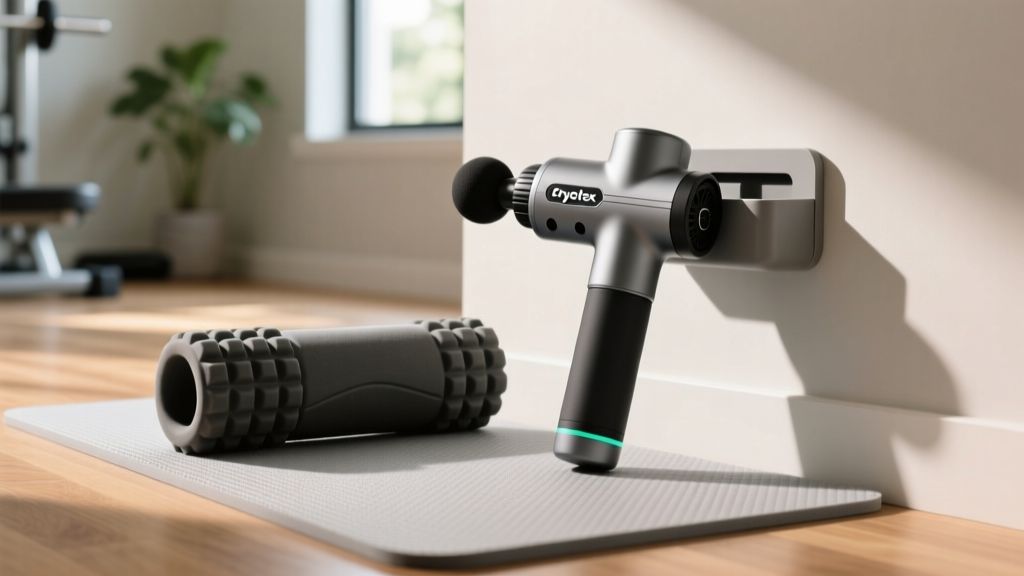
Cryotex Massage Gun Review: Is This Budget Recovery Gear Worth It?

Infrared Sauna Blanket Troubleshooting & NEPQ Massage Gun Guide

Normatec vs Hyperice Boots & Body Sculpture Massage Gun Guide
