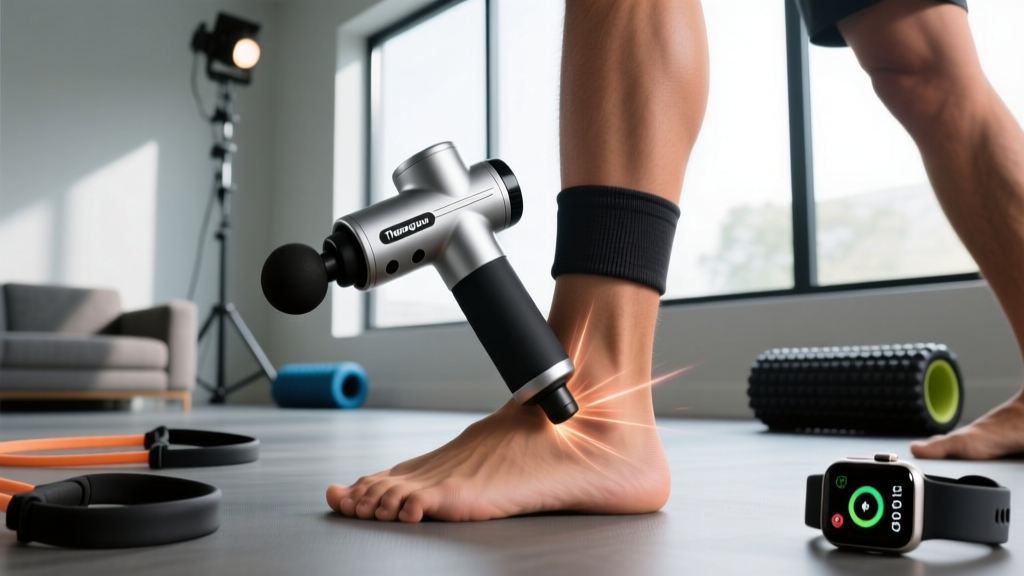
Massage Gun Ankle Recovery: Percussion vs Vibration Therapy & Care
Discover how percussion vs vibration therapy impacts ankle recovery and massage gun longevity. Learn essential maintenance tips for joint-safe device care.

The Biomechanical Reality: Why the Ankle Demands Specific Therapy
When athletes and physical therapists evaluate a massage gun ankle protocol, they are immediately confronted by a harsh anatomical reality: the talocrural joint (ankle) is a minefield of superficial bones, thin tendons, and delicate ligaments. Unlike the gastrocnemius or quadriceps, the ankle lacks thick, protective muscle bellies. Applying deep, aggressive force to this area requires a nuanced understanding of recovery technology—specifically, the critical differences between percussion therapy and vibration therapy.
Choosing the wrong modality does more than just risk bruising your medial malleolus or aggravating Achilles tendinopathy. From an equipment longevity standpoint, using high-stroke percussion on bony prominences is one of the fastest ways to degrade your device's internal motor and battery systems. In this guide, we break down the biomechanics of ankle recovery, compare percussion versus vibration, and provide advanced maintenance protocols to protect your investment.
⚠️ Hardware Warning: Never apply a 16mm stroke percussion device directly to the ankle bone (malleolus) or the calcaneus (heel). The lack of tissue compliance causes immediate motor stalling, which spikes electrical current and degrades the brushless motor's Hall effect sensors.Percussion vs. Vibration: A Deep Dive into Ankle Modalities
While often used interchangeably in marketing, percussion and vibration are mechanically distinct forces. Understanding this distinction is vital for both tissue safety and device preservation.
Percussion Therapy relies on amplitude (stroke depth). Devices like the Theragun PRO Plus feature a 16mm stroke, driving the attachment deep into tissue at frequencies between 20Hz and 40Hz. This is ideal for thick muscle bellies but catastrophic for the ankle joint, where the stroke will simply 'bottom out' against bone.
Vibration Therapy relies on frequency over amplitude. Devices or attachments with a shallow stroke (2mm to 6mm) oscillate at much higher frequencies (50Hz to 150Hz+). According to the American Physical Therapy Association (APTA), localized high-frequency vibration stimulates mechanoreceptors, increases local blood flow, and reduces pain perception without requiring deep tissue compression, making it vastly superior for ankle sprains and tendonitis.
Modality Comparison Matrix
| Feature | Percussion Therapy | Vibration Therapy | Ankle Suitability |
|---|---|---|---|
| Stroke Depth (Amplitude) | 12mm - 16mm | 2mm - 8mm | Vibration wins (prevents bone strikes) |
| Frequency (Hz) | 20 - 40 Hz | 50 - 150+ Hz | Vibration wins (neurological gating) |
| Motor Strain Risk on Joints | High (Frequent stalling) | Low (Surface oscillation) | Vibration preserves motor life |
| Primary Ankle Target | Surrounding calf muscles only | Achilles, ATFL, CFL ligaments | Vibration for joint, Percussion for calf |
Device Longevity: How Incorrect Ankle Therapy Destroys Motors
Most users do not realize that their recovery habits directly impact the lifespan of their equipment. The Mayo Clinic notes that ankle sprains are among the most common sports injuries, leading many to aggressively target the area with whatever tool is at hand. Here is how improper use degrades your hardware.
The 'Stall-Out' Effect on Brushless Motors
Premium massage guns utilize Brushless DC (BLDC) motors equipped with Hall effect sensors to maintain torque. When you press a 16mm percussion head into the hard bone of the ankle, the piston cannot complete its stroke. The motor stalls. In a BLDC motor, a stall condition causes the back-electromotive force (back-EMF) to drop to zero, resulting in a massive spike in electrical current. This current spike generates intense heat, which over time degrades the Battery Management System (BMS) and can permanently demagnetize the motor's rotor, leading to a permanent loss of stall force.
Lateral Torque and Piston Bearing Wear
The ankle's awkward geometry often forces users to tilt the massage gun at severe 45-degree angles to reach the Achilles tendon or the peroneal muscles. Applying downward pressure while the shaft is angled places lateral torque on the internal piston bearings. Over hundreds of cycles, this lateral stress warps the shaft housing, resulting in the dreaded 'rattling' noise and eventual mechanical seizure.
Maintenance Protocol: Hygiene and Hardware Care for Foot/Ankle Use
The foot and ankle region presents unique hygiene challenges. Sweat, dead skin cells, and the presence of common fungi (like tinea pedis) mean that your massage gun attachments require rigorous maintenance to prevent material degradation and cross-contamination.
Pro-Tip: Ditch the Standard EVA FoamStandard Ethylene-Vinyl Acetate (EVA) foam attachments are highly porous. When used on the ankle and foot, they absorb sweat and skin oils, which break down the foam's cellular structure, causing it to crumble within 6 to 8 months.
Step-by-Step Attachment Maintenance
- Material Upgrade: For ankle and foot protocols, swap out porous EVA foam heads for closed-cell Polyurethane (PU), Thermoplastic Polyurethane (TPU), or hard silicone dampener attachments. These non-porous materials resist fungal growth and do not degrade from skin oils.
- Post-Session Sanitization: Wipe down TPU or silicone attachments immediately after use with a 70% isopropyl alcohol wipe. Avoid bleach-based cleaners, which will dry out and crack silicone over time.
- Shaft Debris Clearance: Ankle use often occurs close to the floor, where dust and pet hair are prevalent. Once a month, use a can of compressed air to blow out the piston shaft housing. Hair wrapped around the internal shaft is a leading cause of motor overheating.
- Battery Calibration: Because ankle use (if done correctly with light vibration) draws very little amperage compared to deep thigh work, the battery BMS may lose track of the true charge capacity. Once every 30 days, drain the battery to 5% and perform a continuous charge to 100% to recalibrate the lithium-ion cells.
2026 Device Recommendations for Ankle-Specific Protocols
If your primary focus includes joint-level recovery, consider devices that offer variable stroke lengths or dedicated surface-vibration modes.
- Theragun PRO Plus ($599): Features a smart app with guided routines that explicitly limit user pressure via the OLED screen, preventing the motor stalls that destroy devices during bony ankle protocols. The included 'Dampener' attachment is essential for joint-adjacent vibration.
- Hyperice Hypervolt 2 Pro ($399): Utilizes QuietGlide technology and a slightly shorter 14mm stroke. Its 5-speed dial allows for high-frequency, low-pressure surface vibration that is highly effective for Achilles tendon blood flow without risking bone strikes.
- Ekrin B37S ($229): A mid-tier option with an adjustable 45-degree arm. This ergonomic feature is a game-changer for ankle maintenance, allowing you to reach the lateral malleolus without applying lateral torque to the piston shaft.
Frequently Asked Questions
Can I use a massage gun on a severely sprained ankle?
Never apply percussion or vibration directly to an acute, swollen, or torn ligament (like a Grade 2 or 3 ATFL tear). The mechanical force can disrupt the clotting and early healing phases. According to physical therapy guidelines, you should only use gentle vibration on the surrounding musculature (calves, peroneals) to reduce compensatory tension, avoiding the injury site entirely until cleared by a physician.
Why does my massage gun shut off when I use it on my ankle?
This is the device's internal safety protection triggering. When the percussion head hits the ankle bone, the motor stalls, drawing excess current. The Battery Management System (BMS) detects this thermal and electrical spike and cuts the power to prevent a battery fire or motor burnout. Switch to a dampener attachment and use a gliding, zero-pressure technique to prevent this.
'The ankle is not a muscle to be mashed; it is a complex hinge to be mobilized. Treat your recovery tools with the same respect you treat the joint—use vibration for the tendons, save the percussion for the calves, and your hardware will last a decade.' — Sports Rehabilitation Engineering Consensus
For more detailed maintenance routines and to explore the full Therabody Official Guide on attachment care, always refer to the manufacturer's latest documentation. Proper modality selection not only accelerates your ankle recovery but ensures your recovery technology remains a reliable part of your arsenal for years to come.
More gear to consider
All reviews
Best BTC Recovery Tool: Normatec vs Hyperice (2026)

Normatec vs Hyperice Boots & Best Massage Gun for Knee Relief

Ekrin Massage Gun Value: Percussion vs Vibration Analysis

Home Flexibility Station Setup: How Long to Use Massage Gun

Sauna Blanket Guide: Using Ekrin Athletics Bantam Mini Massage Gun
