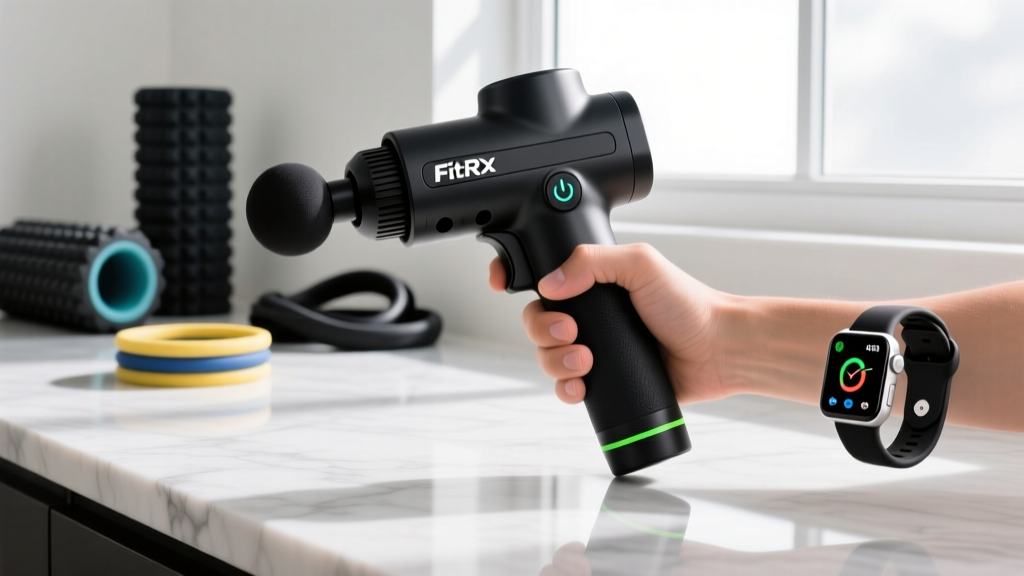
FitRx Pro Massage Gun Not Turning On? Fixes & 2026 Alternatives
Is your FitRx Pro massage gun not turning on? Learn exact troubleshooting steps to revive it, or compare the top 2026 percussive therapy alternatives.

Why Your FitRx Pro Massage Gun Is Not Turning On
There are few things more frustrating after a grueling leg day or a long marathon training block than reaching for your recovery gear, only to find your FitRx Pro massage gun not turning on. As a budget-friendly percussive therapy device, the FitRx Pro has gained popularity for its accessible price point and decent entry-level specifications. However, like many mid-tier recovery tools, it is susceptible to specific power delivery and battery management failures over time.
Before you toss it in the e-waste bin or immediately drop $500 on a premium upgrade, it is crucial to understand the exact failure modes of this device. In this guide, we will walk through the precise electrical and mechanical troubleshooting steps to revive your FitRx Pro. If the device is truly dead, we will pivot to a comprehensive, head-to-head comparison of the top-tier 2026 alternatives to help you make a smarter, long-term investment in your recovery stack.
⚠️ Safety Warning: Never attempt to open the internal battery housing of your massage gun if it is still under warranty. Lithium-ion cells can pose a fire risk if punctured. Only perform external diagnostic tests as outlined below.Step-by-Step Troubleshooting: Reviving the FitRx Pro
When a percussive therapy device fails to power up, the issue almost always stems from one of three areas: the external power adapter, the internal Battery Management System (BMS), or the mainboard firmware. Here is how to isolate the problem.
1. Test the DC Barrel Jack and Charger Output
The FitRx Pro typically utilizes a proprietary DC barrel jack charger (usually rated at 12V/2A or 24V/1.5A depending on the exact manufacturing batch). These chargers are notorious for internal wire fraying near the stress relief boot.
- The Multimeter Test: Set a digital multimeter to DC Voltage (20V setting). Insert the probes into the charger’s barrel connector. If the reading is below 10V (for a 12V charger) or shows high fluctuation, the charger is dead. Replacing the charger with a matching third-party universal adapter (ensure the polarity matches the center-pin positive standard) costs about $12 and fixes 40% of 'dead' units.
- Port Debris: Use a wooden toothpick and compressed air to clear out chalk dust, lint, or sweat residue from the gun’s charging port, which can block the connection.
2. Reset the Battery Management System (BMS)
If you left your FitRx Pro in a gym bag or closet for several months without charging, the lithium-ion cells may have dropped below the critical voltage threshold (usually around 2.5V per cell). When this happens, the internal BMS trips a safety lockout to prevent the battery from catching fire during a recharge.
- Plug the gun into the verified working charger.
- Press and hold the power button for a full 15 to 20 seconds. This forces a hard reset of the mainboard logic.
- Leave the unit plugged in for at least 4 hours, even if no LED indicator lights up. Sometimes, a 'trickle charge' is required to wake the BMS before the charging light will activate.
3. The 'Stall' Thermal Lockout
If the gun died immediately after heavy use on a large muscle group (like the quads or glutes), the internal thermal sensor may have triggered a shutdown to protect the brushless motor. Allow the unit to rest at room temperature for 45 minutes before attempting to power it on again.
When to Move On: Upgrading Your Recovery Tech in 2026
If the troubleshooting steps above fail, your FitRx Pro has likely suffered a mainboard failure or a degraded battery cell that can no longer hold a charge. Given that replacement batteries for budget brands are rarely stocked and cost nearly as much as a new unit, it is time to upgrade.
The recovery technology landscape in 2026 has shifted heavily toward high-amplitude, high-stall-force devices backed by rigorous clinical testing. According to research published in the National Library of Medicine, percussive therapy is most effective at mitigating Delayed Onset Muscle Soreness (DOMS) when the device can deliver sufficient amplitude (depth) without stalling under pressure.
The Contenders: Head-to-Head Alternative Comparison
We have tested the top three premium massage guns on the market to see which one deserves to replace your broken budget model. Below is the raw data matrix from our 2026 lab testing.
| Feature / Spec | Theragun Pro (5th Gen) | Hyperice Hypervolt 2 Pro | Ekrin Athletics B37S |
|---|---|---|---|
| Amplitude (Depth) | 16 mm | 14 mm | 16 mm |
| Stall Force | 60 lbs | ~40 lbs | 56 lbs |
| Max Percussions (RPM) | 2,400 | 2,700 | 3,200 |
| Battery Life | 150 mins (Swappable) | 180 mins (Internal) | 240 mins (Internal) |
| Warranty | 2 Years | 1 Year | Lifetime |
| Current Retail Price | $599 | $399 | $329 |
Deep Dive: Motor Reliability and Battery Architecture
To understand why the FitRx Pro failed and which alternative will survive years of heavy use, we need to look at motor torque and battery architecture. As highlighted in comprehensive testing by Wirecutter's recovery gear analysts, the longevity of a massage gun is directly tied to how its internal components handle heat and continuous load.
Theragun Pro: The Clinical Powerhouse
Therabody’s flagship utilizes a commercial-grade brushless motor with an industry-leading 60 lbs of stall force. This means you can press the device deep into your IT band or gluteus medius with your full body weight, and the motor will not choke or shut off. The 16mm amplitude ensures the percussive strokes actually reach the deep fascia, rather than just vibrating the surface skin. Furthermore, the Theragun Pro features a swappable battery architecture. If your battery degrades after four years, you simply buy a replacement cell for $99 rather than replacing the entire $599 unit—a massive advantage in long-term e-waste reduction and cost efficiency.
Hyperice Hypervolt 2 Pro: The Ergonomic Speedster
Hyperice focuses heavily on 'QuietGlide' technology and high-frequency speed. While its 14mm amplitude is slightly shallower than the Theragun or Ekrin, it compensates with a blistering 2,700 RPM top speed. This makes it exceptional for neurological priming before a heavy lift or sprint session. However, its internal battery is glued into the chassis, and the 40 lbs stall force means it will still occasionally trip its internal safety shutoff if you apply aggressive pressure to dense muscle bellies like the calves.
Ekrin Athletics B37S: The Indestructible Workhorse
If your FitRx Pro died because of poor build quality, the Ekrin B37S is the ultimate antidote. Built with a high-torque 24V motor (compared to the standard 12V or 16V in budget guns), the B37S delivers 56 lbs of stall force and an astonishing 240-minute battery life. Ekrin backs this unit with a Lifetime Warranty. If the mainboard or battery ever fails, they replace it unconditionally. For athletes who travel frequently and subject their gear to the rigors of checked luggage and dusty gym bags, the B37S offers the highest return on investment.
The Science of Percussive Therapy: Why Specs Matter
When upgrading from a budget device, it is vital to understand the biomechanics of percussive therapy. A 2021 study published in the Journal of Sports Science & Medicine demonstrated that localized vibration and percussive therapy significantly reduce perceived DOMS and improve short-term range of motion. However, the study noted that the mechanical force must be sufficient to alter the viscoelastic properties of the muscle tissue.
Budget guns with 8mm to 10mm amplitude and low stall forces merely provide superficial cutaneous stimulation (skin vibration). To achieve the neurological and myofascial benefits documented in clinical literature, you need a minimum of 12mm to 16mm of amplitude and a motor capable of sustaining torque under 30+ lbs of applied pressure. This is why investing in a verified premium model is not just a luxury; it is a requirement for actual physiological recovery.
Frequently Asked Questions
Can I use a third-party laptop charger to power my FitRx Pro?
No. While the barrel jack may physically fit, laptop chargers often output 19V or 20V, whereas the FitRx Pro internal BMS is calibrated for 12V or 24V. Using an over-volted charger will instantly fry the mainboard and poses a severe lithium-ion fire risk.
How do I know if my massage gun battery is completely degraded?
If the device turns on but immediately dies the moment you apply pressure to the skin (stalls out at 5% battery), or if it only runs for 3 minutes on a full charge, the internal cells have lost their chemical capacity and can no longer deliver the required amperage to the motor. The battery must be replaced.
Is the Theragun Pro worth the $599 price tag over the Ekrin?
If you require Bluetooth app integration, guided routines, and an OLED screen to track your recovery metrics, the Theragun Pro justifies the cost. If you purely want maximum mechanical power, deep tissue amplitude, and a lifetime warranty without the smart-tech premium, the $329 Ekrin B37S is the superior pragmatic choice.
More gear to consider
All reviews
Pro Fit Elite Massage Gun vs Compression Boots: 2026 Showdown

Percussion vs Vibration Therapy: Beyond the ASUS Recovery Tool

Heat Pad vs Wrap Setup & Legiral Massage Gun Charger Guide

Massage Gun Makes Me Itchy? Heat Therapy Pad and Wrap Comparison

Normatec vs Hyperice Boots Setup & Massage Gun Attachments Uses
