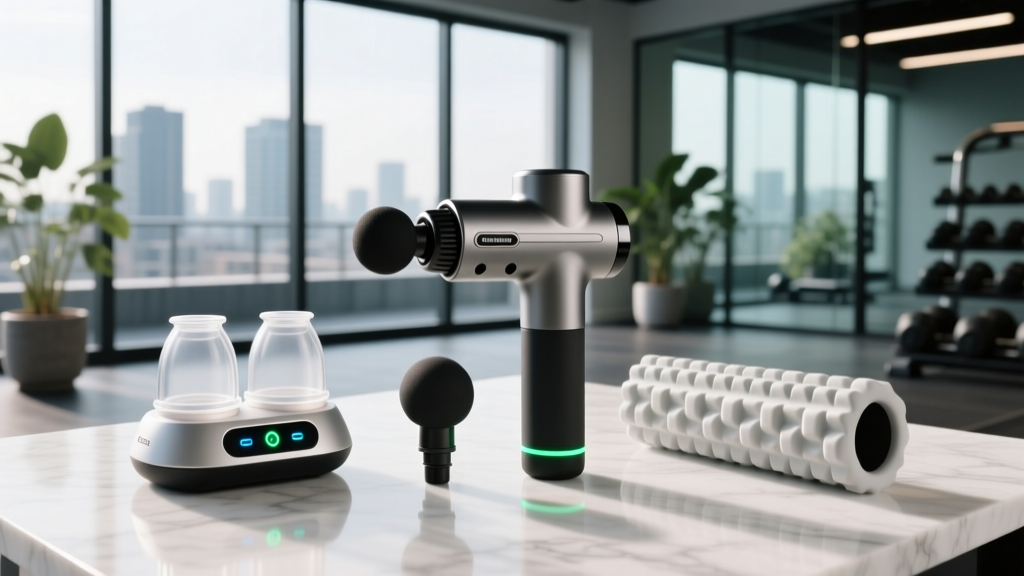
Cupping Therapy Trends: How Do Massage Guns Help Compare?
Explore 2026 recovery trends comparing smart cupping therapy equipment for athletes with percussive devices. Learn how suction and percussion optimize tissue repair.

The 2026 Recovery Landscape: Percussion vs. Decompression
The sports recovery equipment market has undergone a massive paradigm shift as we move through 2026. While percussive therapy devices dominated the late 2010s, elite athletes and physical therapists are increasingly integrating pneumatic decompression into their daily protocols. The global smart recovery devices market is now projected to surpass $24 billion by the end of the decade, driven largely by the rapid adoption of automated, dynamic cupping therapy equipment for athletes. But as suction-based technologies claim superior fascial release, where does that leave traditional percussion? To build an optimal recovery arsenal, sports scientists and weekend warriors alike must understand the distinct biomechanical differences between these two modalities.
The Percussive Baseline: How Do Massage Guns Help?
To understand the current shift toward suction, we must first ask: how do massage guns help at a neuromuscular level? Percussive therapy devices, such as the Theragun Pro, operate on the principles of high-frequency amplitude and the Gate Control Theory of pain. By delivering concentrated kinetic energy—typically at frequencies between 16Hz and 40Hz with an amplitude of 12mm to 16mm—these devices stimulate mechanoreceptors in the muscle belly.
This rapid stimulation effectively 'closes the gate' on nociceptive (pain) signals traveling to the brain, providing immediate, albeit temporary, analgesic relief. Furthermore, the localized mechanical pressure forces a temporary increase in intramuscular blood flow, which aids in the flushing of metabolic waste products like hydrogen ions post-exercise. However, percussive therapy is fundamentally a compressive force. It pushes tissue down and outward. While excellent for neurological down-regulation and acute warm-ups, compression alone cannot address deep fascial adhesions or create the negative pressure required to separate bound tissue layers.
The Rise of Smart Cupping Therapy Equipment for Athletes
This biomechanical limitation is exactly why smart cupping has surged in 2026. Modern cupping devices no longer rely on manual pumps or the fire-hazard risks of traditional glass cups. Today’s automated cupping therapy equipment for athletes combines dynamic pneumatic suction, targeted heat therapy, and photobiomodulation (red light therapy) into a single, handheld node.
According to a comprehensive clinical review published in PLOS One regarding the efficacy of cupping therapy, the application of negative pressure creates a decompressive effect that lifts the epidermis and superficial fascia away from the underlying muscle. This micro-trauma stimulates a localized inflammatory healing response, increases lymphatic drainage, and physically separates fused fascial layers that restrict range of motion (ROM).
Biomechanical Contrast: Compression vs. Decompression
- Massage Guns (Compression): Pushes tissue down. Best for neurological priming, gate-control pain masking, and acute blood flow stimulation prior to competition.
- Smart Cupping (Decompression): Pulls tissue up. Best for fascial release, lymphatic drainage, breaking down scar tissue adhesions, and chronic stiffness mitigation post-competition.
Market Data & Pricing: 2026 Equipment Teardown
The market is currently segmented between premium, multi-modality smart cups and budget-friendly dynamic suction units. Below is an analysis of the top-tier equipment defining the 2026 recovery space.
1. Hyperice Ventuzi (The Premium Multi-Modal Standard)
Retailing at $299, the Hyperice Ventuzi represents the pinnacle of hybrid recovery tech. It features dynamic suction that pulses between -60kPa and -80kPa, preventing the tissue from adapting to static pressure. Crucially, it integrates 660nm red light therapy to stimulate cellular ATP production concurrently with fascial lifting.
2. Achedaway Pro (The High-Value Contender)
Priced aggressively at $129, the Achedaway Pro offers automated sliding cupping modes that mimic traditional 'gliding' massage techniques but with negative pressure. While it lacks the refined app-integration of Hyperice, its -65kPa baseline suction and integrated heating element (up to 40°C) make it a staple for track-and-field athletes managing hamstring tension on a budget.
3. Theragun Pro (The Percussive Benchmark)
At $599, the Theragun Pro remains the gold standard for percussive compression, offering 60 lbs of stall force and a 16mm amplitude. However, its high price point is forcing athletes to weigh whether pure percussion justifies the cost when hybrid suction devices offer multi-modal therapy at half the price.
Feature & Biomechanical Comparison Matrix
| Feature / Metric | Hyperice Ventuzi (Smart Cup) | Theragun Pro (Massage Gun) |
|---|---|---|
| Primary Force Vector | Decompressive (Negative Suction) | Compressive (Kinetic Percussion) |
| Pressure / Amplitude | Up to -80kPa Suction | 16mm Amplitude / 60 lbs Stall Force |
| Frequency / Modality | Dynamic Pulsing + 660nm Red Light | 1750 - 2400 PPM (Percussions/Min) |
| Target Tissue Layer | Superficial Fascia, Epidermis, Lymph | Deep Muscle Belly, Neuromuscular Spindles |
| 2026 Retail Price | $299 USD | $599 USD |
| Best Use Case | Post-event fascial release, DOMS mitigation | Pre-event warm-up, acute pain gating |
Clinical Protocols: Integrating Suction into Training Cycles
Understanding the hardware is only half the battle; application is where athletes see actual information gain and performance returns. Improper cupping can lead to severe petechiae (capillary rupture) or localized bruising that impairs subsequent training sessions. Below is a sports-science-backed protocol for utilizing smart cupping equipment on high-stress areas like the hamstrings and IT band.
Step-by-Step Dynamic Cupping Protocol for Hamstring Recovery
- Preparation (0-2 Minutes): Apply a thin layer of massage oil or recovery lotion to the posterior thigh. This is non-negotiable for dynamic suction; dry skin will cause the device to drag and tear the epidermis.
- Static Anchor (Minutes 2-4): Set the device to a moderate suction level (-40kPa). Place the cup on the proximal hamstring (near the gluteal fold) and leave it static for 90 seconds to initiate localized vasodilation.
- Dynamic Gliding (Minutes 4-8): Switch the device to 'Dynamic Mode' (pulsing suction). Slowly glide the cup down the muscle belly toward the popliteal fossa (back of the knee). Never pull directly over the back of the knee joint due to dense nerve and vascular networks.
- Photobiomodulation (Minutes 8-12): Activate the 660nm red light therapy setting. Anchor the cup on the most adhesed fascial point and allow the light therapy to penetrate the lifted tissue for 4 uninterrupted minutes.
- Flush (Post-Protocol): Drink 16oz of water with electrolytes to support the lymphatic system in clearing the metabolic debris mobilized by the negative pressure.
Expert Warning: Never exceed 5 minutes of continuous static high-pressure suction (-70kPa or higher) on a single zone. Prolonged negative pressure causes localized hypoxia and excessive capillary extravasation, which will delay recovery rather than accelerate it.
Expert Verdict: Building a Hybrid Recovery Arsenal
As we analyze the 2026 recovery equipment market, it is clear that the 'percussion vs. cupping' debate is a false dichotomy. They are complementary tools serving entirely different physiological functions. If your primary goal is pre-workout neurological priming, rapid warm-ups, and masking acute localized pain, a high-amplitude massage gun remains unmatched. However, for athletes dealing with chronic fascial stiffness, restricted range of motion, and the need for deep lymphatic flushing post-competition, smart cupping therapy equipment provides a decompressive mechanism that percussion simply cannot replicate.
For the modern athlete, the optimal investment strategy is hybridization. Utilizing a premium percussive device for warm-ups, followed by a dynamic smart cupping device like the Hyperice Ventuzi or Achedaway Pro for post-event fascial decompression, yields the highest return on investment for long-term tissue health and athletic longevity.
More gear to consider
All reviews
Compression Boots vs How to Use a Massage Gun After Workout (2026)

Compression Boots vs Elefor Massage Gun: 2026 Recovery Review

Massage Guns Effectiveness: Percussion vs Vibration Value Analysis

Ice Bath Budgets: Cold Plunge Value & Lexar Recovery Tool Fixes

Normatec vs Hyperice Boots & HSA Approved Massage Gun Guide
