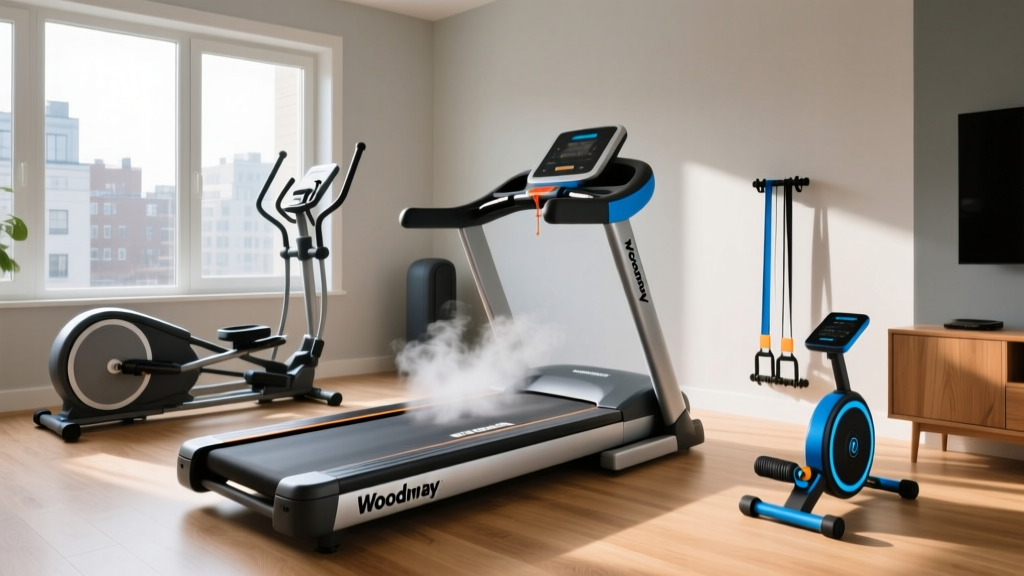
How Much Is a Woodway Treadmill? Compact Alternatives
Wondering how much is a Woodway treadmill? We break down the $7K+ costs, space requirements, and the best compact portable cardio alternatives for small homes.

If you have been researching premium home gym setups, you have likely asked yourself: how much is a Woodway treadmill? Known for their durable vulcanized rubber slat belts and biomechanically superior curved decks, Woodway treadmills are the gold standard in commercial and elite athletic facilities. However, bringing this elite technology into a residential space requires a serious conversation about both budget and square footage.
In 2026, urban living spaces and multi-use rooms are smaller than ever. While a Woodway is a phenomenal piece of engineering, its massive footprint and premium price tag force many home gym builders to pivot. This guide breaks down the true cost and spatial demands of Woodway machines, and then explores the best compact portable cardio equipment options that deliver high caloric burn and joint-friendly mechanics without dominating your living room.
The Woodway Reality Check: Pricing and Spatial Demands
Before pivoting to space-saving alternatives, it is crucial to understand exactly what you are pricing out. Woodway primarily offers two residential-friendly models, though neither is truly 'compact'.
1. The Woodway Curve (Manual Slat Treadmill)
- Estimated Cost: $7,200 - $8,000
- Footprint: 67" L x 33" W x 63" H
- Weight: 345 lbs
- Space Requirement: Minimum 30 square feet (including safety clearance)
2. The Woodway 4Front (Motorized Slat Treadmill)
- Estimated Cost: $9,500 - $12,500+ (depending on console and accessories)
- Footprint: 80" L x 36" W x 68" H
- Weight: 430 lbs
- Space Requirement: Minimum 40 square feet
The Pivot: Why Compact Portable Cardio is the 2026 Standard
According to the American Heart Association, adults need at least 150 minutes of moderate-intensity aerobic activity per week. You do not need a $10,000, 400-pound slat treadmill to achieve this. The fitness industry has seen a massive surge in high-resistance, low-footprint portable cardio equipment designed specifically for spatial optimization.
Modern portable cardio machines utilize advanced magnetic resistance, foldable aerospace-grade aluminum hinges, and vertical storage capabilities. They allow you to maintain a dedicated cardio zone in a 500-square-foot apartment without sacrificing the aesthetic or functional flow of your home.
Top Compact Portable Cardio Alternatives
If the Woodway price tag or spatial footprint is a dealbreaker, here are the top-tier portable alternatives that maximize layout efficiency.
1. The Biomechanical Pivot: Premium Folding Treadmills
If you are committed to running or walking, you do not need a slat belt to get a great workout. The Horizon Fitness 7.0S (approx. $1,199) or the NordicTrack T Series 10 (approx. $599) offer motorized belts with hydraulic folding mechanisms.
- Space Optimization: When folded, the deck locks vertically, reducing the footprint from roughly 70" x 30" down to 35" x 30".
- Failure Mode Warning: Cheap sub-$300 folding treadmills often suffer from hinge fatigue and motor burnout within 14 months. Stick to brands with lifetime frame warranties and continuous-duty motors (minimum 2.75 CHP) to ensure longevity.
2. The Full-Body Saver: Stowable Smart Rowers
Rowing recruits 86% of the body's musculature, offering a higher metabolic demand per minute than walking on a curved treadmill. The Hydrow Wave ($1,495) or the classic Concept2 Model D ($1,125) are elite alternatives.
- Space Optimization: The Hydrow Wave features a patented 'Stow' mechanism that allows it to tilt vertically, occupying just 20" x 83" of floor space against a wall. The Concept2 separates into two pieces in seconds and can be slid under a bed or stood in a closet.
- Layout Tip: Place rowers parallel to a window or media wall. Because the user sits low to the ground (approx. 14" seat height), the machine does not block sightlines or television views when in use.
3. The Ultra-Compact Option: Motorized Walking Pads
For those who primarily want to hit their daily step count while working from home, motorized walking pads are the ultimate space-saving solution. The KingSmith WalkingPad X21 (approx. $799) features a dual-fold design.
- Space Optimization: Folds down to a mere 10 inches thick and can be stored vertically in a closet, under a sofa, or behind a door. It weighs just 55 lbs and includes built-in transport wheels.
- Limitation: Max speed is usually capped at 7.5 mph, and there are no handrails. This is strictly for walking and light jogging, not high-intensity sprint intervals.
Space-Optimization Layout Framework for Small Gyms
Designing a home cardio layout requires more than just measuring the machine. Follow this 4-step framework to optimize your space for portable equipment.
Step 1: Map the 'Active Zone' vs. 'Storage Zone'
Never measure a room based on a machine's folded dimensions. Map out the 'Active Zone' (the space required while the machine is in use, including your body's wingspan and stride length) and the 'Storage Zone' (where it lives 22 hours a day). Use painter's tape on your floor to visualize both zones before purchasing.
Step 2: Invest in Interlocking Horse Stall Mats
Portable cardio machines can vibrate or shift during high-intensity intervals. Instead of buying a single massive commercial gym mat (which is hard to move and clean under), purchase 4x6 foot interlocking rubber horse stall mats (approx. $50 each at agricultural supply stores). They provide superior acoustic dampening for downstairs neighbors and can be pulled apart to clean the floor beneath them.
Step 3: Vertical Wall Utilization
When floor space is at a premium, look up. Wall-mounted racks for rower handles, resistance bands, and even wall-hooks for folded walking pads keep the floor clear. A clear floor reduces visual clutter, which psychological studies show decreases workout friction and increases adherence to the CDC's physical activity guidelines.
Step 4: Power and Cable Management
Motorized portable cardio requires power. Route cables along baseboards using paintable cord covers. Never run a power cord across a walking path; a tripping hazard in a compact home gym is a leading cause of residential fitness injuries.
Head-to-Head: Woodway vs. Compact Alternatives
The table below illustrates the massive disparity in spatial and financial requirements between elite commercial treadmills and modern portable cardio alternatives.
| Equipment Type | Average Cost | Active Footprint | Storage Footprint | Weight |
|---|---|---|---|---|
| Woodway Curve (Slat) | $7,500 | 30+ sq ft | 15.3 sq ft (Static) | 345 lbs |
| Hydrow Wave (Rower) | $1,495 | 24 sq ft | 2.5 sq ft (Vertical) | 102 lbs |
| Horizon 7.0S (Folding) | $1,199 | 28 sq ft | 7.5 sq ft (Folded) | 180 lbs |
| WalkingPad X21 (Pad) | $799 | 12 sq ft | 3 sq ft (Dual-Fold) | 55 lbs |
"The best home gym equipment is the equipment that removes friction from your daily routine. If a machine is too large, too heavy to move, or too expensive to replace, it becomes a monument to guilt rather than a tool for health. Compact, stowable cardio equipment respects your living space and your lifestyle."
Final Verdict: Budget and Space Dictate the Meta
So, how much is a Woodway treadmill? Expect to pay between $7,200 and $12,500, and be prepared to dedicate a permanent, reinforced 30-to-40 square foot footprint in your home. For elite sprinters, physical therapy clinics, and those with sprawling dedicated gym spaces, the Woodway is an unmatched investment in joint health and biomechanics.
However, for the vast majority of home users in 2026, the spatial and financial ROI simply does not align. By pivoting to compact portable cardio equipment options—like vertical-stowing smart rowers, hydraulic folding treadmills, or dual-fold walking pads—you can achieve the exact same cardiovascular health benefits recommended by top medical institutions. You get to keep your living room, your budget, and your joints intact, all while maintaining the flexibility to adapt your home layout as your life changes.
For more in-depth reviews on optimizing your home fitness layout, explore our comprehensive guides on space-efficient home gym equipment and modular flooring solutions.
More gear to consider
All reviews
Lopifit Treadmill & Cardio Machine Noise Comparison Guide 2026

Virtual Reality Treadmills: 2026 Motor & HP Comparison Guide
Stair Climber Guide: Beyond the Elliptical Versus Treadmill Debate

Walking Pad Treadmill Costco Guide & Office Layout Design 2026
How to Calibrate Garmin to Treadmill & Home Stair Climbers
