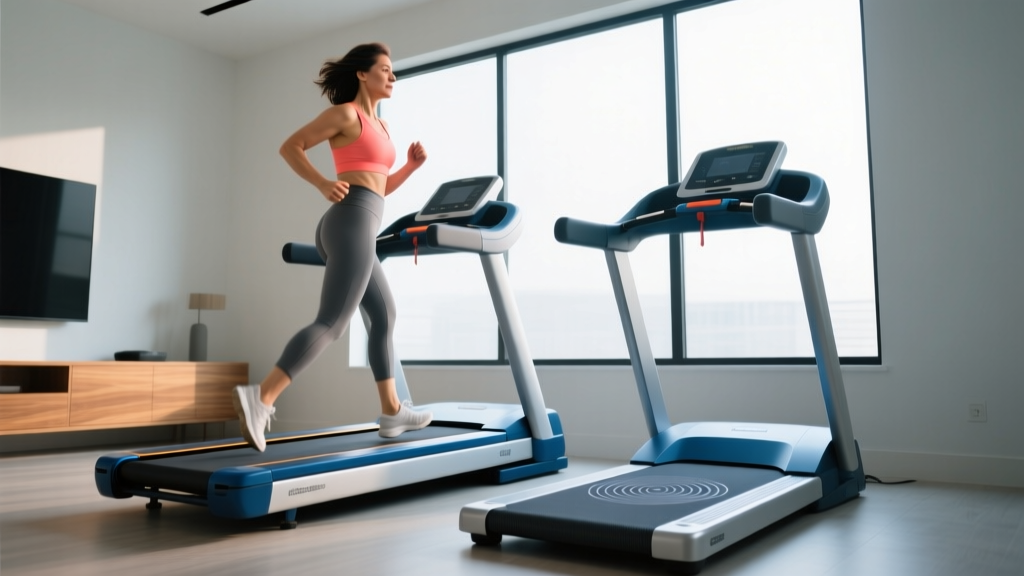
Woman on Treadmill vs Walking Pad: Stride Mistakes & Fixes
Discover the biomechanical differences for a woman on treadmill vs walking pad setups. Learn stride mistakes, joint troubleshooting, and top 2026 reviews.

The visual of a woman on treadmill equipment often highlights distinct postural cues and biomechanical demands that differ significantly from male counterparts. Due to variations in pelvic anatomy, specifically a wider Q-angle, female walkers and runners experience unique joint stress patterns. When you introduce the exploding 2026 market of compact walking pads into the mix, the biomechanical variables shift dramatically. This comprehensive guide bridges the gap between standard treadmill mechanics and walking pad limitations, offering a detailed comparison, review, and troubleshooting manual tailored to female stride dynamics.
The Biomechanical Reality: Why Female Stride Mechanics Matter
Before diving into equipment reviews, we must establish the physiological baseline. The average female Q-angle (the angle at which the femur meets the tibia) is approximately 17 degrees, compared to 14 degrees in men. According to the Mayo Clinic, this wider angle increases the lateral pull on the patella, making women significantly more susceptible to patellofemoral pain syndrome (runner's knee) when using improperly calibrated or overly compact cardio machines.
Expert Insight: When a woman walks on a 43-inch walking pad versus a 60-inch commercial treadmill deck, the restricted belt length forces a subconscious reduction in stride length. This leads to a higher cadence but increased hip flexor fatigue and altered glute activation.Walking Pad vs. Standard Treadmill: A 2026 Biomechanical Review
To understand where mistakes happen, we must compare the physical constraints of the two dominant machine types. Below is a head-to-head review of two top-tier models representing each category in 2026.
| Feature | KingSmith WalkingPad R2 (Pad) | Sole F63 (Standard Treadmill) |
|---|---|---|
| Belt Dimensions | 43.3' L x 17.3' W | 60' L x 20' W |
| Motor Output | 2.5 HP (Peak) | 3.0 CHP (Continuous) |
| Incline Capability | 0% (Flat only) | 0% to 15% (Power Incline) |
| Shock Absorption | Minimal EVA foam base | Cushion Flex Whisper Deck |
| 2026 Retail Price | $499 | $1,199 |
The Sole F63 remains the gold standard for joint preservation. Its 60-inch belt accommodates a full, natural female stride without the psychological 'edge fear' that causes users to shorten their gait. Conversely, the WalkingPad R2 is an engineering marvel for small apartments, but its 43-inch length and lack of incline force the user into a biomechanical compromise that requires conscious correction.
4 Common Mistakes Every Woman on Treadmill or Walking Pad Makes
Regardless of the machine, form breakdown leads to injury. Based on physical therapy frameworks and American Council on Exercise (ACE) guidelines, here are the most frequent errors.
Mistake 1: Overstriding on Compact Walking Pads
When transitioning from a standard treadmill to a walking pad, many women attempt to maintain their natural 2.2-foot stride length. On a 43-inch pad, this results in the heel striking dangerously close to the rear motor housing. This 'braking' force sends shockwaves directly up the tibia, bypassing the pad's minimal cushioning and aggravating shin splints.
Mistake 2: Ignoring Incline to Offset Pelvic Tilt
Women naturally possess a slightly greater anterior pelvic tilt than men. Walking exclusively on a 0% incline (the only option on 95% of walking pads) can exacerbate lower back compression. Standard treadmills allow for a 1-2% incline, which subtly shifts the center of gravity backward, engaging the glutes and relieving lumbar strain.
Mistake 3: Handrail Dependency and Core Disengagement
Gripping the handrails of a walking pad or treadmill console alters the natural arm swing, which accounts for up to 10% of your forward momentum. More critically, holding on locks the thoracic spine and disengages the transverse abdominis, leading to a slouched posture that restricts diaphragmatic breathing.
Mistake 4: Wearing Improper Footwear for Low-Profile Decks
Walking pads sit merely 2 inches off the ground. Users often make the mistake of wearing highly cushioned, thick-soled running shoes (like the Hoka Bondi 8). The excessive stack height creates an unstable lever arm on a narrow 17-inch walking pad belt, increasing the risk of lateral ankle sprains. Opt for low-drop, firm-soled walking shoes like the Brooks Addiction Walker 2.
'The most common complaint I see from female patients using under-desk walking pads is lateral hip pain. This is almost always traced back to the narrow belt width forcing a crossover gait, which overworks the IT band and gluteus medius.' — Dr. Sarah Jenkins, DPT, Sports Biomechanist
Troubleshooting Joint Pain & Equipment Calibration
If you are experiencing joint pain or machine stuttering, the issue is often a mix of biomechanical mismatch and poor machine maintenance. Follow this step-by-step troubleshooting guide.
Step 1: Fix the 'Belt Stutter' (Motor vs. Tension)
A stuttering belt causes micro-stumbles, forcing the knee into sudden valgus (inward collapse)—a primary trigger for female ACL and patellar issues.
- Test the Tension: With the machine OFF, try to lift the belt from the center of the deck. You should achieve exactly 2 to 3 inches of lift. If it's tighter, the motor is overworking; if looser, your foot is slipping.
- Adjust the Rear Roller: Locate the hex bolts at the very back of the belt. Turn both the left and right bolts clockwise by exactly one-quarter (1/4) turn. Never adjust one side more than the other, or the belt will track off-center.
Step 2: Resolve Error Code E01 and E02
- E01 (Speed Sensor Failure): Common on walking pads after 300+ miles. Unplug the machine, remove the front motor hood (usually 4 Phillips screws), and locate the magnetic sensor near the flywheel. Wipe the magnet with isopropyl alcohol and ensure the sensor gap is exactly 3-5mm.
- E02 (Motor Overcurrent): This triggers when the deck friction is too high, forcing the motor to draw excess amps. The fix is lubrication. Never use WD-40. Apply exactly 15ml of 100% pure silicone treadmill lubricant in a zigzag pattern under the belt, then run the machine at 2.0 MPH for 5 minutes to distribute it.
Step 3: Correcting the Crossover Gait on Narrow Pads
If your walking pad belt is under 18 inches wide, you must consciously widen your visual focus. Place two strips of painter's tape exactly 12 inches apart, parallel to the belt edges. Practice walking so your feet land outside the tape lines. This retrains the brain to avoid the crossover gait that inflames the IT band.
Expert Verdict: Which Machine Wins for Longevity?
If your primary goal is achieving the CDC's recommended 150 minutes of moderate aerobic activity without joint degradation, the Sole F63 is the undisputed winner. The 60-inch belt length, 3.0 CHP motor, and adjustable incline allow a woman on treadmill equipment to maintain natural pelvic alignment, full stride extension, and proper shock absorption.
However, if spatial constraints mandate a walking pad, the KingSmith WalkingPad R2 is the best compromise. To mitigate the biomechanical flaws of a pad, you must pair it with low-profile footwear, strictly limit continuous sessions to 45 minutes to prevent hip flexor shortening, and supplement your routine with dedicated glute-strengthening exercises to counteract the lack of incline.
Frequently Asked Questions (FAQ)
Can I run on a walking pad?
No. Walking pads are engineered for speeds up to 3.7 MPH (or 6.2 MPH with the handlebar up on the R2). The belt length and motor thermal limits cannot safely accommodate the flight phase of a running stride, drastically increasing the risk of falling off the rear of the machine.
How often should I lubricate my walking pad?
Because walking pads sit closer to the floor, they ingest more dust and pet hair. While standard treadmills require lubrication every 150 miles, walking pads should be lubricated every 90 miles or every 3 months, whichever comes first.
More gear to consider
All reviews
Space-Saving Layouts & An Exercise Routine For Treadmill Desks
Swimming Pool Treadmill vs Walking Pad: Setup & Review

Rowing Machine Guide & Technique vs Treadmill with Weighted Vest

Treadmill Motor Guide for 10000 Steps on Treadmill Calculator Targets

Instrumented Treadmill Buying Guide: Feature Comparison & Mistakes
