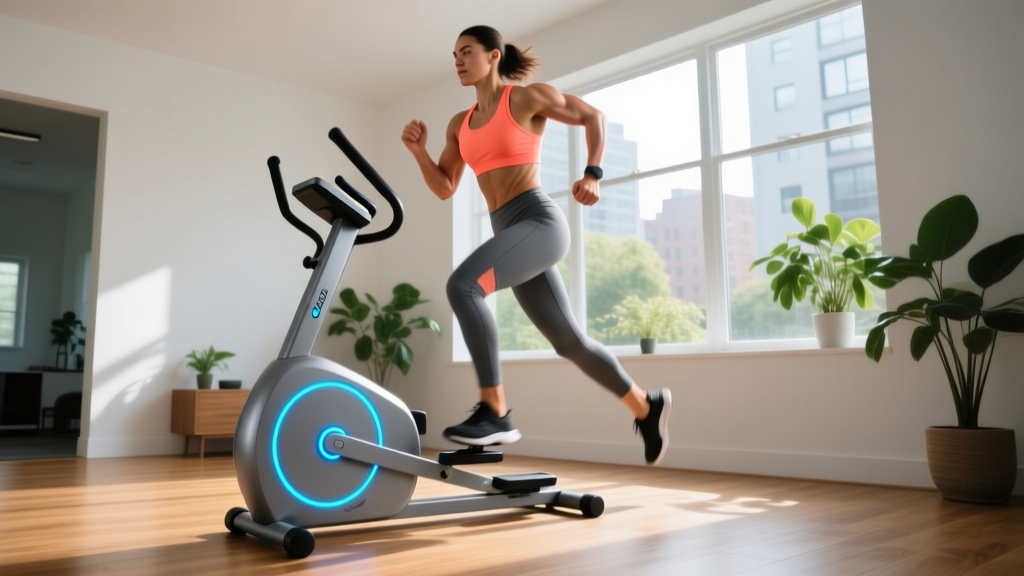
Why Is Running Outside Harder Than Treadmill? 2026 Portable Cardio
Discover why running outside is harder than treadmill workouts. We analyze 2026 market trends in compact portable cardio equipment to bridge the gap.

The Biomechanics: Why Is Running Outside Harder Than Treadmill?
For decades, runners and sports scientists have debated the physiological discrepancies between overground and indoor running. If you have ever transitioned from a 5K outdoor run to a 5K treadmill run and felt unexpectedly fatigued outdoors, you are not alone. Understanding why running outside is harder than treadmill exercise requires a deep dive into biomechanics, environmental resistance, and neuromuscular activation.
According to comprehensive biomechanical studies comparing overground and treadmill running, the primary difference lies in posterior chain activation. When running outside, your hamstrings and glutes must actively pull your center of mass forward over your stance leg. On a motorized treadmill, the belt mechanically pulls your foot backward, reducing hamstring and glute activation by roughly 10% to 15%. This mechanical assistance lowers the metabolic cost of indoor running.
Furthermore, outdoor running introduces aerodynamic drag. Wind resistance increases exponentially with speed, adding anywhere from 2% to 10% to your total energy expenditure depending on your pace and weather conditions. Uneven terrain, micro-fluctuations in elevation, and the need for constant proprioceptive adjustments to avoid obstacles further tax the central nervous system and stabilizing muscles, making outdoor running a fundamentally more demanding full-body exercise.
💡 The Landmark 1% Incline Rule
To accurately simulate the energetic cost of outdoor running on a flat surface, sports scientists recommend the 1% incline rule. Landmark research published in the Journal of Sports Sciences demonstrated that setting a treadmill to a 1% grade perfectly offsets the lack of wind resistance for runners maintaining a pace faster than 7:09 per mile (8.4 mph). For slower paces, a 0% incline is generally sufficient to match outdoor caloric burn.
The 2026 Market Shift: Compact Portable Cardio Equipment Options
While full-sized commercial treadmills offer the closest indoor approximation to outdoor running, the realities of modern urban living and hybrid work models have triggered a massive shift in consumer purchasing behavior. Recent industry analysis on fitness equipment trends highlights that the compact and portable cardio segment is the fastest-growing niche in the home fitness market for 2026.
Consumers are no longer willing to dedicate 30 square feet of living space to a monolithic treadmill. Instead, the market has responded with highly engineered, space-saving alternatives that allow users to maintain cardiovascular health, simulate outdoor efforts, and seamlessly integrate movement into the workday. Below, we analyze the top compact portable cardio equipment options dominating the 2026 market.
1. Advanced Folding Treadmills & Walking Pads
The evolution of the 'walking pad' has moved beyond simple under-desk strollers. In 2026, premium folding treadmills bridge the gap between portability and genuine running mechanics.
- WalkingPad R2 ($499 - $549): Featuring a 180-degree folding hinge and a 1.25 HP motor, the R2 reaches speeds up to 7.5 mph. While not designed for sprinting, it is the gold standard for high-volume zone-2 walking and light jogging in micro-apartments. It folds to just 10.6 inches thick and supports up to 240 lbs.
- Echelon Stride-S ($799): For users needing to simulate outdoor hill running, the Stride-S offers 12 levels of motorized incline and a 1.5 HP motor capable of 12 mph. Its standout feature is the auto-fold mechanism, reducing its footprint to a mere 10-inch depth against a wall. It supports 300 lbs and includes a 20-inch running belt width, which requires a slightly more focused stride than standard outdoor running.
2. Micro-Ellipticals & Compact Gliders
For runners dealing with the high-impact joint stress of outdoor pavement, compact ellipticals offer a zero-impact alternative that still targets the posterior chain without the belt-assistance of a treadmill.
- Cubii Jr2 ($249): The premier under-desk elliptical. Weighing just 15 lbs with a 15 lb flywheel, it provides 8 levels of magnetic resistance. While it won't replace a 10K run, it is an invaluable tool for active recovery and maintaining joint mobility on days when outdoor running is too physically taxing.
- Sunny Health & Fitness SF-E3912 Air Walker ($159): A budget-friendly, full-body compact glider. With a 30-inch stride length and a 330 lb weight capacity, it forces the user to actively engage the hamstrings and glutes to pull the pedals, closely mimicking the overground propulsion mechanics lacking in motorized treadmills.
Data Matrix: Outdoor vs. Full-Size vs. Portable Cardio
To help you decide which modality fits your lifestyle, we have mapped the critical performance metrics across the three primary cardio environments.
| Feature | Outdoor Running | Full-Size Treadmill | Portable Compact Cardio |
|---|---|---|---|
| Posterior Chain Activation | High (100%) | Moderate (85-90%) | Variable (60-95% depending on modality) |
| Joint Impact | High (Concrete/Asphalt) | Low (Cushioned Deck) | Zero to Low (Ellipticals/Walking Pads) |
| Space Required | N/A | 25 - 35 sq ft | 3 - 8 sq ft |
| Average Cost (2026) | $150 - $250 (Shoes/Gear) | $1,200 - $3,500+ | $159 - $799 |
| Environmental Variables | Wind, Temp, Terrain | Climate Controlled | Climate Controlled |
Bridging the Gap: Simulating Outdoor Effort on Portable Gear
Because compact portable cardio equipment often lacks the heavy-duty motors required for steep inclines or the deck length for unrestricted sprinting, users must employ strategic programming to match the caloric and muscular demands of outdoor running. Here is an expert-approved protocol for 2026:
The 'Overground Simulator' Interval Protocol
Use this 30-minute workout on a folding treadmill (like the Echelon Stride-S) or a high-resistance compact glider to compensate for the lack of wind resistance and belt-assisted propulsion.
- Warm-Up (5 Minutes): Flat surface (0% incline), conversational pace. Focus on actively pushing off the back foot rather than just letting the belt carry you.
- Wind Resistance Blocks (15 Minutes): Alternate between 3 minutes at a 2% to 3% incline (simulating a headwind or slight grade) and 2 minutes at 0% incline at a faster cadence. This forces the hamstrings to engage similarly to overground running.
- Proprioception Finisher (5 Minutes): If using a compact glider or elliptical, remove your hands from the stabilizing bars. Engaging your core to balance without upper-body support mimics the stabilizing demands of uneven outdoor terrain.
- Cool Down (5 Minutes): Flat surface, slow walking pace to flush lactic acid.
"The biggest mistake consumers make with portable cardio is treating it as a passive activity. To replicate the metabolic demand of outdoor running, you must actively manipulate resistance, incline, and cadence to force the posterior chain to do the work the treadmill belt normally does for you."
Frequently Asked Questions
Can a walking pad replace outdoor running for marathon training?
No. Walking pads like the WalkingPad R2 top out around 7.5 mph and lack the deck length required for a natural running gait. They are exceptional for Zone-2 base building and active recovery, but marathon training requires the impact adaptation and biomechanical specificity of outdoor running or a full-sized commercial treadmill.
Why do my calves hurt more on a treadmill than outside?
Treadmill running often encourages a more forefoot or midfoot strike compared to the heel-strike common in outdoor running, especially when users are fatigued. This places continuous eccentric load on the calf muscles and Achilles tendon. Transitioning to a compact elliptical or incorporating dedicated calf-stretching routines can mitigate this issue.
Are compact ellipticals better for joints than outdoor running?
Absolutely. Outdoor running generates ground reaction forces equivalent to 2.5 to 3 times your body weight with every stride. Compact ellipticals like the Cubii Jr2 or Sunny Health gliders provide a closed-kinetic-chain movement, reducing joint impact to near zero while still elevating heart rate and promoting synovial fluid circulation in the knees and hips.
More gear to consider
All reviews
Silicone Treadmill Market: 2026 Compact Portable Cardio Trends
Rowing Buying Guide & Technique: ProForm Carbon T7 Treadmill Reviews
What's Better Walking Outside or Treadmill? The Rowing Machine Setup
Air Bike vs Assault Bike: What Does the Incline Number on a Treadmill Mean?
Assault Bike vs Air Bike: Space Layouts & T Series 6.5 S Treadmill
