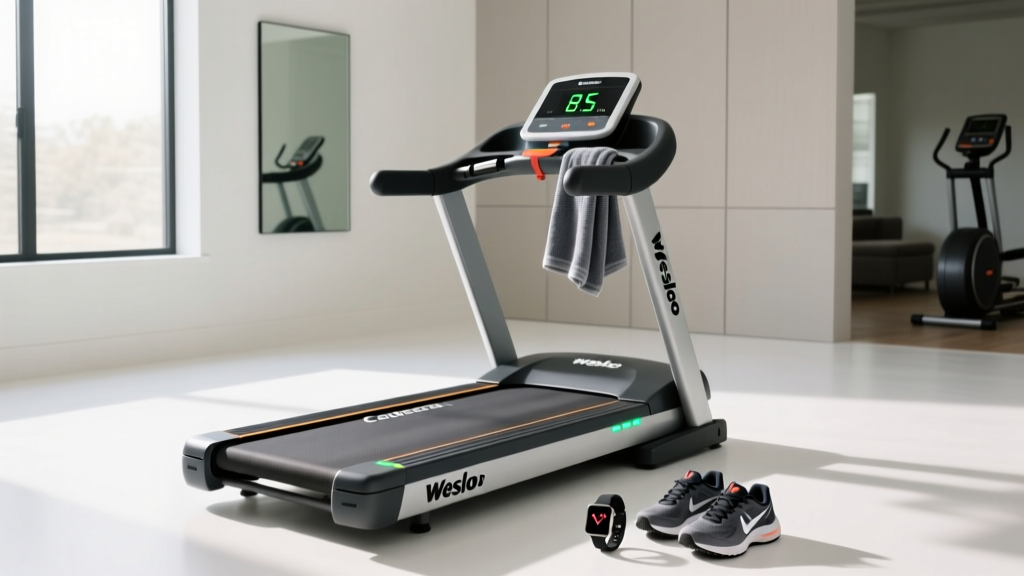
Maintaining Your Weslo Treadmill Cadence G-40 & Compact Cardio
Maximize the lifespan of your Weslo Treadmill Cadence G-40 and other compact cardio gear with our expert maintenance, lubrication, and longevity guide.

The Rise and Reality of Compact Cardio Equipment
As home fitness spaces shrink and urban living demands more efficient use of square footage, compact portable cardio equipment options have dominated the market. Among the most popular budget-friendly folding models is the Weslo Treadmill Cadence G-40. Retailing historically between $299 and $349, this treadmill offers a 16-inch by 50-inch running surface and a 2.25 horsepower motor, making it a staple for walkers and light joggers. However, the very engineering that allows these machines to fold away and fit under a bed or in a closet also makes them uniquely vulnerable to premature wear and tear.
According to fitness equipment analysts at Consumer Reports, budget and compact treadmills experience motor and belt failures at nearly twice the rate of their full-sized commercial counterparts when subjected to identical usage hours. This is not necessarily due to poor manufacturing, but rather the physics of compact design: smaller motor cowlings restrict airflow, and shorter wheelbases place higher tension on the drive belt. To keep your equipment running smoothly in 2026 and beyond, a rigorous, model-specific maintenance protocol is non-negotiable.
The Engineering Trade-offs of Portable Cardio Machines
Before diving into the wrench-and-lubricant specifics, it is crucial to understand why your compact machine requires more hands-on care than a $2,000 commercial treadmill. The Weslo Treadmill Cadence G-40 utilizes a 2.25 HP continuous duty motor. When a 180-pound user jogs at 5.0 mph, that motor is operating at roughly 85% of its maximum thermal capacity.
In a full-sized machine, a 3.5 HP motor would handle the same load at 50% capacity, generating significantly less heat. Furthermore, compact portable cardio equipment options like the G-40 feature manual incline hinges and lightweight steel frames that absorb more vibrational shock, transferring that kinetic energy directly into the pivot points and floor stabilizers. Ignoring these stress points leads to the most common failure modes: squeaking hinges, frayed belts, and overheated control boards.
Weslo Treadmill Cadence G-40 Core Maintenance Protocol
To extract a 5-to-7-year lifespan from your G-40, you must move beyond basic wipe-downs and perform mechanical maintenance. Here is the exact protocol recommended for this specific chassis and motor configuration.
1. Belt Tension and Alignment Calibration
The 16x50 inch belt on the Cadence G-40 is prone to lateral drift, especially if you favor one leg while running. Every 60 days, perform the lift test: power off and unplug the machine, then lift the belt from the center of the deck. It should rise exactly 2 to 3 inches. If it lifts higher, the belt is too loose and will slip during acceleration; if lower, it is choking the motor and drawing excess amperage.
- Adjustment Tool: Use a 3/16-inch Allen wrench on the rear roller bolts.
- Correction Method: Turn the bolt a maximum of one-quarter (1/4) turn clockwise to tighten. Never adjust one side more than the other to prevent tracking issues.
2. Deck Lubrication Strategy
Friction is the enemy of the 2.25 HP motor. The G-40 requires 100% silicone, non-petroleum-based treadmill lubricant. Petroleum-based products like WD-40 will dissolve the cotton backing of the belt and ruin the deck coating.
- Loosen the belt tension using the rear bolts (count 1/4 turns so you can reverse it exactly later).
- Lift the belt and apply exactly 0.5 ounces of silicone fluid in a zig-zag pattern across the center of the deck.
- Retighten the belt to the original 2-to-3-inch lift specification.
- Run the treadmill at 2.0 mph for 3 minutes without standing on it to distribute the silicone evenly.
3. Motor Hood Dust Extraction
Because the G-40 folds vertically, dust and pet hair are constantly pulled into the lower motor cowling via static electricity. Every 90 days, use a Torx T15 screwdriver to remove the three screws securing the front plastic hood. Use a vacuum with a soft brush attachment to clear the motor fan blades and the drive belt pulley. A clogged fan will cause the motor control board to overheat and trip the internal thermal breaker.
Compact Cardio Longevity Matrix
While the Weslo Treadmill Cadence G-40 is a fantastic entry-level folder, it is not the only compact portable cardio equipment option on the market. Below is a comparative analysis of maintenance requirements and common failure points across the three most popular compact cardio categories in 2026.
| Equipment Type | Example Model | Primary Failure Point | Maintenance Frequency | Expected Lifespan |
|---|---|---|---|---|
| Folding Treadmill | Weslo Cadence G-40 | Motor overheating / Belt fraying | Lube every 130 miles; Dust every 90 days | 5 - 7 Years |
| Under-Desk Walking Pad | UREVO / KingSmith | Control board short / Belt slip | Lube every 30 days (high friction) | 2 - 4 Years |
| Mini Elliptical | Sunny Health & Fitness | Pedal arm bearing seizure | White lithium grease on joints bi-annually | 3 - 5 Years |
As highlighted by the American Council on Exercise (ACE), users of compact walking pads often fail to realize that the smaller roller diameter creates a tighter belt turn radius, generating significantly more friction and heat than a standard treadmill. This necessitates lubricating walking pads more than twice as often as a traditional folding model like the G-40.
Step-by-Step Folding Hinge and Stabilizer Care
The folding mechanism is the defining feature of compact portable cardio equipment options, yet it is the most abused. The Weslo Cadence G-40 uses a manual pull-pin folding system. Over time, the steel-on-steel friction at the pivot point causes micro-abrasions, leading to the dreaded 'popping' sound when lowering the deck.
A popping hinge is not just an annoyance; it indicates that the sheer pin is taking uneven lateral load, which can eventually snap under the dynamic weight of a 200-pound user stepping off the machine.
The Hinge Maintenance Routine:
- Fold the treadmill into the upright, locked position.
- Locate the main pivot bolt on both sides of the lower frame.
- Wipe away any existing black grime (oxidized metal and old oil) with a degreaser and a microfiber cloth.
- Apply a small bead of white lithium grease directly into the seam of the pivot joint. Avoid standard WD-40, which attracts dust and evaporates quickly.
- Check the rubber floor stabilizers at the rear base. If they are compressed flat or cracked, replace them with generic 1-inch rubber furniture cups to prevent the machine from 'walking' across hardwood floors during use.
When to Repair vs. Replace Budget Compact Gear
Because compact machines occupy the budget tier of the fitness market, owners frequently face the 'repair vs. replace' dilemma. A replacement motor for the Weslo Treadmill Cadence G-40 typically costs between $120 and $160, while a new control board can run $80 to $110. When you factor in the original $300 purchase price, spending $200 on parts feels economically unjustifiable.
The 50% Rule for Compact Cardio
Apply the 50% Rule: If the cost of the replacement part plus your estimated hourly labor value exceeds 50% of the current replacement cost of a brand-new equivalent model, scrap the machine. However, if the issue is a frayed belt ($40-$60) or a snapped drive belt ($15-$25), repairing the G-40 is highly cost-effective and can easily add another three years to its life.
Pro-Tip for Sourcing Parts: Because Weslo is manufactured by iFIT (the parent company of NordicTrack and ProForm), many generic 16x50 replacement belts and 3/8-inch drive belts will fit the Cadence G-40 perfectly. You do not always need to pay the premium for OEM-branded packaging when sourcing routine wear-and-tear consumables.
Frequently Asked Questions
Can I use the Weslo Cadence G-40 for sprint intervals (HIIT)?
No. The 2.25 HP motor and lightweight flywheel are designed for steady-state walking (up to 4.0 mph) and light jogging (up to 5.5 mph). Rapid acceleration and deceleration required for HIIT will strip the teeth off the plastic front roller pulley and overheat the motor control board.
How do I stop the walking pad from drifting to the left?
If your compact walking pad drifts left, the left rear roller bolt is too tight relative to the right. Using the provided Allen key, turn the left bolt counter-clockwise by one-eighth (1/8) of a turn, or tighten the right bolt clockwise by 1/8 of a turn. Run the machine at 1.0 mph and observe. Never make adjustments larger than 1/8th of a turn at a time.
Is it safe to store the G-40 in an unheated garage?
Storing any compact cardio equipment in an unclimate-controlled garage is highly discouraged. Extreme temperature fluctuations cause the rubber walking belt to stiffen and crack, while ambient humidity will corrode the exposed steel of the folding hinge and the internal copper windings of the motor. Always store portable cardio gear in a climate-controlled interior room.
More gear to consider
All reviews
Escaping the Hedonistic Treadmill: Motor Size & HP Guide
Under Desk Treadmill Office Review & How to Turn On Precor Treadmill

Under Desk Treadmill Review: Space Layouts vs Bowflex T9 Treadmill

Tunturi Treadmill vs Walking Pad: A Beginner's Guide

2026 Market Report: Compact Cardio vs. The Treadmill Mile Pace Chart
