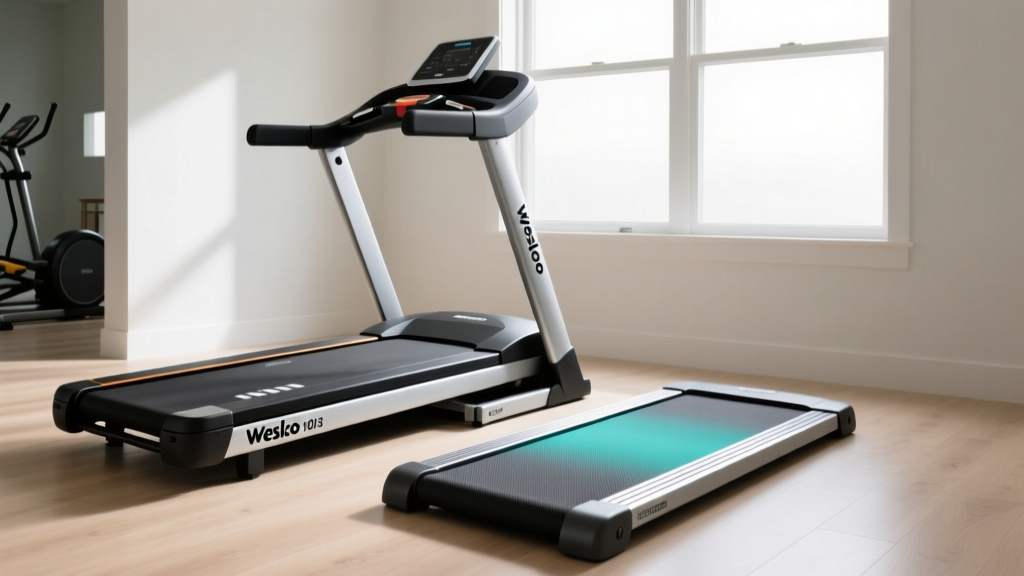
Weslo Cadence 1015 Treadmill vs. 2026 Walking Pads: Which Wins?
Is the Weslo Cadence 1015 treadmill still viable? We compare its budget foldable design against top 2026 walking pads to find the best small-space cardio.

The Small-Space Cardio Dilemma: Legacy Foldables vs. Modern Walking Pads
When outfitting a home gym in a compact apartment or dedicated office, the battle for floor space is fierce. For years, the Weslo Cadence 1015 treadmill has been the default budget-friendly, foldable solution for home cardio enthusiasts. However, the explosive rise of under-desk walking pads has disrupted the market. In this 2026 in-depth buying guide, we pit the legacy Weslo Cadence 1015 treadmill against today's top-tier walking pads to determine which machine truly deserves your square footage and your sweat.
Deconstructing the Weslo Cadence 1015 Treadmill
Despite being an older model in the fitness landscape, the Weslo Cadence 1015 treadmill remains highly relevant in the secondary and refurbished markets, typically pricing between $180 and $250 in 2026. Its enduring popularity stems from its traditional treadmill architecture, which offers distinct biomechanical advantages over flat walking pads.
Motor Dynamics: The CHP Advantage
The Weslo Cadence 1015 is equipped with a 2.25 Continuous Horsepower (CHP) motor. This is a critical distinction. CHP measures the motor's sustained output under a continuous load (like a 150 lb user jogging for 45 minutes). In contrast, most walking pads advertise '2.5 HP Peak' motors, which only reflect the maximum burst of power before the thermal overload protector trips. Under sustained running loads, the Weslo's 2.25 CHP motor will run cooler, quieter, and with significantly less belt stutter than a peak-rated walking pad motor.
Belt Geometry and Stride Freedom
With a 50-inch length and 18-inch width, the Weslo's belt accommodates a natural running gait. The 18-inch width is particularly crucial; it allows for natural lateral foot placement variance and hip sway, reducing the risk of IT band friction during longer sessions.
The 2026 Walking Pad Contenders
To provide a fair comparison, we are testing the Weslo against the two most dominant walking pads of 2026: the UREVO Strol 2E and the WalkingPad R2.
UREVO Strol 2E: The Hybrid Bridge
Priced around $359, the UREVO Strol 2E attempts to bridge the gap between a walking pad and a traditional treadmill. It features a foldable handlebar that unlocks a 10.5 MPH top speed. However, its 40-inch by 16.5-inch belt restricts true running. Users over 5'8' will find their stride artificially shortened, turning a 'run' into a rapid, choppy jog. Furthermore, its 10-inch folded profile is sleek, but the 63-pound weight makes sliding it under a bed a two-person chore.
WalkingPad R2: The Pure Under-Desk Specialist
At roughly $499, the WalkingPad R2 is the premium choice for pure NEAT (Non-Exercise Activity Thermogenesis) integration. It folds in half to a mere 6 inches thick, sliding effortlessly under modern sofas. With a 1.25 HP motor and a 7.5 MPH speed cap, it is strictly designed for walking and light jogging. Pushing this machine to its speed limit for extended durations will rapidly degrade the motor brushes and stretch the PVC belt.
Expert Insight: The NEAT Factor
According to research highlighted by the Mayo Clinic, Non-Exercise Activity Thermogenesis (NEAT) — the calories burned through daily, non-sleeping activities like walking — can account for a massive variance in daily energy expenditure. Walking pads excel at boosting NEAT during the workday, whereas traditional treadmills like the Weslo are better suited for dedicated, high-heart-rate cardiovascular conditioning.
Head-to-Head Comparison Matrix
| Feature | Weslo Cadence 1015 | UREVO Strol 2E | WalkingPad R2 |
|---|---|---|---|
| Motor Type | 2.25 CHP (Continuous) | 2.5 HP (Peak) | 1.25 HP (Peak) |
| Belt Dimensions | 50' L x 18' W | 40' L x 16.5' W | 47' L x 17' W |
| Max Speed | 10.0 MPH | 10.5 MPH (Handle Up) | 7.5 MPH |
| Weight Capacity | 250 lbs | 315 lbs | 240 lbs |
| Folded Footprint | 65.5' H x 26.5' W x 10.5' D | 61' H x 22' W x 10' D | 39' L x 28' W x 6' H |
| Incline | 2-Position Manual | None | None |
| 2026 Avg. Price | $180 - $250 (Refurb/Clearance) | $359 | $499 |
Biomechanics, Space, and Real-World Edge Cases
Choosing between the Weslo Cadence 1015 treadmill and a modern walking pad ultimately comes down to your primary physiological goal and your spatial constraints.
The 'Tightrope' Gait Problem
When utilizing the narrower 16.5-inch belt of the UREVO Strol 2E, users subconsciously adopt a 'tightrope' gait, placing one foot directly in front of the other to avoid stepping off the edge. Over a 60-minute walking session, this altered biomechanics can place undue stress on the medial knee and hip stabilizers. The American Heart Association emphasizes the importance of sustainable, joint-friendly physical activity for long-term cardiovascular health. If your goal is dedicated 45+ minute cardio sessions, the 18-inch width of the Weslo is vastly superior for joint preservation.
The Storage Reality Check
While the Weslo Cadence 1015 folds vertically, its 65.5-inch height and 115-pound total weight mean it requires a dedicated wall anchor and significant floor clearance to deploy safely. It is a 'closet' machine, not an 'under-bed' machine. Conversely, the WalkingPad R2's 6-inch folded height allows it to vanish beneath standard 7-inch bed frames, making it the undisputed king of micro-apartments.
Maintenance Protocols and Failure Modes
Budget cardio equipment requires strict adherence to maintenance schedules to prevent catastrophic failure. Here is what you must know for 2026 ownership:
- Belt Lubrication: Both the Weslo and the walking pads utilize low-friction decks that require 100% silicone lubricant. For the Weslo, apply 0.5 oz of silicone under the belt every 130 miles. For the WalkingPad R2, the smaller motor works harder against friction; lubricate every 100 miles to prevent the control board from throwing an 'E02' overcurrent error.
- Motor Brush Degradation: Walking pads with brushed DC motors (like the R2) will experience noticeable torque loss after roughly 1,500 hours of use. The Weslo's larger motor housing allows for better heat dissipation, extending the lifespan of its internal components significantly.
- Incline Mechanism: The Weslo's manual incline requires you to step off the machine, pull a pin, and adjust the rear feet. While rudimentary, it provides a 3% to 5% grade increase, which engages the posterior chain (glutes and hamstrings) far more effectively than the flat 0% grade of standard walking pads.
Final Verdict: Which Should You Buy?
The Weslo Cadence 1015 treadmill remains a highly capable, biomechanically sound budget treadmill for users who prioritize dedicated running and jogging sessions over ultra-compact storage. Its 2.25 CHP motor and 18-inch wide belt provide a safe, natural stride that walking pads simply cannot replicate. If you have a spare closet and want to run at 8 MPH without the belt stuttering beneath your feet, hunt down a refurbished Weslo.
However, if your primary objective is integrating low-intensity steady-state (LISS) walking into your work-from-home routine, or if you live in a studio apartment where every square inch matters, the WalkingPad R2 or UREVO Strol 2E are the superior 2026 investments. They eliminate the friction of starting a workout by allowing you to walk while you work, ultimately maximizing your daily NEAT and long-term metabolic health.
More gear to consider
All reviews
Bruce Test Treadmill Noise: Cardio Machine Decibel Comparison

NordicTrack Treadmill T5zi vs Ellipticals: Home Cardio Guide 2026

Curved Manual vs Motorized: NTD 700 Treadmill Head-to-Head

Echelon Stride Auto-Fold Treadmill Motor Troubleshooting & HP Guide

Beyond the ProForm Treadmill 520 ZN: 2026 Compact Cardio Trends
