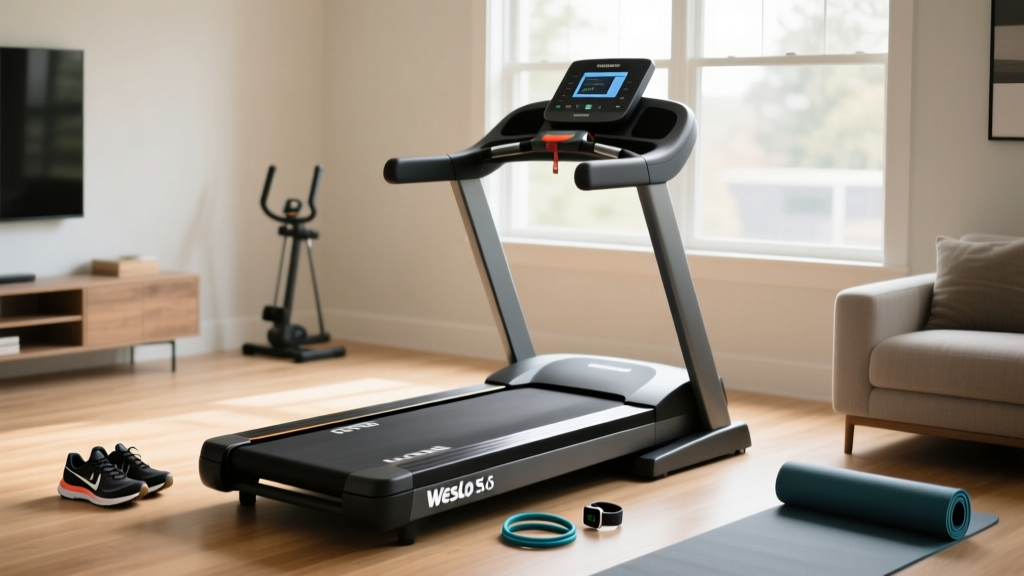
Treadmill Motor Size Guide: Is the Weslo 5.9 Treadmill Enough?
Learn how to choose the right treadmill motor size. We break down CHP vs. HP and use the Weslo 5.9 treadmill as a real-world baseline for beginners.

The Beginner’s Guide to Treadmill Motor Sizing
Walking into the fitness equipment market in 2026 can feel like stepping into a physics lecture. Between belt ply counts, incline gradients, and interactive screen subscriptions, the sheer volume of specifications is overwhelming. Yet, the most critical component of any cardio machine is often the most misunderstood: the motor. If you choose a motor that is too weak, you will experience belt hesitation, thermal shutdowns, and premature electronic failure. If you overbuy, you waste hundreds of dollars on unnecessary horsepower.
To make this beginner-friendly, we are going to break down the exact mechanics of treadmill motor sizing. More importantly, we will use one of the most popular entry-level machines on the market—the Weslo 5.9 treadmill—as our real-world baseline case study. By understanding what this specific machine can and cannot do, you will learn how to calculate your own exact motor requirements.
Step 1: Decoding the Horsepower Illusion (HP vs. CHP)
Before we look at specific models, you must understand the marketing trap that catches nearly every first-time buyer. Manufacturers use three different metrics to describe motor power, and only one of them actually matters for your daily workouts.
- Peak HP: This is the absolute maximum power the motor can generate for a fraction of a second before it burns out. It is a meaningless marketing metric designed to make budget treadmills look more powerful than they are.
- Continuous Duty HP (CHP): This is the gold standard. CHP measures the power the motor can sustain indefinitely during a normal workout without overheating. Always base your purchasing decisions on CHP.
- Treadmill HP (THP): A vague middle-ground term some brands use to obscure the lack of a true continuous duty rating. If a spec sheet says THP instead of CHP, consider it a red flag.
Step 2: The Weslo 5.9 Treadmill Case Study
Let us apply this knowledge to a real machine. The Weslo Cadence G 5.9 (and its closely related 5.9 series variants) is a staple in the budget fitness category, frequently retailing between $229 and $299 in 2026. It is heavily marketed toward beginners and casual walkers.
Examining the Weslo 5.9 Specs
The Weslo 5.9 treadmill is equipped with a 2.25 HP Continuous Duty motor. It features a 16-inch by 50-inch running belt, a top speed of 10 MPH, and a stated weight capacity of roughly 250 pounds. But is a 2.25 CHP motor actually enough? The answer depends entirely on your biomechanics and usage patterns.
For a user weighing 150 pounds who plans to walk at 3.0 to 4.0 MPH for 45 minutes a day, the 2.25 CHP motor in the Weslo 5.9 is perfectly adequate. The motor will operate at roughly 60% of its maximum capacity, keeping the internal temperature low and the PWM (Pulse Width Modulation) control board stress-free.
However, if a 230-pound user attempts to jog at 6.5 MPH on this same machine, the motor will be forced to draw maximum amperage just to keep the belt moving under the increased friction and impact load. This leads to the dreaded 'belt hesitation'—a micro-stutter where the belt slows down upon foot strike and speeds up during the flight phase, which is a major cause of treadmill-related joint injuries.
Step 3: DC vs. AC Motors in Home Fitness
When researching motor sizes, you will inevitably encounter the terms DC (Direct Current) and AC (Alternating Current). Understanding the difference is vital for setting realistic expectations for your home gym.
Virtually all residential treadmills, including the Weslo 5.9 treadmill and premium models up to $3,000, use DC motors. DC motors are preferred for home use because they offer incredibly smooth, precise control at very low speeds (essential for walking and rehabilitation) and operate much quieter than AC motors. The trade-off is that DC motors require internal cooling fans and cannot run continuously for hours on end without thermal limits being reached.
AC motors are found exclusively in commercial gym equipment (like the Life Fitness Integrity series or Technogym Excite lines). They are designed to run 24/7 without overheating but are loud, heavy, and require a dedicated high-voltage circuit. As a beginner outfitting a home space, you will be shopping exclusively for high-quality DC motors.
Step 4: Calculating Your Minimum Motor Requirement
Experts at Wirecutter’s comprehensive treadmill testing lab consistently emphasize that motor sizing must be scaled to the user's weight and primary activity. Use the step-by-step framework and matrix below to find your baseline CHP requirement.
The 2026 Motor Sizing Matrix
| Primary Activity | User Weight: Under 180 lbs | User Weight: 180 - 220 lbs | User Weight: 220+ lbs |
|---|---|---|---|
| Walking (Under 4.5 MPH) | 2.0 CHP Minimum | 2.25 CHP Minimum | 2.5 CHP Minimum |
| Jogging (4.5 - 6.5 MPH) | 2.5 CHP Minimum | 2.75 CHP Minimum | 3.0 CHP Minimum |
| Running (6.5+ MPH) | 3.0 CHP Minimum | 3.25 CHP Minimum | 3.5 to 4.0 CHP Minimum |
Applying the Matrix to the Weslo 5.9: With its 2.25 CHP motor, the Weslo 5.9 treadmill perfectly satisfies the requirements for walkers under 220 pounds, and very light joggers under 160 pounds. If your profile falls outside these parameters, you must look at mid-tier machines in the $600 to $900 range that feature 3.0+ CHP motors.
Step 5: Spotting Motor Failure and Edge Cases
Even if you buy the correct motor size, improper maintenance can cause a 3.5 CHP motor to fail just as quickly as an undersized 2.0 CHP motor. As a beginner, you need to know the physical warning signs of motor strain before the warranty expires.
1. The Amp Draw Spike (Belt Friction)
The most common killer of treadmill motors is not the running itself, but the friction between the running belt and the wooden deck. If the belt is not lubricated with 100% silicone treadmill lubricant every 3 to 6 months, the friction coefficient increases. The motor must draw significantly more amps to pull the belt. Over time, this excess heat degrades the copper windings inside the DC motor and blows the capacitors on the lower control board.
2. Thermal Limit Switches
Most modern home treadmill motors are equipped with an internal thermal breaker. If you are using a 2.25 CHP machine for high-intensity interval training (HIIT) with a heavy user, the motor housing will eventually exceed 105°F (40°C). The machine will abruptly stop, and the console will display an error code (often 'E1' or 'E2'). This is not a malfunction; it is a safety feature. If this happens, you have fundamentally mismatched your motor size to your workout intensity.
3. Belt Tension Misalignment
Beginners often try to fix a slipping belt by tightening the rear roller bolts. If you over-tighten the belt, you place immense lateral strain on the motor shaft bearings. This leads to a high-pitched whining noise and eventual bearing seizure. The belt should be tight enough not to slip at 8 MPH, but loose enough that you can lift the edge of the belt roughly 2 inches off the deck in the center.
Pro-Tip for 2026 Buyers: When evaluating budget machines like the Weslo 5.9, check the warranty specifically on the motor. A lifetime motor warranty on a budget machine is often a marketing gimmick, as the labor costs to replace it will exceed the value of the treadmill after year two. Always prioritize a robust 1-year parts and labor warranty over a 'lifetime' motor promise.
Final Verdict: Sizing for Your Success
Understanding treadmill motor size is about matching physics to your personal fitness goals. The Weslo 5.9 treadmill remains an excellent, highly affordable entry point for dedicated walkers and seniors looking to maintain daily step counts indoors. Its 2.25 CHP motor is perfectly calibrated for that specific, low-impact demographic.
However, if your goals involve couch-to-5K training, sprint intervals, or if you weigh over 200 pounds, you must use the matrix above to upgrade to a 3.0 CHP minimum. By ignoring 'Peak HP' marketing fluff and focusing strictly on Continuous Duty ratings, user weight, and proper deck lubrication, you will secure a cardio machine that delivers smooth, reliable performance for years to come.
For more detailed biomechanical data on how treadmill belt sizes correlate with motor strain, refer to the Healthline fitness and treadmill safety guidelines to ensure your home setup promotes joint health rather than compromising it.
More gear to consider
All reviews
ProForm Pro 2000 Treadmill vs Rivals: 2026 Smart Features Comparison
WalkingPad Denise Austin 2.0 Foldable Treadmill Belt Care Trends 2026
NordicTrack Treadmill Coupons: Feature Comparison & Setup Guide
Treadmill or Elliptical for Belly Fat? Motor Size & HP Guide
Is Walking Barefoot on a Treadmill Good for You? Cardio Care
